
Image by Chris Fletcher; © Crown copyright 2026. Open Government Licence.
By Eva Sula
Editor’s note: BISC added the maps and the visuals to this article. They are not part of Eva Sula’s original paper, which appears here as she wrote it.
All opinions expressed are those of the author alone and may not represent those of the institutions they represent or the Baltic International Security Centre (BISC). BISC maintains a strict intellectual independence policy across all its projects and publications.
© Eva Sula
First published on LinkedIn on October 26, 2026. Read the original article.
From Regional Cooperation to Operational Capability
Author’s Note
The first four papers in The JEF Papers examined why the Joint Expeditionary Force works, the connected security geography of Northern Europe, its relationship with NATO, and the strategic considerations surrounding membership and expansion. This fifth paper moves from institutional arrangements and political commitments to the practical requirements of operational capability.
JEF’s geographic coherence, political relationships and institutional flexibility provide a valuable foundation, but they do not automatically produce forces that can operate, communicate and sustain themselves together under contested conditions. National differences in doctrine, procurement, training, technical standards, legislation and readiness continue to influence what participating nations can realistically deliver.
This paper examines capability integration from the perspective of operational requirements, dependencies, resilience and institutional responsibility. It considers the lessons of Ukraine, the changing security environment across the Baltic Sea, North Sea, North Atlantic and Arctic, and the implications of technological development, industrial fragmentation and political uncertainty.
The analysis does not propose an alternative NATO command structure, revisit the membership assessments of Paper 4, or develop detailed technical architectures for command and control, artificial intelligence or autonomous systems. Nor does it attempt to construct a comprehensive European defence financing model. These subjects are addressed only where they directly affect regional operational capability.
The central concern is whether JEF nations possess the personnel, procedures, equipment, information-sharing arrangements, logistics, medical support and political authority required to operate effectively together, including when critical infrastructure, communications or external services become unavailable.
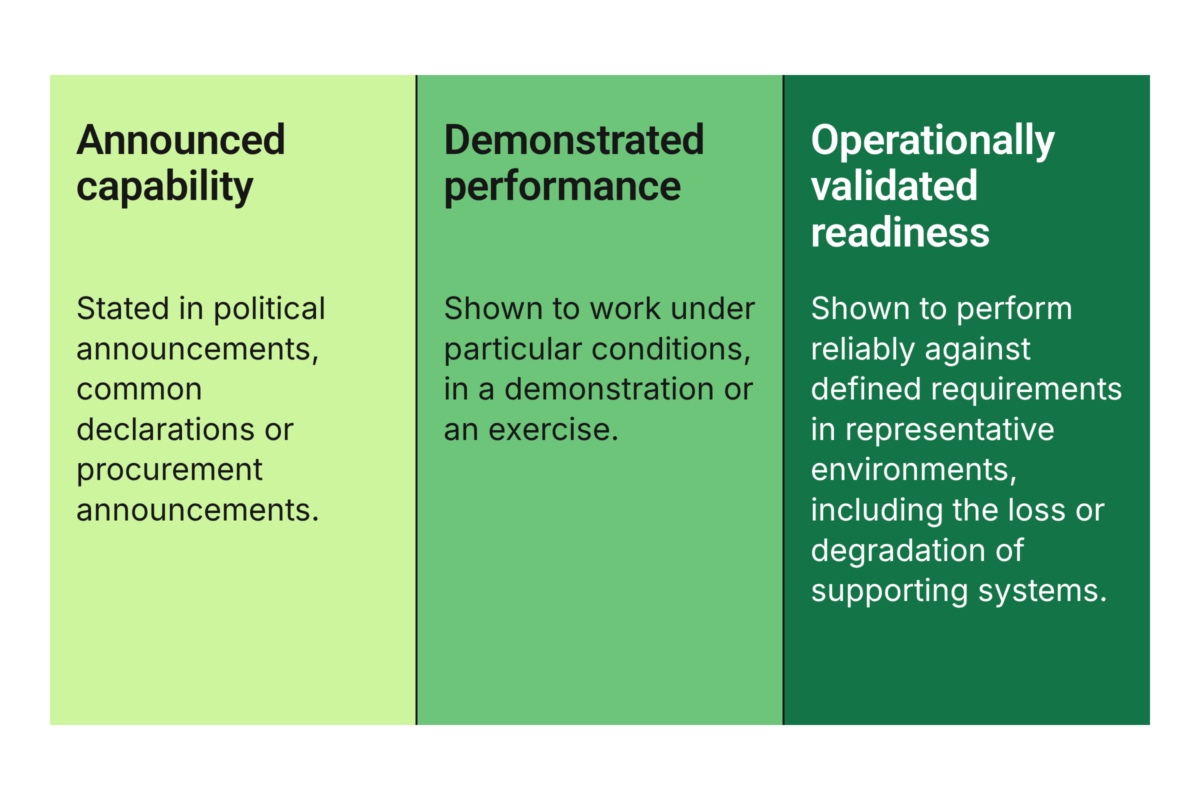
Throughout, the distinction between announced capability, demonstrated performance and operationally validated readiness remains essential. The assessment prioritises practical military outcomes and the responsibilities of political and military leadership over technological ambition or institutional expansion.
1. Introduction: The Capability Integration Problem Has Changed
1.1 From Cooperation to Usable Capability
The Joint Expeditionary Force (JEF) has developed during a period of profound change in European security. Russia’s full-scale invasion of Ukraine, Finland’s and Sweden’s accession to NATO, the growing strategic importance of the Arctic and North Atlantic, and increasing pressure on European defence capabilities have altered the conditions under which regional military cooperation must operate. JEF’s ten participating nations share substantial strategic interests, but political alignment and geographic proximity do not automatically translate into forces capable of operating effectively together.
Joint exercises, common declarations and compatible equipment provide important foundations for interoperability. Their operational value, however, depends on whether participating forces can exchange information, coordinate decisions, sustain operations and maintain effectiveness when communications are disrupted, infrastructure becomes unavailable or national procedures prove incompatible. A successful exercise demonstrates particular capabilities under particular conditions; it does not necessarily establish readiness for a prolonged operation against an adversary actively seeking to exploit organisational and technical weaknesses.
Announced is not demonstrated, and demonstrated is not validated
Graphic: BISC.
1.2 The Changing Political and Strategic Environment
Canada’s September 2026 application to join JEF introduces a potentially significant transatlantic dimension to the framework’s future development. Canada’s existing NATO commitments in Latvia, Arctic responsibilities and participation in Northern European exercises provide an operational foundation for deeper cooperation. However, additional geographic reach and military resources would also introduce requirements concerning reinforcement, sustainment, information exchange and the coordination of capabilities across considerable distances.
Germany’s expanding responsibilities in Lithuania and the Baltic maritime environment, together with Poland’s central position in northeastern European defence and reinforcement, further illustrate the importance of integrating capabilities beyond JEF’s formal membership. NATO’s evolving northern command arrangements make coordination between regional frameworks, national forces and Alliance structures increasingly relevant, particularly where maritime, land, air and infrastructure dependencies intersect.
European governments are simultaneously increasing defence investment while confronting industrial capacity constraints, personnel shortages, procurement fragmentation and the long-term costs of sustaining modern equipment. These pressures raise questions about whether additional expenditure is producing forces that can operate together or reinforcing nationally organised capability programmes whose integration remains incomplete.
Dependence on externally supplied communications, software, satellite services, components and technical support introduces another planning consideration. This includes certain US-origin capabilities, although the degree of exposure varies substantially according to contractual arrangements, national control, technical architecture and available alternatives. Political uncertainty makes understanding these dependencies increasingly important without establishing that their disruption is inevitable.
Russia’s continued military adaptation, electronic warfare activity, cyber operations and pressure on critical infrastructure reinforce the requirement to prepare for simultaneous disruption across several operational domains.
1.3 The Governing Problem
The central question is therefore whether JEF nations understand which capabilities they can actually deliver together, what those capabilities depend upon and how long they can remain operational under sustained pressure. This requires examining personnel, training, doctrine, information sharing, logistics, medical support, procurement and political authority alongside the technologies themselves.
Capability integration must ultimately be assessed through operational performance rather than national inventories or procurement announcements. For JEF, the relevant measure is whether participating nations can combine their resources into credible military options, maintain those options when supporting systems fail and contribute effectively to NATO’s wider deterrence and defence arrangements.
2. The Strategic Environment JEF Must Actually Prepare For
2.1 One Connected Region, Different Operational Conditions
The Baltic Sea, Danish Straits, North Sea, North Atlantic and Arctic form an interconnected security environment, but geographic continuity should not be confused with operational uniformity. Each area presents different conditions for force deployment, surveillance, communications, logistics and military sustainment. Effective regional capability integration requires understanding both the connections between these environments and the limitations of applying identical solutions across them.
The Baltic Sea’s confined waters, dense commercial traffic, critical infrastructure and proximity to Russian military capabilities create particular requirements for mine countermeasures, maritime surveillance, coastal defence and reinforcement. The Danish Straits connect Baltic operations to the North Sea, making access, maritime traffic management and infrastructure protection relevant to the wider region. North Atlantic operations introduce different demands involving distance, antisubmarine warfare, maritime patrol, reinforcement routes and sustainment, while Arctic conditions add extreme weather, limited infrastructure, communications constraints and substantial search-and-rescue requirements.
These differences affect equipment selection, training, maintenance, personnel requirements and operational planning. A system validated in Baltic coastal waters cannot automatically be assumed suitable for sustained North Atlantic operations, just as equipment demonstrated in temperate conditions may require substantial adaptation for Arctic deployment. JEF’s regional value depends partly on recognising where common capabilities are appropriate and where specialised national contributions must remain distinct but operationally connected.
2.2 Russia’s Multidomain Pressure
Russia’s military infrastructure and operational capabilities influence the region from several directions. Kaliningrad supports Russian military activity affecting the southern Baltic, while the St Petersburg region remains strategically relevant to the Gulf of Finland and eastern Baltic approaches. The Kola Peninsula hosts important Northern Fleet facilities and Russia’s sea-based nuclear deterrent, giving the Barents Sea and adjacent Arctic approaches significance extending beyond conventional regional defence.
The Joint Expeditionary Force
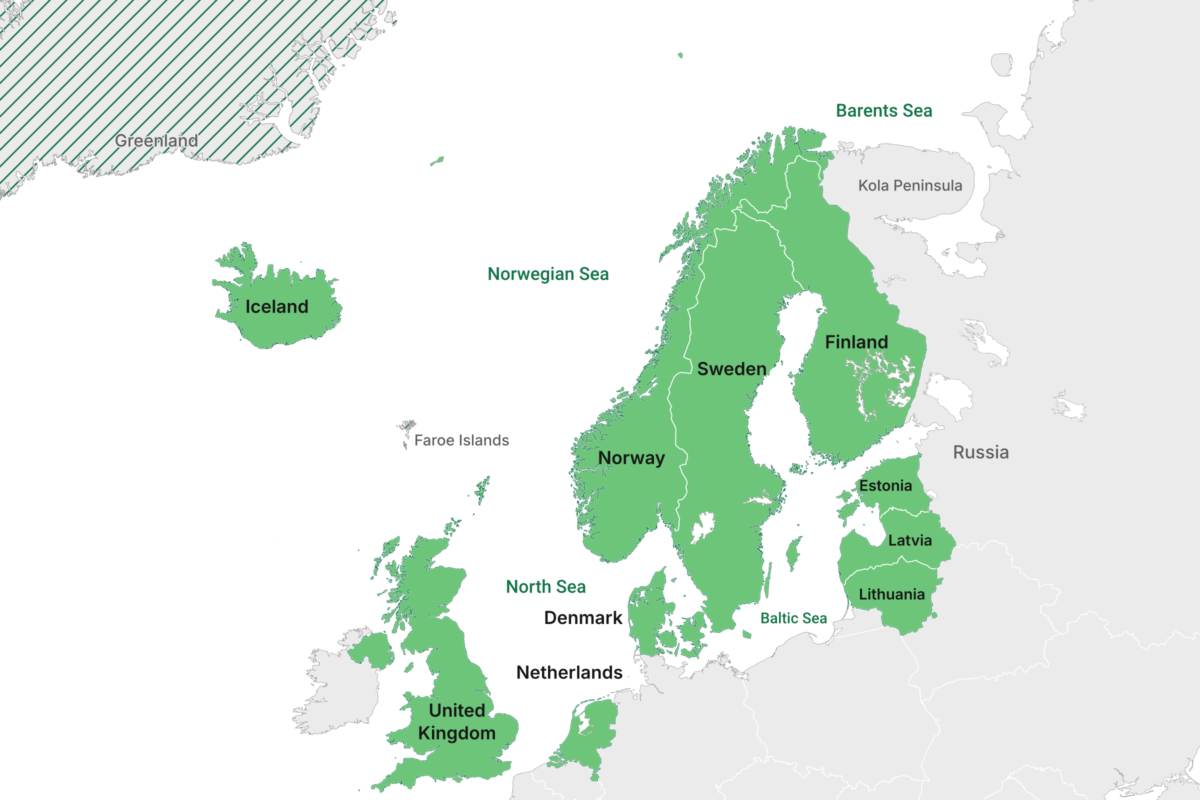
The ten JEF participating nations. Greenland and the Faroe Islands are autonomous territories within the Kingdom of Denmark and are not separate JEF participants. Map: BISC.
Russian electronic warfare and interference with global navigation satellite systems have already affected civilian aviation and maritime navigation in parts of Northern Europe. Such disruption illustrates how military capabilities can produce consequences across civilian and military systems that depend on shared navigation, timing and communications services. Cyber operations, suspected sabotage, intelligence activity and pressure on critical infrastructure introduce additional requirements for resilience and coordination, although individual incidents must be assessed according to the available evidence rather than automatically attributed to Moscow.
JEF planning must also consider the possibility of concurrent incidents across different parts of the region. Disruption affecting Baltic maritime infrastructure could coincide with cyber activity against logistics networks, navigation interference or increased military activity in the High North. These events would not necessarily share a single cause, but their combined consequences could strain national authorities, complicate reinforcement and expose dependencies between civilian infrastructure and military operations.
Svalbard illustrates the importance of distinguishing strategic geography from legal authority. The archipelago is under Norwegian sovereignty, subject to the provisions of the 1920 Svalbard Treaty, including specific restrictions concerning naval bases, fortifications and use for warlike purposes. Its proximity to important Arctic operating areas makes it strategically relevant, but neither that relevance nor Norway’s JEF participation gives the framework an independent operational mandate there. Any proposed activity must account for Norwegian authority, applicable treaty obligations and relevant NATO arrangements.
2.3 Hybrid Activity and the Problem of Attribution
Hybrid activity creates particular difficulties because operational consequences may become apparent before responsibility can be established. Damage to an undersea cable, suspicious vessel movements, cyber disruption or coordinated information manipulation may require immediate protective measures while investigations remain incomplete. Technical failure, accidental damage, criminal activity and deliberate hostile action can initially produce similar observable effects, making premature attribution a potential source of political and operational error.
Regional cooperation must therefore support action under uncertainty without replacing national legal responsibilities or prejudging NATO decisions. Governments may be able to increase surveillance, exchange technical evidence, protect infrastructure, coordinate maritime safety measures and prepare contingency responses before reaching agreement on attribution. More intrusive measures, including enforcement action or military responses, remain subject to applicable national and international law and the authorities responsible for authorising them.
This raises three practical questions for JEF nations: what protective measures can be coordinated before attribution is established, which decisions require explicit national authorisation, and how should cooperation continue when governments interpret the same evidence differently? Answering them requires pre-agreed information-sharing procedures, clarity over civilian and military responsibilities, and exercises that test political disagreement alongside technical disruption. Regional readiness cannot depend on every participating government reaching identical conclusions at precisely the same moment.
3. Integration Begins Before Technology
3.1 Doctrine, Training and Common Understanding
Military interoperability is frequently assessed through equipment compatibility, communications standards and participation in multinational exercises. These are necessary components, but they do not establish whether participating forces share a sufficiently consistent understanding of operational requirements, readiness, command responsibilities and acceptable risk. NATO standardisation provides an important foundation, yet the adoption of common standards does not guarantee identical national implementation, particularly where doctrine, legal restrictions and operational procedures differ.
These differences become consequential when forces must coordinate under time pressure. National units may interpret reporting requirements, information classification, targeting procedures or escalation thresholds differently despite using compatible equipment. Training must therefore test not only whether systems exchange information, but whether personnel understand its operational significance, possess the authority to act upon it and can coordinate decisions when national procedures conflict. Exercises that consistently avoid these disagreements risk demonstrating technical interoperability while leaving operational integration largely untested.
3.2 People and Institutional Competence
Capability integration depends on personnel who understand their own equipment, the limitations of supporting systems and the operational procedures of partner nations. Technical literacy is increasingly important as military capabilities incorporate automated processing, software-dependent functions and complex communications architectures. Commanders do not need to become software engineers, but they must understand what information systems can reliably provide, how outputs are validated and when technical limitations require alternative procedures.
Multinational staff familiarity, language proficiency, maintenance competence and continuity of personnel are equally important. Frequent rotations, insufficient specialist training and dependence on a small number of experienced individuals can weaken institutional knowledge even where equipment remains available. JEF nations should assess whether essential integration functions depend on informal personal relationships or established procedures that survive changes in personnel. Training should also include recognising unreliable automated outputs, managing contradictory information and maintaining operations when specialist technical support is unavailable.
3.3 Governance and National Responsibility
National procurement, cybersecurity and information-management decisions frequently create consequences beyond national boundaries. Equipment acquired without sufficiently defined interoperability requirements may introduce proprietary interfaces, incompatible data formats, restrictive licensing arrangements or maintenance dependencies that become apparent only during multinational operations. Similarly, information-security policies intended to protect national capabilities can prevent timely exchange of information required for regional coordination.
These problems cannot be resolved entirely by operators during exercises. Procurement authorities, capability planners, security organisations and military leadership must establish integration requirements before acquisition decisions become difficult or prohibitively expensive to reverse. This includes identifying the information that must be exchanged, applicable security restrictions, technical interfaces, sustainment responsibilities and the conditions under which systems must continue functioning without external support. Integration should be assessed throughout the capability lifecycle rather than treated as an additional requirement after equipment enters service.
3.4 Culture as an Operational Constraint
Institutional culture can obstruct integration even where political commitments and technical solutions exist. Defence organisations may publicly support interoperability while internal incentives continue to favour national ownership, established procurement programmes, organisational autonomy or control over information. These behaviours are not necessarily evidence of deliberate obstruction. They can emerge from legitimate security responsibilities, budgetary accountability, different national priorities and institutional arrangements that were never designed around multinational operational requirements.
Nevertheless, their cumulative consequences can be substantial. Information may remain inaccessible despite technical compatibility, procurement decisions may reproduce existing fragmentation, and multinational cooperation may depend excessively on individuals willing to navigate institutional obstacles. Leadership must distinguish legitimate national constraints from procedures that persist primarily through organisational habit, then establish mechanisms for resolving disagreements before they affect operational readiness.
JEF’s relatively small membership offers an opportunity to address these problems through sustained professional relationships and practical cooperation, but familiarity alone is insufficient. Participating nations need agreed responsibilities, transparent assessments of interoperability failures and mechanisms that connect exercise findings to procurement, training and policy decisions. Institutional learning should be measured by whether identified problems are corrected and subsequently validated, rather than by the production of additional lessons-learned reports.
The responsibility ultimately rests with political and military leadership to ensure that national systems, organisations and personnel are prepared to operate as part of a regional force. Without that responsibility being exercised consistently, technological investment can increase the sophistication of individual national capabilities while leaving the practical difficulties of operating together largely unchanged.
4. From National Inventories to Regional Operational Capability
4.1 What Capability Integration Actually Means
National capability inventories describe equipment, force structures and available resources, but they provide an incomplete picture of what multinational forces can accomplish together. Capability integration requires several distinct conditions: technical compatibility between systems, procedural interoperability between organisations, shared operational understanding and the ability to combine national contributions into a coherent military effect. NATO standardisation supports these requirements, but compliance with common standards does not establish that equipment, personnel and procedures will function together under operational pressure.
Two nations operating similar aircraft, naval platforms or unmanned systems may still encounter substantial integration difficulties. Differences in software configurations, communications security, ammunition certification, maintenance arrangements and national information-release policies can restrict cooperation. Even where platforms exchange data, national authorities may impose different conditions on operational tasking or the use of targeting information. These limitations affect how quickly forces can coordinate, whether resources can be shared and which missions remain feasible when national support arrangements become unavailable.
JEF capability planning should therefore distinguish between forces that can operate alongside one another and forces capable of delivering integrated operational effects. The distinction requires exercises to assess complete mission sequences, including information collection, validation, decision-making, task execution, reporting and sustainment, rather than demonstrating isolated technical functions.
4.2 Dependency Mapping
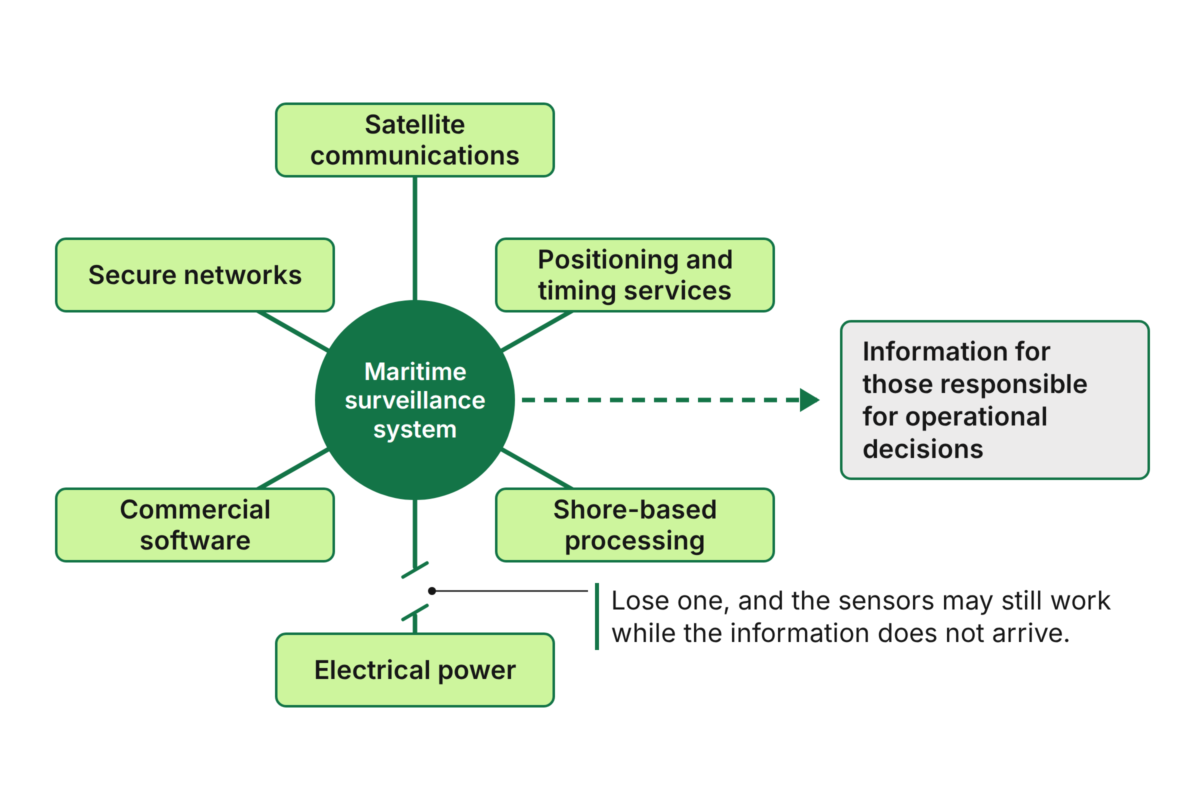
Military capabilities operate within networks of supporting services, infrastructure, personnel and institutional arrangements. A maritime surveillance system may rely on satellite communications, positioning and timing services, shore-based processing, electrical power, commercial software and secure networks. Its sensors may remain functional while the loss of one supporting service prevents collected information from reaching those responsible for operational decisions.
What one maritime surveillance system depends on
Graphic: BISC.
Similar dependencies affect naval platforms, aviation, logistics and medical support. A vessel may be technically available but unable to deploy because its designated port is inaccessible, specialist maintenance is delayed or essential mission equipment cannot be supported. Shared dependence on a small number of suppliers, communications providers, transport corridors or infrastructure facilities can also create vulnerabilities across several nations simultaneously.
JEF nations should develop a common understanding of these dependencies, identifying which are nationally controlled, commercially supplied, shared between partners or subject to external political and regulatory decisions. This assessment must distinguish critical dependencies from those for which practical alternatives exist. It should also consider whether replacing one supplier or service simply transfers the same vulnerability elsewhere.
The operational purpose is to establish which combinations of national capabilities remain available under different disruption scenarios, how long they can be sustained and where investment in redundancy or alternative arrangements would produce the greatest regional benefit.
4.3 Integration Under Degraded Conditions
Operational integration should be validated against the loss or degradation of supporting systems, including communications, navigation, information services and infrastructure. Exercises conducted under reliable connectivity and predictable logistical conditions provide limited evidence of performance against an adversary capable of disrupting those assumptions.
Fallback arrangements may include alternative radio communications, independent navigation methods, locally available information, manual reporting procedures and pre-authorised decisions within clearly defined national and operational limits. Such arrangements require trained personnel, maintained equipment and regular practice. A contingency procedure that exists in documentation but has not been exercised cannot be assumed to provide dependable operational resilience.
Degraded-mode testing should also examine how national forces continue cooperating when information arrives late, differs between participants or cannot be independently verified. Commanders need to understand which decisions can proceed with reduced information, which require additional confirmation and when operations must be modified because the risk has become unacceptable.
For JEF, the objective is not to eliminate every dependency or require identical equipment across participating nations. It is to establish whether national capabilities can be combined reliably, identify where their supporting arrangements create shared vulnerabilities and ensure that operational cooperation remains possible when preferred systems are unavailable. This provides a more credible measure of regional readiness than the aggregate size or technological sophistication of national inventories.
5. Ukraine’s Lessons: Adaptation, Scale and Operational Validation
5.1 Adaptation Cycles and Battlefield Relevance
Ukraine’s experience demonstrates how rapidly military capabilities must evolve when an adversary continuously adapts its tactics, electronic warfare and countermeasures. Close cooperation between operators, engineers, manufacturers and military organisations has enabled modifications based on battlefield feedback, often considerably faster than conventional Western acquisition processes permit.
However, rapid innovation introduces difficulties involving configuration management, training, maintenance, cybersecurity and standardisation. Equipment modified frequently may become incompatible with existing software, supporting infrastructure or other systems. Operational urgency can justify accepting such compromises, but JEF nations must distinguish between solutions that address immediate battlefield requirements and capabilities suitable for sustained multinational employment.
The relevant lesson is not simply to accelerate procurement. It is to shorten the cycle between operational requirements, development, realistic testing, deployment and subsequent adaptation while maintaining accountability for safety, security and effectiveness.
5.2 Unmanned Systems and the Integration Problem
The proliferation of unmanned systems illustrates both the benefits and complications of distributed innovation. Ukraine employs diverse aerial, maritime and ground systems for reconnaissance, strike, logistics and other military functions. Their operational effectiveness depends on more than individual platform performance.
Different systems introduce requirements for operator training, electromagnetic compatibility, secure communications, identification, maintenance, ammunition or payload integration and operational coordination. Increasing the number of available platforms without addressing these requirements can increase organisational complexity without producing a corresponding improvement in military effectiveness.
For JEF, procurement should begin with the required operational effect and examine the complete capability needed to deliver it. Surveillance, for example, requires reliable collection, information processing, verification, distribution and decisions that can be acted upon. Purchasing individual components without establishing responsibility for their integration transfers costs and operational risk to military units already facing personnel and resource constraints.
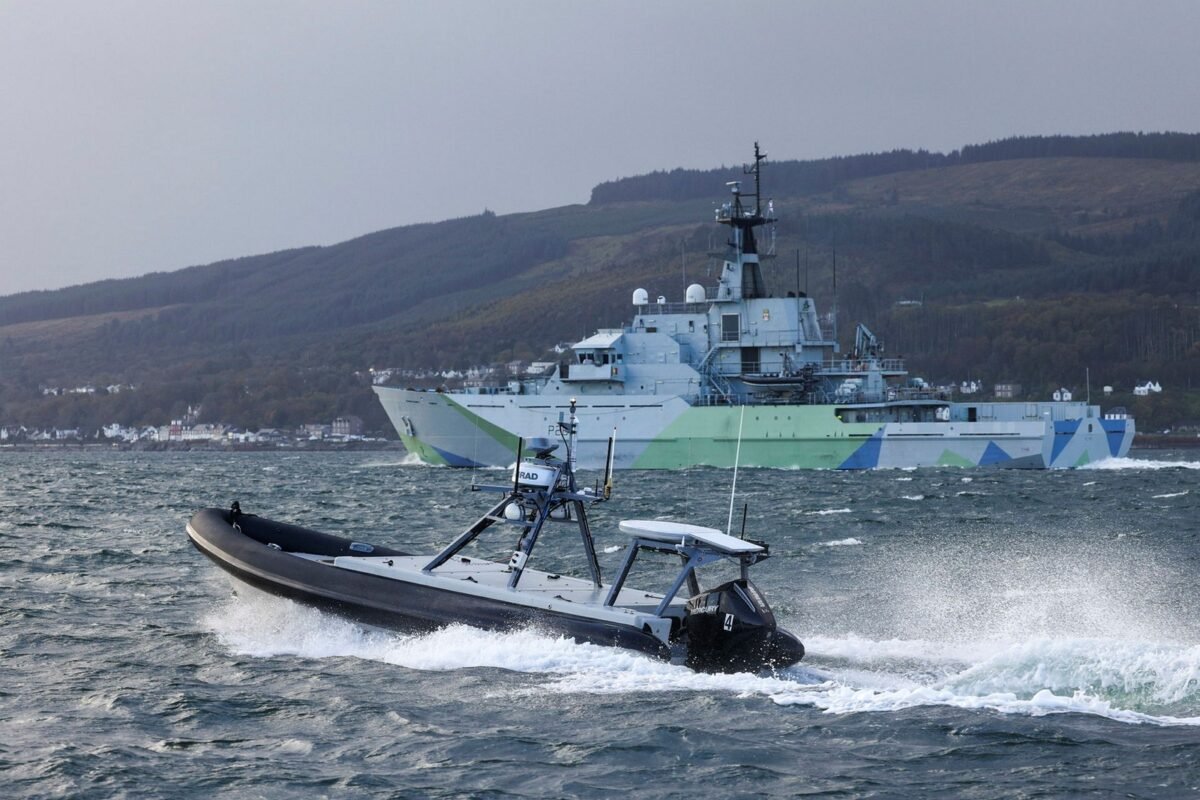
The uncrewed surface vessel Rattler escorts HMS Tyne off the coast of Scotland, October 28, 2025, during a Royal Navy demonstration. Image by LPhot Daniel Bladen; © Crown copyright 2025. Open Government Licence.
5.3 Electronic Warfare, Space Dependencies and Survivability
Ukraine’s battlefield experience demonstrates the continuing interaction between unmanned systems, electronic warfare, navigation interference and technical countermeasures. Radio-frequency links and satellite navigation can be disrupted, forcing operators and manufacturers to modify equipment, procedures and methods of employment. A system effective during one period may become substantially less useful when an adversary introduces new countermeasures.
These vulnerabilities extend beyond the immediate battlefield. Satellite communications, positioning, navigation and timing services depend on space-based infrastructure and terrestrial systems that can be affected by interference, cyber operations or disruption to supporting facilities. Electronic warfare does not necessarily disable satellites themselves; interference with signals and receiving equipment can nevertheless deny users essential services.
Operational validation must therefore examine cybersecurity, electromagnetic resilience, human supervision, alternative operating modes and the consequences of losing connectivity. Human control must remain meaningful, with clearly defined responsibilities for authorisation, supervision and intervention appropriate to the system and mission.
JEF should plan from the assumption that communications and external information services may become unavailable, establishing workable local procedures and alternative capabilities before adding more sophisticated connectivity. Continuous access to shared information is desirable, but cannot be treated as a guaranteed foundation for military operations.
5.4 Lessons That Cannot Simply Be Copied
Ukraine’s operational urgency, industrial mobilisation, force structure and battlefield conditions differ substantially from those of JEF nations. Solutions developed for immediate wartime requirements may not satisfy different legal obligations, maritime operating conditions, personnel arrangements or long-term sustainment needs.
Equally, the pursuit of entirely separate national solutions risks multiplying development costs, fragmenting production and delaying operational integration. National control over critical capabilities remains important, but sovereignty should not automatically be equated with domestic duplication of every component, platform or supporting service.
Regional cooperation can provide a more effective approach through shared requirements, complementary industrial responsibilities, common testing arrangements and coordinated production capacity. Such cooperation must still preserve the ability to maintain, repair and adapt equipment when suppliers or external services become unavailable.
5.5 Reciprocity and Joint Capability Development
Ukraine should be treated as an operational partner contributing expertise to capability development rather than merely supplying battlefield observations for Western acquisition programmes. Meaningful cooperation requires arrangements that respect Ukrainian operational priorities, security restrictions, intellectual property and the resources needed to support joint testing and production.
For JEF, the opportunity lies in combining Ukrainian operational experience with regional industrial capacity, specialist expertise and sustained investment. Joint validation should assess complete mission capabilities under realistic electronic warfare, cyber and logistical constraints, including the time required to integrate new equipment and train personnel.
The objective should be capabilities that can be produced at useful scale, adapted as threats evolve and sustained throughout their operational employment. Their value ultimately depends on whether they remain effective within a functioning military organisation, not on how quickly individual technologies can be demonstrated or purchased.
6. The Contested Information Environment
6.1 Situational Awareness and Information Sharing
Northern Europe possesses extensive military, civilian and commercial information resources, including maritime surveillance networks, national intelligence systems, satellite services and NATO information-sharing arrangements. Their combined potential is considerable, but the availability of information does not guarantee that relevant authorities can access, interpret or use it when operational decisions are required.
Classification rules, national legislation, commercial restrictions and incompatible access arrangements can prevent information from reaching those who need it. Different organisations may also apply inconsistent standards for validating sources, identifying uncertainty or distinguishing confirmed observations from assessments. These limitations become particularly consequential during rapidly developing maritime incidents, when military authorities, coastguards, infrastructure operators and civilian agencies may hold different parts of the available evidence.
JEF integration should prioritise agreed information requirements, appropriate release procedures, source reliability and clearly assigned responsibilities for resolving contradictory assessments. Sharing more data is not necessarily beneficial if recipients cannot establish its provenance, relevance or reliability.
6.2 Artificial Intelligence and Data Integrity
Artificial intelligence can support information processing, anomaly detection and the identification of patterns across large datasets. However, system performance depends on the quality and representativeness of its inputs, the conditions under which models were developed and their suitability for the operational environment.
Military applications introduce additional risks because adversaries may deliberately manipulate observations, interfere with sensors or exploit weaknesses in automated classification. Data poisoning, misleading inputs and changes in operational conditions can undermine system performance without producing obvious technical failures. Outputs presented with numerical confidence may also encourage automation bias when operators lack sufficient information to assess their reliability.
Validation must therefore examine adversarial conditions, uncertain data provenance, false positives and the consequences of incorrect recommendations. Human oversight requires personnel with the authority, training and time to question automated outputs, supported by procedures for independent verification and intervention. Responsibility for operational decisions cannot be transferred to an algorithm or its supplier.
6.3 Electronic Warfare and Satellite Dependence
Satellite communications and global navigation satellite systems support military coordination, aviation, maritime navigation, precision timing and unmanned operations. Their importance creates dependencies that adversaries can exploit through interference, deception, cyber operations and attacks against supporting infrastructure.
Documented GNSS interference affecting aviation in the Baltic region demonstrates that disruption is already a practical concern rather than a hypothetical wartime scenario. Maritime operations face related risks, including unreliable positioning, navigation anomalies and difficulties coordinating activities that depend on accurate timing or location information.
Nevertheless, observed interference should not automatically be attributed to a particular electronic warfare platform. Identifying its origin, equipment and operational purpose requires evidence beyond the geographic distribution of affected signals. JEF assessments must distinguish documented disruption from intelligence assessments of Russian capabilities and claims about individual systems that cannot be independently verified.
Space-based services also depend on ground stations, communications links, software and terrestrial infrastructure. Resilience planning must consider the complete service rather than concentrating exclusively on satellites.
6.4 Cybersecurity as a System-Wide Requirement
Military cybersecurity cannot be confined to protecting individual platforms or classified networks. Regional operations depend on ports, transport operators, fuel suppliers, maintenance contractors, telecommunications providers and civilian infrastructure whose systems may be interconnected with military support arrangements.
A cyber incident affecting a logistics provider could delay military movement without compromising a military network directly. Similarly, disruption to port management systems, commercial communications or contracted maintenance services could reduce operational availability even when deployed equipment remains technically functional.
JEF nations should identify critical digital dependencies across military and civilian organisations, establish appropriate information-sharing arrangements for incidents and exercise recovery procedures with relevant infrastructure operators. Procurement requirements must address software maintenance, vulnerability management, supplier access and continuity of support throughout the capability lifecycle.
6.5 Alternatives When Connectivity Fails
Operational resilience requires practical arrangements for periods when digital connectivity, satellite navigation or external information services are unavailable. Alternative radio communications, independent positioning methods, locally stored information, manual reporting and established procedures for operating with delayed information can preserve essential functions.
These alternatives must be compatible with national authorities and realistic personnel capacity. Their effectiveness depends on equipment availability, training, maintenance and repeated testing under conditions that prevent participants from quietly reverting to preferred systems.
JEF should therefore assess whether participating forces can continue essential missions with incomplete information, intermittent communications and reduced technical support. Advanced connectivity remains valuable, but its operational contribution is credible only when the underlying force can function without assuming uninterrupted access to it.
7. Maritime, Arctic and Critical Infrastructure Integration
7.1 JEF’s Maritime Development
Maritime security has become increasingly important to JEF’s operational development, particularly following heightened concern about undersea infrastructure, Russian naval activity and the protection of Northern European reinforcement routes. The UK has promoted closer maritime cooperation within JEF, including improved surveillance, information exchange and coordination of responses to potential threats against critical infrastructure.
The operational value of these initiatives must be assessed against their actual implementation. Political announcements, additional surveillance arrangements and multinational exercises represent different stages of capability development. None independently establishes whether participating nations possess the personnel, equipment, legal authorities and sustainment arrangements necessary to maintain effective maritime protection during a prolonged crisis.
JEF should therefore distinguish capabilities already available for operational employment from initiatives requiring further investment, integration or validation. Particular attention should be given to whether national contributions can support coordinated surveillance, investigation and protective measures without creating additional command structures that duplicate NATO’s established maritime responsibilities.
7.2 Baltic and North Sea Operational Requirements
The Baltic Sea and North Sea present interconnected but distinct maritime challenges. Baltic operations must account for confined waters, dense shipping traffic, mine warfare, coastal threats and the movement of reinforcements through strategically important approaches. North Sea operations involve major commercial ports, offshore energy infrastructure, international shipping routes and connections to North Atlantic reinforcement and sustainment.
Mine countermeasures illustrate the integration problem particularly well. National forces may possess capable vessels, autonomous systems and specialist personnel, but their combined effectiveness depends on compatible procedures, reliable information exchange, maintenance support and arrangements for coordinating activity around civilian shipping. Port access and maritime protection similarly require cooperation between naval forces, coastguards, harbour authorities and commercial operators.
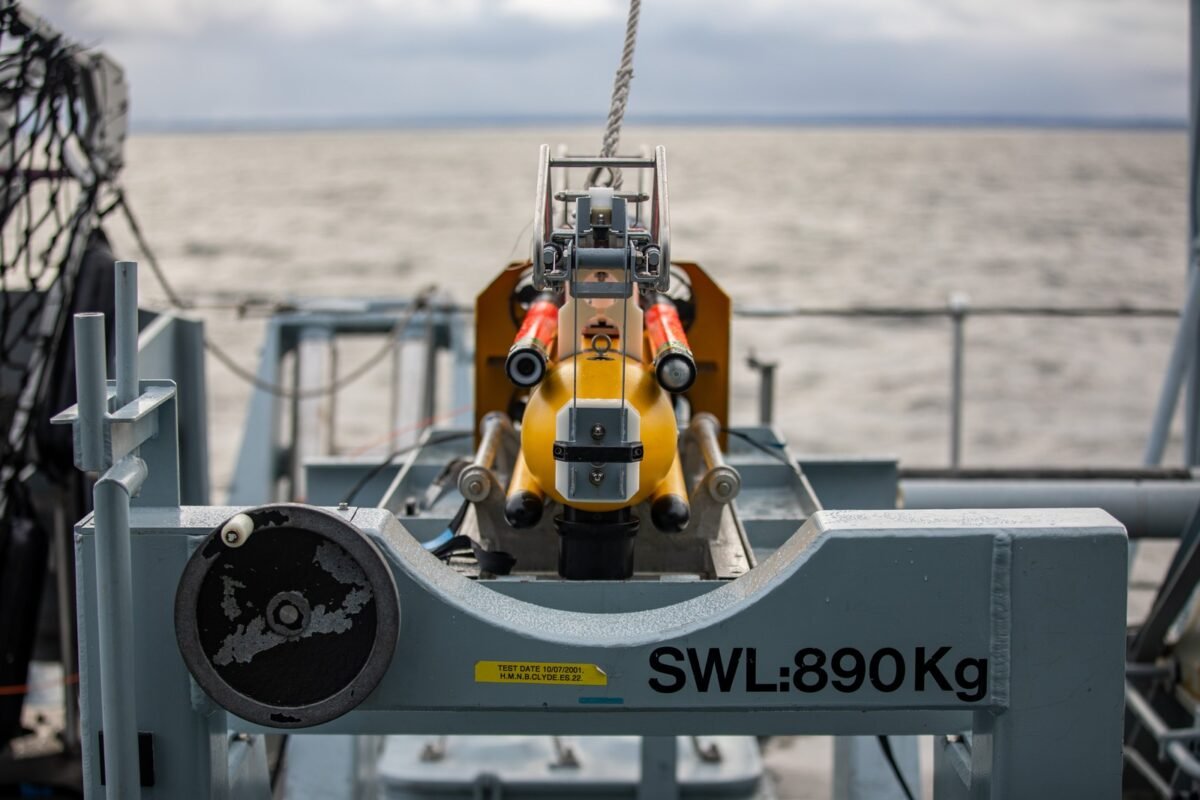
Mine countermeasures equipment on the deck of a ship during a mine countermeasures operation by the Estonian Navy in Narva Bay, November 2023. Photo: kaitsevägi, pildid.mil.ee
Regional capability development should concentrate on making these national contributions operationally compatible while preserving NATO’s maritime command arrangements. JEF can facilitate preparedness, exercises and coordination among participating nations, but operational responsibilities must remain consistent with the relevant national and Alliance authorities.
7.3 Arctic Conditions
Arctic operations introduce constraints that cannot be resolved through equipment compatibility alone. Distance, extreme weather, seasonal variations in sea ice, limited transport infrastructure and restricted communications complicate deployment, maintenance, medical evacuation and emergency response. Personnel require specialist training, while equipment must be validated for the environmental conditions in which it is expected to operate.
Norway’s northern responsibilities, Iceland’s North Atlantic position and the UK’s maritime capabilities already provide important contributions to regional cooperation. Canada’s prospective involvement could add Arctic experience, infrastructure relationships and transatlantic operational depth. Nevertheless, geographic reach does not automatically provide deployable capability, and additional participation would require practical arrangements for logistics, communications, rescue support and the coordination of national responsibilities.
Arctic readiness must therefore be measured through sustained operations under realistic environmental conditions rather than occasional deployments or demonstrations of individual platforms.
7.4 Civilian Infrastructure and Resilience
Regional military operations depend extensively on infrastructure owned or operated outside defence establishments. Commercial ports, electricity networks, telecommunications, fuel distribution, shipping services and emergency response organisations support military mobility and sustainment. Their disruption can restrict military options even when national armed forces retain their personnel and equipment.
These dependencies create requirements for cooperation that extend beyond military interoperability. Infrastructure operators possess technical knowledge and operational responsibilities that cannot simply be transferred to military authorities during a crisis. National legislation, commercial obligations, information-security requirements and emergency powers determine which information can be exchanged and what protective measures can be undertaken.
JEF nations should establish practical arrangements for identifying critical dependencies, coordinating protective measures and exercising responses with civilian authorities and operators. These arrangements must clarify responsibility for incident investigation, infrastructure restoration, maritime safety and military support where legally authorised.
The regional objective should be to ensure that maritime forces, civilian infrastructure and supporting services can function together under disruption. This requires sustained coordination between institutions whose responsibilities differ, but whose operational effectiveness becomes increasingly interdependent during a crisis.
8. Logistics, Medical Support and the Human Foundations of Readiness
8.1 The Neglected Foundations of Readiness
Military readiness is frequently discussed through equipment availability, force structures and technological capabilities. However, operational effectiveness depends equally on personnel, food, drinking water, suitable clothing, protective equipment, accommodation, ammunition, fuel, maintenance and transport. Shortages in these areas can prevent deployment or reduce combat effectiveness regardless of the sophistication of available weapons systems.
Northern European conditions make these requirements particularly important. Cold-weather operations demand appropriate clothing, shelter, heating, equipment maintenance and medical preparation. Personnel operating for extended periods require reliable resupply, rest arrangements and the ability to replace damaged equipment. National readiness assessments should therefore examine complete deployable formations and their supporting resources rather than counting available platforms or nominal personnel strength.
For JEF, integration requires identifying which sustainment functions can be shared, which remain national responsibilities and where shortages could restrict multinational operations.
8.2 Medical Support and Casualty Evacuation
Ukraine’s experience has demonstrated the consequences of conducting casualty evacuation under persistent surveillance, artillery threats, electronic warfare and contested movement routes. Delayed evacuation increases demands on frontline medical personnel, medical supplies and the capacity to provide care when conventional evacuation timelines cannot be achieved.
These lessons require careful adaptation to Northern European conditions. Baltic operations may involve disrupted roads, contested ports and limited evacuation routes, while North Atlantic and Arctic deployments introduce long distances, severe weather and restricted medical infrastructure. Medical planning must account for circumstances in which aircraft cannot operate, maritime evacuation is delayed or civilian hospitals face simultaneous demand.
JEF nations should assess their capacity for prolonged casualty care, medical evacuation coordination, casualty tracking, blood and pharmaceutical supply, and the movement of patients between national healthcare systems. Such arrangements require advance agreement on clinical responsibilities, information sharing, reimbursement and national legal requirements.
Medical exercises should test realistic casualty volumes and disrupted transport rather than assuming rapid access to established evacuation chains.
8.3 Reinforcement and Movement
Regional defence depends on the ability to move personnel, equipment and supplies through roads, railways, ports and airfields. Host-nation support, border procedures, transport availability and infrastructure capacity determine how quickly reinforcements can reach operational areas and whether they can subsequently be sustained.
Movement planning must consider damaged infrastructure, cyber disruption, congestion and competition between military requirements and civilian needs. Heavy equipment may require specialised rail capacity, suitable bridges and port-handling equipment, while commercial transport assets may be unavailable or already committed elsewhere.
JEF cooperation can support the identification of critical routes, alternative transport arrangements and national procedures that complicate movement. Exercises should assess actual throughput, delays and recovery options, including the consequences of losing important infrastructure nodes.
8.4 Sustainment and Ammunition Compatibility
Equipment compatibility does not automatically extend to ammunition, spare parts, maintenance procedures or technical support. National forces may operate similar platforms with different configurations, certification requirements or supply arrangements, limiting their ability to share resources during prolonged operations.
Some difficulties reflect genuine technical incompatibility, while others can be addressed through advance planning, common stock arrangements, approved substitution procedures or coordinated maintenance support. The distinction matters because complete standardisation is neither immediately achievable nor always necessary.
JEF nations should identify where shared ammunition stocks, maintenance facilities, repair capacity and supply arrangements could improve regional resilience. Planning must also account for industrial replenishment rates and the availability of specialist components during sustained demand.
8.5 Personnel Availability and Readiness
European defence commitments increasingly depend on expanding forces while retaining experienced personnel and developing specialised technical skills. Recruitment, retention, reserve training and the availability of qualified instructors affect whether announced force structures can become operationally credible.
Modern military systems also depend on civilian engineers, software specialists, maintenance personnel, transport workers and healthcare professionals. These skills are frequently required across military, government and commercial organisations simultaneously, creating competing demands during mobilisation.
JEF readiness assessments should therefore examine whether participating nations can staff, train, maintain and replace the personnel required for sustained operations. Particular attention is needed where essential functions depend on small specialist communities or individual contractors.
A credible regional capability assessment must establish not only what forces can deploy initially, but whether the personnel and supporting systems required to sustain them remain available after weeks or months of operational pressure.
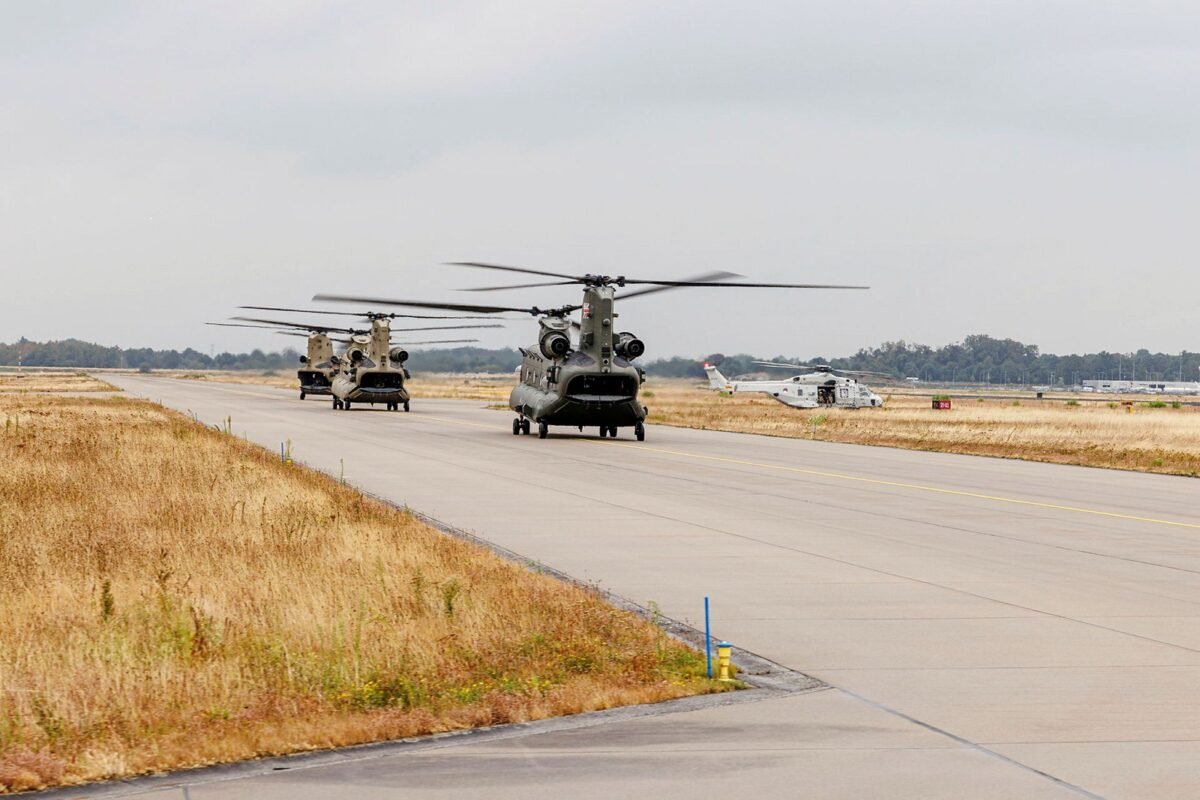
A Chinook of 18 Squadron, Royal Air Force, with Chinooks and an NH90 of 298 Squadron, Royal Netherlands Air Force, at Exercise Medic Falcon, August 18, 2026. Image by AS1 Joseph Head RAF; © Crown copyright 2026. Open Government Licence.
9. Procurement, Industry and the Cost of Fragmentation
9.1 The Acquisition Problem
European defence procurement is frequently criticised for excessive bureaucracy and slow decision-making. Although lengthy acquisition processes can obstruct operational adaptation, procurement speed is only one dimension of a more substantial problem. National budgeting, industrial policies, incompatible requirements and insufficient attention to integration and sustainment can produce expensive equipment that contributes less operational capability than anticipated.
Accelerating purchases without addressing these weaknesses risks accelerating fragmentation. Acquisition decisions must establish the military requirement, integration responsibilities, security obligations, production capacity and resources needed to maintain effectiveness throughout the capability’s intended service life.
For JEF, procurement cooperation should concentrate on compatible operational requirements and sustainable regional capability rather than simply purchasing similar equipment.
9.2 The Opportunity Cost of Major Programmes
Major defence programmes require substantial investment beyond initial acquisition. Personnel, infrastructure, ammunition, maintenance, training and periodic upgrades create obligations extending across decades. These costs compete with less visible requirements, including medical preparedness, logistics, spare parts and the ability to sustain deployed forces.
Capability planning must therefore consider whether programmes remain affordable and operationally relevant over five, ten or more years. Purchasing additional platforms while underfunding their supporting arrangements can increase national inventories without producing equivalent deployable strength.
9.3 Defence Technology and Market Incentives
Growing defence technology investment has expanded opportunities for innovation, but commercial incentives can also encourage exaggerated claims about technological maturity, interoperability and military relevance. Venture capital expectations and accelerator programmes often favour rapid growth and demonstrations, while military customers require reliability, security, maintainability and sustained operational performance.
A demonstration establishes that something can function under particular conditions. Operational validation examines whether it performs reliably against defined requirements in representative environments. Certification, where required, establishes compliance with applicable technical, safety or regulatory standards. None of these stages should be presented as interchangeable.
Experimental procurement has a legitimate role in development and testing, but purchasing an unvalidated prototype must not be confused with acquiring operational capability. Military customers need evidence of cybersecurity, survivability, human control, integration, production scalability and lifecycle support.
The designation dual-use does not itself establish a defence requirement. Technologies relevant to civilian security, emergency services or healthcare may have considerable value without necessarily meeting an armed force’s operational needs.
9.4 Vendor Dependence and Sovereignty
Modern capabilities may depend on proprietary software, external cloud services, restricted technical data, controlled updates and supplier-managed maintenance. Such arrangements can limit national freedom of action when services are interrupted or modifications become necessary.
These risks require precise assessment. Export-control restrictions, contractual limitations, commercial service availability and political decisions operate through different legal and technical mechanisms. Dependence on US-origin technology, for example, cannot automatically be equated with an external authority possessing unrestricted technical control over deployed equipment.
JEF nations should examine supplier access, data portability, alternative support arrangements, update authority and the ability to operate without external connectivity. Regional cooperation could reduce unnecessary duplication while strengthening negotiating capacity, maintenance arrangements and industrial resilience.
Procurement reform should ultimately enable faster adaptation of capabilities that have been properly tested, integrated and supported. Its purpose is to deliver sustainable military effectiveness, not merely to purchase experimental technologies more quickly.
10. Political Authority, Institutional Culture and Operational Responsibility
10.1 National Sovereignty and Collective Effectiveness
JEF operates through cooperation among sovereign states, each retaining political authority over its armed forces, national resources and decisions concerning military participation. This flexibility supports regional cooperation without requiring a separate supranational command structure, but it also creates practical limitations when collective operational requirements depend on national decisions.
Participating nations may agree on common priorities while maintaining different readiness standards, deployment restrictions, information-release procedures and resource commitments. Consequently, the availability of a national capability does not automatically establish its availability for multinational operations.
JEF planning should identify these limitations in advance, distinguishing capabilities routinely available for cooperation from those requiring additional political authorisation. Shared readiness assessments must reflect actual national commitments rather than assumptions based on equipment inventories or exercise participation.
10.2 Information-Sharing Legislation and Institutional Barriers
Information-sharing restrictions arise from different sources, including national security legislation, intelligence protection, privacy requirements, commercial obligations and institutional procedures. Some restrictions are legally necessary, while others result from inconsistent interpretations, outdated agreements or organisational practices that have not adapted to multinational operational requirements.
These distinctions determine the appropriate response. Legislative reform may be necessary where existing law genuinely prevents essential cooperation, but many difficulties can be addressed through revised agreements, clearer classification guidance, established release authorities and improved implementation of existing provisions.
Military and civilian organisations should identify specific information exchanges that repeatedly fail, establish the legal or procedural reasons and assign responsibility for resolving them. General commitments to improved information sharing are insufficient without evidence that operational users can obtain the information they require.
10.3 Political Uncertainty and External Dependence
European capability planning must account for changes in political priorities, supplier relationships and international security arrangements, including those involving the United States. Such developments can influence procurement, industrial supply chains, software support, export permissions and access to externally provided services.
However, political uncertainty should not be treated as evidence that particular capabilities will necessarily become unavailable. JEF nations need assessments based on contractual conditions, technical dependencies, applicable regulations and credible disruption scenarios.
Practical safeguards may include alternative suppliers, national maintenance capacity, appropriate contractual protections, shared industrial arrangements and procedures for operating without external services. These measures should strengthen resilience without unnecessarily fragmenting regional procurement or weakening established transatlantic cooperation.
10.4 Leadership Accountability
Capability integration requires identifiable responsibility across procurement authorities, military leadership, security organisations and political decision-makers. When nationally acquired systems cannot exchange essential information, exercises repeatedly identify the same weaknesses or known dependencies remain unresolved, responsibility cannot be assigned indefinitely to future coordination efforts.
JEF nations should establish which authorities own particular integration requirements, who must fund corrective measures and how progress will be verified. Recurring deficiencies should influence procurement approvals, training priorities, readiness assessments and subsequent exercise objectives.
Leadership should be evaluated against measurable operational outcomes, including corrected interoperability failures, validated contingency arrangements and the availability of sustainable multinational capabilities. Existing national and JEF mechanisms should provide sufficient opportunities for assigning these responsibilities without creating another permanent committee.
Ultimately, political commitment becomes operationally meaningful when participating governments accept responsibility for ensuring that their national contributions can function within the regional arrangements they have agreed to support.
11. A Practical JEF Capability Integration Agenda
JEF should concentrate on seven priorities implemented through existing national authorities, JEF coordination arrangements and NATO structures. Each requires an accountable owner, realistic testing and evidence of improved operational performance.
1. Establish a common regional capability-dependency assessment. National planners should map critical infrastructure, communications, suppliers, specialist personnel and dependencies on external services, including US-origin technology and Chinese-manufactured components where relevant. Commercial confidentiality, classification and national security restrictions will complicate disclosure. The measurable outcome should be an agreed assessment of critical dependencies, available alternatives and unresolved vulnerabilities.
2. Agree minimum operational interoperability requirements. Participating forces should establish what information, equipment support and operational procedures must remain compatible, including during communications loss or navigation disruption. National technical standards and security requirements may limit uniformity. Success should be measured through demonstrated multinational mission performance under degraded conditions.
3. Establish joint operational validation under realistic threats. Testing must include representative electronic warfare, cyber disruption, manipulated information and adversarial adaptation, incorporating Ukrainian operational expertise where appropriate. Laboratory certification and demonstrations cannot substitute for operational validation. Testing must also examine human supervision, civilian interference risks, collateral effects and the safety implications of compromised systems. Results should determine whether capabilities are accepted, modified or rejected.
4. Improve regional information-sharing governance. Governments should review legal authorities, classification policies and organisational restrictions affecting situational awareness, historical data analysis and the identification of developing threat patterns. Privacy, intelligence protection and national sovereignty remain legitimate constraints. Measurable progress requires verified improvements in information availability, reliability, release times and coordinated responses. JEF can facilitate cooperation across regional responsibilities without exercising authority over NATO’s separate command structures.
5. Prioritise sustainment, medical preparedness and reinforcement. Joint exercises should test disrupted transport, ammunition availability, equipment repair, casualty evacuation and civilian infrastructure dependencies. Limited resources and competing national requirements will constrain implementation. Outcomes should include demonstrated reinforcement timelines, repair capacity, medical evacuation arrangements and sustained operational availability.
6. Connect procurement to regional operational requirements. National acquisition authorities should assess interoperability, cybersecurity, electromagnetic resilience, lifecycle costs, industrial scalability and supplier dependencies before committing to procurement. Different national budgets and industrial interests will complicate alignment. Success requires fewer unresolved integration problems and evidence that acquired systems remain supportable and adaptable throughout their intended service lives.
7. Measure operational outcomes and political accountability. JEF cooperation should be assessed through readiness, validated capability, information exchange, resilience and effective support to NATO operations rather than announcements or exercise participation. Political leaders must also establish national authorities, rules of engagement and agreed safeguards for operating under uncertainty, including acceptable risk, civilian protection and responsibility for unintended effects.
Implementation should remain a national responsibility supported by existing regional and Alliance mechanisms. JEF’s contribution is to connect those responsibilities across participating nations, identify operational gaps and sustain political attention until corrective measures have been tested. This requires governments to translate summit commitments into funded decisions, revised policies and demonstrable military readiness.
12. Conclusion: Capability Must Survive Contact With Reality
JEF’s strategic value rests on its ability to translate political alignment, geographic advantages and established defence relationships into military capabilities that participating nations can employ and sustain together. Its relatively flexible structure provides opportunities for practical regional cooperation, but those opportunities depend on national decisions concerning readiness, procurement, personnel, information sharing and operational responsibilities.
Technological sophistication cannot compensate for inadequate training, incompatible procedures, insufficient logistics or unavailable personnel. Equally, common technical standards and successful demonstrations do not establish operational interoperability. Capabilities must be validated under realistic conditions, including electronic warfare, cyber disruption, degraded communications, contested infrastructure and prolonged sustainment requirements.
Effective integration also requires political leadership willing to address institutional fragmentation, national dependencies and difficult questions concerning authority, acceptable risk and accountability. JEF can support this process by connecting national efforts, encouraging shared requirements and strengthening cooperation across Northern Europe’s interconnected security environment, while remaining complementary to NATO’s established responsibilities.
The challenge is to ensure that regional cooperation produces measurable improvements in military effectiveness rather than additional commitments that cannot be reliably implemented.
This paper has examined what JEF nations must be able to deliver together. The sixth and final paper will consider what this approach to regional cooperation means for the future of European defence, particularly the relationship between national sovereignty, Alliance responsibilities, regional initiative and the institutional adaptation required to sustain collective security.
References and Further Reading
Previously Published Papers in This Series
Eva Sula. The JEF Papers | Paper 1: Why JEF Works. Examines the political, geographic and institutional foundations of the Joint Expeditionary Force and its contribution to Northern European security. https://www.linkedin.com/pulse/jef-papers-paper-1-why-works-eva-sula-bya6f/
Eva Sula. The JEF Papers | Paper 2: The Baltic-Arctic Security Bridge. Examines the connected strategic geography of the Baltic Sea, North Sea, North Atlantic and Arctic. https://www.linkedin.com/pulse/jef-papers-paper-2-baltic-arctic-security-bridge-eva-sula-dzf1f/
Eva Sula. The JEF Papers | Paper 3: NATO’s Complement, Not Competitor. Examines JEF’s relationship with NATO, regional coordination and the use of existing institutions and expertise. https://www.linkedin.com/pulse/jef-papers-paper-3-nato-complement-competitor-eva-sula-ozrrf/
Eva Sula. The JEF Papers | Paper 4: The Expansion Question. Assesses JEF membership, partnership arrangements and the operational implications of closer cooperation with strategically relevant countries. https://www.linkedin.com/pulse/jef-papers-paper-4-expansion-question-eva-sula-ryy9f/
Reference Materials and Official Sources
UK Government, Ministry of Defence. Joint Expeditionary Force. Official information on JEF membership, political-military cooperation and regional defence activities. https://www.gov.uk/government/organisations/ministry-of-defence
NATO. NATO’s Military Committee and Command Structure. Institutional reference for NATO’s military responsibilities and command arrangements, relevant to distinguishing JEF cooperation from Alliance operational command. https://www.nato.int/
Finnish Defence Forces. JEF Cooperation. National perspective on Finland’s participation in JEF and its role in Northern European military cooperation. https://puolustusvoimat.fi/en/international-activities/jef-cooperation
Ministry of National Defence of Lithuania. Joint Expeditionary Force (JEF). Official Lithuanian information on JEF participation and regional defence cooperation. https://kam.lt/en/faq/joint-expeditionary-forces/
European Commission. European Defence Industry Programme (EDIP). Policy material concerning European defence industrial capacity, cooperation and the development of defence production. https://defence-industry-space.ec.europa.eu/
European Union Agency for Cybersecurity (ENISA). European cybersecurity guidance relevant to critical infrastructure, supply chains, digital dependencies and resilience. https://www.enisa.europa.eu/
European Union Aviation Safety Agency (EASA). Official aviation safety information relevant to GNSS interference and its operational consequences for European airspace. https://www.easa.europa.eu/
International Maritime Organization (IMO). International maritime safety and security framework relevant to navigation, shipping, port operations and maritime infrastructure. https://www.imo.org/
Further Reading and Strategic Analysis
Royal United Services Institute (RUSI). The Joint Expeditionary Force and Its Contribution to European Security (2024). Analysis of JEF’s strategic contribution and its place within Europe’s evolving security arrangements. https://www.rusi.org/explore-our-research/publications/occasional-papers/joint-expeditionary-force-and-its-contribution-european-security
Royal United Services Institute (RUSI). Stretching the Joint Expeditionary Force: An Idea for Our Times (2023). Examines the possibilities and limitations of extending JEF cooperation in response to Northern Europe’s security requirements. https://www.rusi.org/explore-our-research/publications/commentary/stretching-joint-expeditionary-force-idea-our-times
Finnish Institute of International Affairs (FIIA). The Joint Expeditionary Force in Northern Europe. Research on JEF’s strategic relevance, regional cooperation and Northern European security. https://www.fiia.fi/en/publication/the-joint-expeditionary-force-in-northern-europe
Center for Strategic and International Studies (CSIS). The Joint Expeditionary Force: Global Britain in Northern Europe (2022). Examines JEF’s strategic development and the UK’s role in Northern European defence cooperation. https://www.csis.org/analysis/joint-expeditionary-force-global-britain-northern-europe
Reuters. Canada Applies to Join UK-Led Military Coalition, Says Carney’s Office (16 September 2026). Reporting on Canada’s formal application to join JEF and its implications for transatlantic and Northern European defence cooperation. https://www.reuters.com/world/canada-applies-join-uk-led-military-coalition-says-carneys-office-2026-09-16/
Eva Sula is an independent defence and security strategic advisor specialising in NATO and European defence cooperation, regional security, emerging technologies and operational capability development. She is a NATO DIANA Defence Mentor, a Senior Fellow for Estonia at the Council on Strategic and Foreign Intelligence (CSFI), and a member of The Alphen Group.
© Eva Sula
First published on LinkedIn on October 26, 2026. Read the original article.
All opinions expressed are those of the author alone and may not represent those of the institutions they represent or the Baltic International Security Centre (BISC). BISC maintains a strict intellectual independence policy across all its projects and publications.