
Photo: Alex Gerst, International Space Station, June 15, 2014. Source: NASA.
By Eva Sula
Editor’s note: BISC added the maps and the visuals to this article. They are not part of Eva Sula’s original paper, which appears here as she wrote it.
All opinions expressed are those of the author alone and may not represent those of the institutions they represent or the Baltic International Security Centre (BISC). BISC maintains a strict intellectual independence policy across all its projects and publications.
© Eva Sula
First published on LinkedIn on June 23, 2026. Read the original article or the LinkedIn post.
Why Northern Europe’s Security Must Be Understood as a Single Strategic System
0. Author’s Note
This paper is the second in a six-paper series examining the Joint Expeditionary Force and its role in the evolving security architecture of Northern Europe. The first paper, Why JEF Works, examined why JEF has become one of Europe’s most effective regional defence frameworks, arguing that its strength lies in practical cooperation, political trust, shared strategic exposure and a geography that has become increasingly difficult to divide into separate security problems.
This paper moves from the framework to the operating environment that makes such a framework necessary. It examines why the Baltic Sea, the North Atlantic and the High North should increasingly be understood as parts of one connected strategic system rather than as separate theatres. The question is not only where JEF operates, but why the geography it spans has become so central to deterrence, reinforcement, resilience and operational readiness across Northern Europe.
The argument developed here is not a proposal for a new institution, a new command structure or an additional layer of bureaucracy. NATO remains the foundation of collective defence for its members, and regional frameworks must strengthen rather than duplicate Alliance planning. The purpose of this paper is narrower and more practical: to examine how geography, infrastructure, military mobility, maritime security and critical dependencies now connect Northern Europe in ways that affect both political decision-making and operational planning.
The Baltic-Arctic security bridge is therefore not a slogan. It is a description of an emerging strategic reality. Reinforcement routes across the North Atlantic, access through the GIUK gap, Norwegian and High North security, the Danish Straits, the Baltic Sea, Finland’s and Sweden’s NATO accession, critical underwater infrastructure and regional military mobility are all part of the same problem set. Treating them as disconnected issues risks misunderstanding how deterrence would have to function under pressure.
This paper builds directly on the logic of the first. If JEF works because it is built around shared geography and practical cooperation, then the next question is why that geography has changed so significantly. Understanding the Baltic-Arctic security bridge is essential not only for understanding JEF, but for understanding the wider transformation of Northern European defence.
1. Introduction: The End of Separate Theatres
Northern European security has often been analysed through separate regional lenses. The Baltic Sea has been treated primarily as an eastern flank and maritime access problem. The High North has been treated as an Arctic, Norwegian and Russian Northern Fleet problem. The North Atlantic has been treated as a transatlantic reinforcement and sea lines of communication problem. Those distinctions still have analytical value, but they no longer describe the full operational reality facing NATO, JEF members or regional defence planners.
The security environment across Northern Europe has become increasingly connected. Russia’s full-scale invasion of Ukraine accelerated changes that were already visible in military posture, infrastructure vulnerability, maritime security and Alliance planning. Finland joined NATO on 4 April 2023 and Sweden joined on 7 March 2024, bringing all Nordic states into the Alliance and fundamentally changing the military geography of the region. NATO has also adapted its command structure to protect the transatlantic link, including Joint Force Command Norfolk, which was established to help ensure sea lines of communication between North America and Europe remain free and secure. These developments show that Northern European defence can no longer be understood only through national borders or isolated regional maps.
The Baltic Sea, the North Atlantic and the High North now form a connected strategic system because the military problem has changed. Reinforcement of the Baltic states depends on access through the North Atlantic, the Norwegian Sea, Nordic territory, the Danish Straits and Baltic ports. Security in the High North affects surveillance, anti-submarine warfare, air and maritime access, and the ability to manage Russian military activity from the Kola Peninsula and surrounding areas. The Baltic Sea remains a constrained and vulnerable operating environment, but its defence depends on wider regional depth rather than on the Baltic littoral alone.
This connected system is also shaped by critical infrastructure. Undersea pipelines, power cables, data cables, ports, airfields, railways, energy interconnectors and satellite-enabled services are no longer civilian background conditions. They are operational dependencies. The Nord Stream sabotage in 2022, the Balticconnector incident in 2023, subsequent damage to cables and interconnectors in the Baltic Sea, and NATO’s launch of Baltic Sentry in 2025 all demonstrate that regional security increasingly operates across the boundary between military threat, hybrid activity, law enforcement, maritime governance and private-sector infrastructure ownership. NATO described Baltic Sentry as a military activity to strengthen the protection of critical infrastructure in the Baltic Sea and improve the ability of Allies to respond to destabilising acts.
The same logic applies to Russian military activity. Russia does not experience the region as neatly separated into Baltic, Arctic and Atlantic compartments. Its naval, air, intelligence, missile, cyber and hybrid activities can create pressure across multiple parts of the same strategic environment. Activity in the High North can affect North Atlantic access. Pressure in the Baltic Sea can test allied cohesion and infrastructure resilience. Disruption of undersea infrastructure can create political uncertainty without crossing clear thresholds for collective defence. Long-range strike, electronic warfare, cyber operations and information activity further compress the distance between what were previously treated as distinct theatres.
For commanders and planners, this means that cross-domain coordination is no longer an optional enhancement to regional defence. Land, air, maritime, cyber, space, intelligence, logistics and civil infrastructure dependencies must be understood together because operational failure in one domain can constrain choices in another. A port may be a civilian logistics hub in peacetime and a critical reinforcement node in crisis. A data cable may support financial services, government communications and military coordination simultaneously. A railway, bridge or airfield may be part of national infrastructure in one planning cycle and part of allied mobility in another. The operational challenge is therefore not only to defend territory, but to preserve the connected systems that allow deterrence and reinforcement to function.
This is why the Baltic-Arctic security bridge matters. It is not an attempt to erase the differences between the Baltic Sea, the High North and the North Atlantic. Each has its own geography, military requirements, political sensitivities and operational constraints. The argument is that these differences now sit inside a wider strategic system where developments in one area can quickly affect another. JEF leaders have increasingly used this language themselves, describing the Baltic Sea region, the High North and the North Atlantic as a core, interlinked geostrategic area of concern and mutual interest.
The practical consequence is that deterrence in Northern Europe must be planned across connections, not only across borders. The Baltic states cannot be reinforced without secure maritime and air access. Norway’s High North cannot be separated from North Atlantic surveillance and allied reinforcement. Sweden and Finland cannot be integrated into NATO planning without understanding how their geography changes the relationship between the Baltic Sea, Nordic territory and Arctic approaches. Denmark’s role cannot be reduced to either Baltic or Arctic responsibilities because the Danish Straits, Greenland and the Faroe Islands connect several parts of the same security system.
The first paper in this series argued that JEF works because it is built around shared geography, political trust and practical cooperation rather than institutional ambition. This paper develops the geographical foundation of that argument. If Northern Europe is now a connected operating environment, then regional defence frameworks must be judged by how well they help states understand, prepare for and operate across that connected environment. JEF’s relevance stems from the fact that it already sits across the Baltic Sea, the North Atlantic and the High North, but its future value will depend on whether its members can turn that geography into shared situational awareness, credible reinforcement, resilient infrastructure and practical operational coordination.
2. Understanding the Baltic-Arctic System
The strategic geography of Northern Europe has traditionally been described through separate regional lenses. One analytical framework focuses on the Baltic Sea and the defence of NATO’s eastern flank, another examines the Arctic and the High North through the perspectives of resource competition, great-power rivalry and Russian military activity, while a third concentrates on the North Atlantic and the transatlantic reinforcement routes that underpin NATO’s collective defence posture.
These distinctions remain useful for administrative responsibilities, force generation and regional expertise, but they increasingly obscure the operational reality. Military planners do not reinforce, sustain or defend these regions in isolation, because decisions taken in one part of Northern Europe can create consequences elsewhere through shared infrastructure, logistics networks, military capabilities and reinforcement routes.
The Baltic-Arctic system is best understood as an integrated network of maritime, air, cyber, space and logistics dependencies extending from North America through the Greenland-Iceland-United Kingdom Gap, across the Norwegian Sea and Barents region, through the Nordic countries and into the Baltic Sea. This system is held together by shared infrastructure, intelligence and surveillance networks, critical undersea assets, military mobility corridors and common exposure to Russian military activity.
The Joint Expeditionary Force
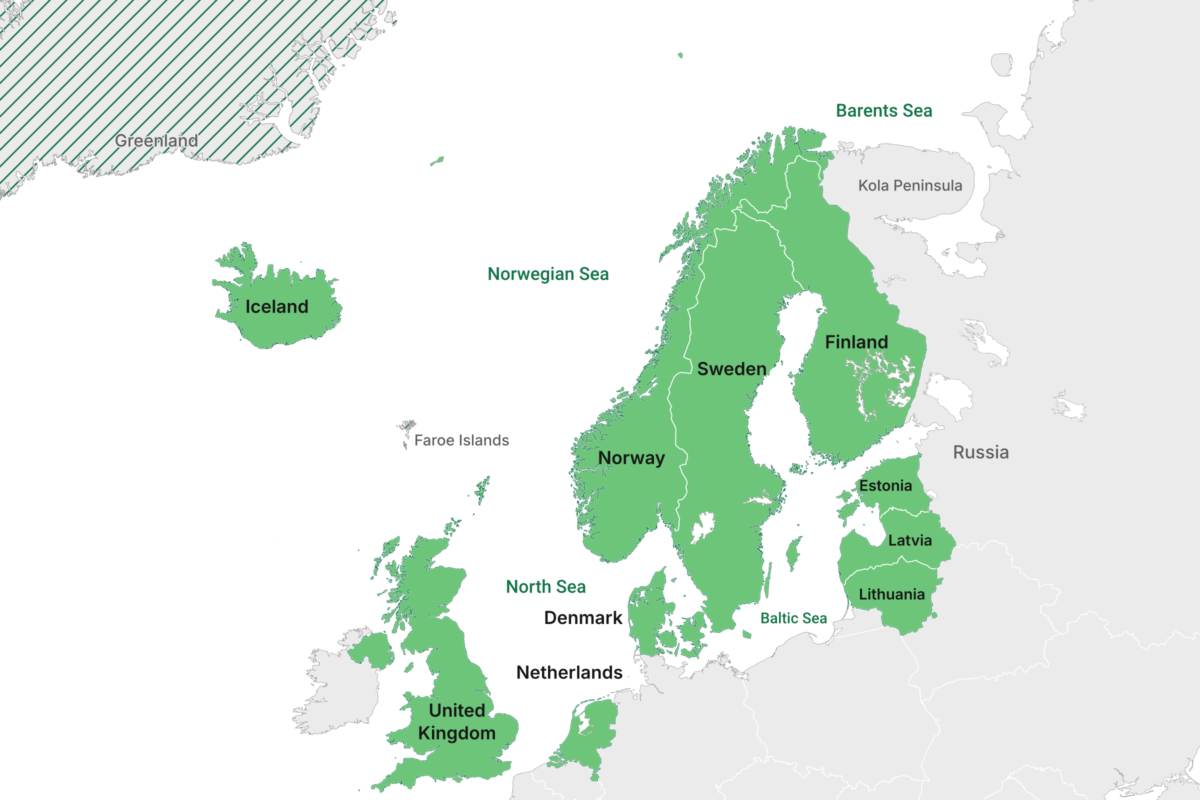
The ten JEF participating nations. Greenland and the Faroe Islands are autonomous territories within the Kingdom of Denmark and are not separate JEF participants. Map: BISC.
Understanding these connections is essential because deterrence depends not only on defending territory, but also on preserving access, mobility, resilience and decision advantage across the wider operating environment. A disruption to undersea infrastructure in the Baltic Sea may require maritime assets and intelligence capabilities from the North Atlantic, while Russian activity in the High North may affect reinforcement timelines for the Baltic states and air or maritime operations in the Norwegian Sea may directly influence NATO’s ability to maintain secure sea lines of communication between North America and Europe.
For policymakers, commanders and capability planners, the central challenge is no longer how to defend separate theatres independently. The operational problem has become one of preserving freedom of action across a connected regional system in which disruption in one area can rapidly affect outcomes elsewhere, making access, resilience and coordination across the wider network as important as military capability within individual regions.
2.1 The North Atlantic
The North Atlantic remains NATO’s strategic bridge between North America and Europe. Despite significant increases in European defence spending and renewed efforts to strengthen European military capabilities, the Alliance continues to rely heavily on North American reinforcement in the event of a major crisis or conflict.
Personnel, equipment, munitions and sustainment resources must cross the Atlantic quickly and securely to support operations in Europe. This requirement makes the North Atlantic more than a transit corridor, because it is the operational environment that underpins NATO’s ability to generate combat power, reinforce exposed allies and sustain military operations over time.
Key functions include:
- Strategic sealift for heavy equipment, ammunition and sustainment. Heavy armour, engineering equipment, ammunition stockpiles and sustainment resources cannot be moved at scale by air. Strategic sealift remains essential for transporting the capabilities required to sustain high-intensity operations, and any disruption to maritime access, port infrastructure or shipping capacity would directly affect NATO’s ability to reinforce Northern Europe.
- Air mobility for personnel, high-value assets and time-sensitive cargo. Strategic airlift enables the rapid deployment of personnel, command elements, intelligence capabilities, medical support and critical supplies. It cannot replace maritime transport, but it provides speed during the initial stages of a crisis and supports operational flexibility when timelines are compressed.
- Protection of sea lines of communication. Reinforcement depends on secure maritime routes linking North America and Europe. These routes face pressure from submarine activity, long-range strike systems, cyber operations and threats to critical underwater infrastructure, which means their protection remains a prerequisite for credible deterrence.
- Coordination of multinational reinforcement flows. Reinforcement is not solely a transportation challenge, because it requires political decision-making, host nation support, customs arrangements, infrastructure readiness and interoperability across multiple national systems. Delays caused by administrative friction can undermine military readiness as effectively as physical disruption.
- Sustainment of long-duration operations. Deterrence depends not only on the ability to deploy forces quickly, but also on the capacity to sustain them. Fuel supplies, maintenance capacity, spare parts, industrial production and logistics resilience determine whether forces can remain effective after the initial deployment phase.
The importance of these functions has increased since Russia’s full-scale invasion of Ukraine. NATO’s regional defence plans place renewed emphasis on readiness, pre-positioning and rapid reinforcement, all of which depend on secure transatlantic access and the ability to move forces across the Atlantic under contested conditions.
The establishment of NATO’s Joint Force Command Norfolk reflects this changing reality. Its mission includes protecting Atlantic sea lines of communication and ensuring the rapid movement of forces between North America and Europe, which acknowledges that reinforcement can no longer be treated as an assumed condition of collective defence but must instead be understood as an operational challenge requiring continuous planning, regular exercising and close coordination between military, civilian and commercial stakeholders.
2.2 The GIUK Gap
The Greenland-Iceland-United Kingdom Gap remains one of the most strategically significant maritime corridors in the world. Stretching between Greenland, Iceland and the United Kingdom, it connects the North Atlantic with the Norwegian Sea and provides access routes into the Arctic and Baltic regions.
Control of this corridor influences NATO’s ability to reinforce Europe, monitor Russian naval activity and maintain freedom of manoeuvre across Northern Europe. During the Cold War, the GIUK Gap served as a critical barrier for monitoring Soviet submarine operations originating from the Kola Peninsula, and while the strategic environment has evolved, the underlying geography has not changed.
The renewed importance of the GIUK Gap reflects a broader shift in European defence planning. As NATO has returned its focus to collective defence and large-scale reinforcement, the ability to secure transatlantic access has regained the prominence it held during the Cold War, with the corridor functioning as a gateway linking North American reinforcement with operations across the North Atlantic, High North and Baltic regions.
Russia’s Northern Fleet remains concentrated on the Kola Peninsula and includes ballistic missile submarines, attack submarines, long-range aviation and supporting maritime capabilities. Russian submarines operating beyond the GIUK Gap can threaten reinforcement routes, undersea infrastructure and NATO freedom of action across the North Atlantic.
Controlling access through the GIUK Gap supports several operational objectives:
- Monitoring Russian submarine movements. Early detection and tracking of submarine activity improves situational awareness and enables timely decision-making. This is particularly important because delayed detection can reduce warning time and complicate escalation management.
- Protecting transatlantic reinforcement routes. Secure access across the North Atlantic is essential for moving personnel, equipment and sustainment resources into Europe. If reinforcement routes are threatened, the credibility of NATO’s regional defence plans is weakened before forces even arrive.
- Supporting anti-submarine warfare operations. Effective anti-submarine warfare requires coordination between maritime patrol aircraft, naval forces, undersea sensors and intelligence capabilities. No single platform or nation can maintain persistent awareness alone, which makes integration across allies essential.
- Maintaining maritime domain awareness. Understanding activity above and below the surface is increasingly important as military and civilian infrastructure become more interconnected. Maritime awareness must therefore include commercial traffic, underwater activity, seabed infrastructure and military movement within the same operating picture.
- Preserving access to the Norwegian Sea and High North. Control of the GIUK Gap influences NATO’s ability to operate effectively across the wider Baltic-Arctic system. Access through this corridor affects reinforcement, surveillance, deterrence and the ability to respond to Russian activity in the High North.
Advances in undersea technologies, autonomous systems, long-range precision weapons and seabed warfare capabilities have increased the complexity of this environment. The protection of undersea cables, energy infrastructure and communications networks now sits alongside more traditional anti-submarine warfare tasks, creating a wider operational problem that crosses military, civilian and commercial responsibilities.
The GIUK Gap should therefore be understood not as a static defensive line, but as a dynamic operating environment in which maritime, air, cyber, intelligence and space-enabled capabilities must operate together. Preserving access through the corridor requires persistent situational awareness, resilient communications and effective coordination across multiple domains because disruption to reinforcement routes would have consequences far beyond the North Atlantic itself.
2.3 The High North and Arctic
The High North has moved from the strategic periphery to the centre of Northern European security planning. Climate change, technological developments and renewed great-power competition have increased international attention on the Arctic, but geography remains the principal driver of military relevance.
The region connects the North Atlantic to the Arctic Ocean, provides access to critical sea routes and hosts some of Russia’s most important military capabilities. The Russian Northern Fleet, strategic nuclear forces and long-range strike systems are concentrated on the Kola Peninsula, giving the region direct relevance for deterrence, escalation management and NATO’s ability to operate in the Norwegian Sea and North Atlantic.
Activity in the High North affects far more than Arctic security alone. Decisions and developments in this region influence reinforcement planning, maritime access, intelligence collection and deterrence across Northern Europe because the High North forms a critical link between the North Atlantic and Baltic theatres.
Norway occupies a uniquely important position within this environment. As NATO’s northern flank state, Norway provides essential capabilities for intelligence collection, maritime surveillance, anti-submarine warfare and Arctic operations, while its ports, airfields and infrastructure support allied presence and reinforcement activities throughout the region.
Norway’s role illustrates a broader reality within the Baltic-Arctic system. Infrastructure that appears national during peacetime often becomes multinational during crisis because allied reinforcement depends on shared access to ports, logistics hubs, airfields and transportation networks, all of which require coordination across military, civilian and commercial stakeholders long before a crisis emerges.
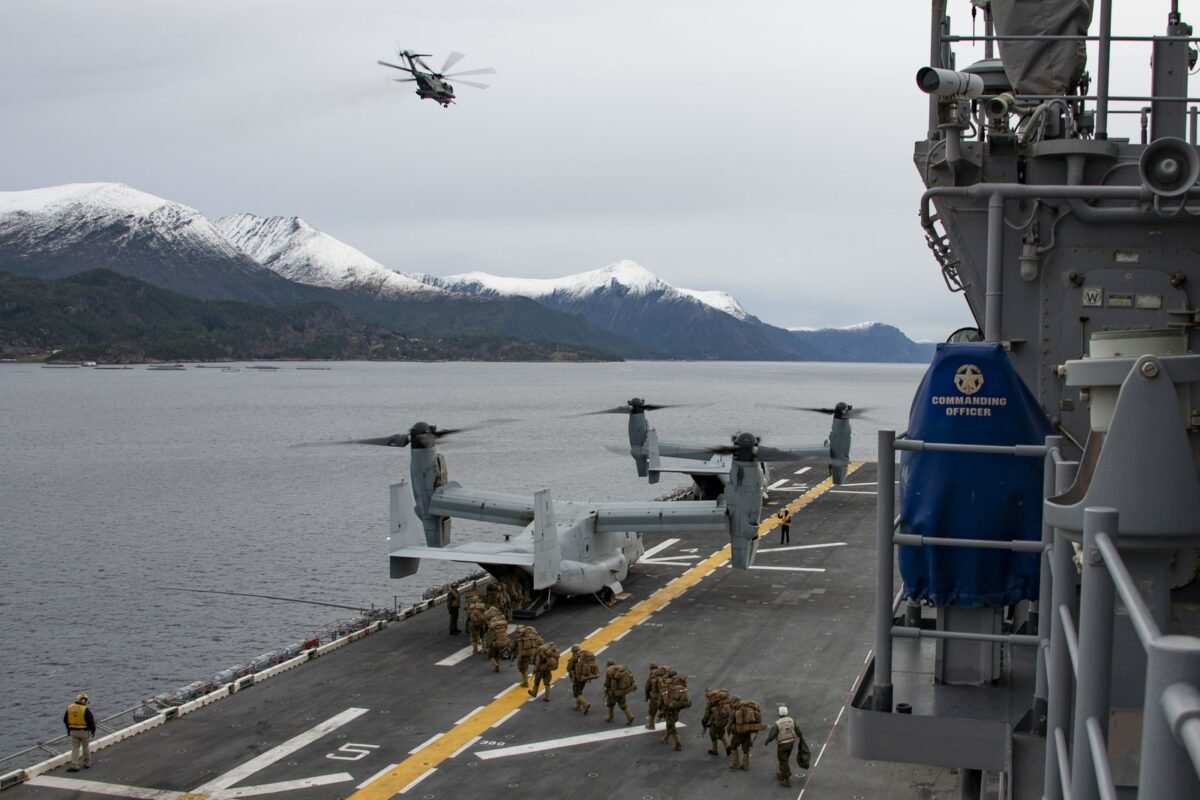
U.S. Marines board an MV-22B Osprey on the amphibious assault ship USS Iwo Jima in Alvund Fjord during Trident Juncture 2018, October 31, 2018. Photo: Chief Mass Communication Specialist David Holmes, U.S. Navy. Alvund Fjord, October 31, 2018. Public domain, via Wikimedia Commons.
Svalbard further illustrates the complexity of the High North operating environment. Governed under the 1920 Svalbard Treaty, the archipelago occupies a strategically sensitive location between mainland Norway and the Arctic Ocean, and while the treaty recognises Norwegian sovereignty, differing interpretations regarding military activity, economic access and resource rights create legal and political sensitivities that can complicate strategic signalling and crisis management.
Key characteristics of the High North include:
- Proximity to Russian strategic assets. The concentration of Russian nuclear and conventional capabilities on the Kola Peninsula creates unique deterrence and escalation challenges. Political and military leaders must consider how activity in the region may be perceived by Russia and by allies during periods of heightened tension.
- Harsh environmental conditions. Extreme weather, limited visibility and difficult operating conditions place significant demands on personnel, equipment and sustainment. Capability that performs well elsewhere may fail or degrade in the Arctic environment unless it is tested, maintained and exercised under realistic conditions.
- Long distances and limited infrastructure. The vast geography of the region creates challenges for logistics, mobility and command and control. Reinforcement and sustainment require careful planning because distance, weather and infrastructure scarcity can slow operational tempo.
- Dependence on space-based capabilities. Communications, navigation, intelligence and weather forecasting rely heavily on space-enabled services. This creates operational advantages, but also increases vulnerability if satellite services are degraded, disrupted or denied.
- Increasing military and commercial activity. Growing activity creates economic opportunities but also increases the potential for misunderstanding, competition and escalation. Military planners must account for civilian presence, commercial interests and environmental risks in the same operating environment.
- Complex legal and governance frameworks. Sovereignty issues, treaty obligations and overlapping interests require careful management. Legal ambiguity can become operationally relevant when adversaries exploit grey zones, contested interpretations or slow political decision-making.
The High North cannot be viewed separately from the North Atlantic or Baltic regions because activity there directly influences maritime access, intelligence collection, reinforcement planning and deterrence across the wider Baltic-Arctic system. The challenge for political and military leaders is therefore not only to understand the unique characteristics of the Arctic environment, but also to recognise how developments in the region shape operational outcomes elsewhere.
2.4 The Baltic Sea
The Baltic Sea is one of the world’s most strategically significant constrained maritime environments. Its narrow waterways, dense civilian traffic, proximity to multiple national borders and concentration of critical infrastructure create unique operational challenges that distinguish it sharply from the open waters of the North Atlantic.
Unlike the North Atlantic, the Baltic Sea offers limited manoeuvre space, short warning times and high exposure to long-range precision strike capabilities. The density of commercial shipping, fishing activity, ports, pipelines, cables, offshore energy infrastructure and military movement means that operational clarity can be difficult to achieve even before deliberate disruption or hostile activity is introduced.
The accession of Finland and Sweden to NATO has significantly changed the regional military balance. All Baltic Sea littoral states, with the exception of Russia, are now members of the Alliance, creating new opportunities for integrated planning, intelligence sharing and coordinated operations across the region.
Although Finland’s and Sweden’s accession has transformed the strategic balance in Northern Europe, geography continues to impose significant constraints on military operations. The Baltic Sea remains a confined operating environment characterised by limited manoeuvre space, short warning times and dependence on a small number of critical access routes.
Access to the Baltic Sea depends on the Danish Straits, creating a critical dependency between Baltic security and the wider Nordic region. Reinforcement of the Baltic states requires secure access through maritime and air corridors that extend well beyond the Baltic Sea itself, meaning that Baltic defence cannot be separated from North Atlantic, Nordic and Danish security considerations.
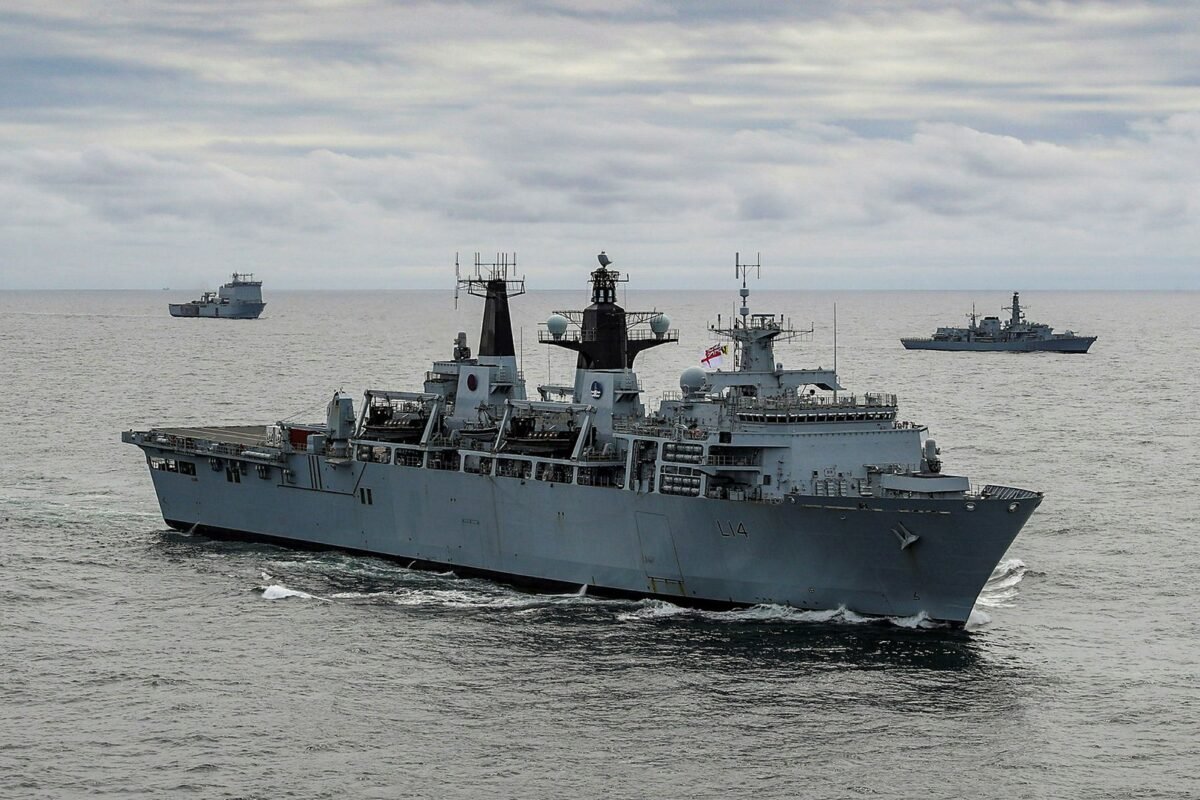
HMS Albion exercises with other ships of the Joint Expeditionary Force (Maritime) task group off the coast of Denmark during Baltic Protector, May 26, 2019. Image by LPhot Paul Hall; © Crown copyright 2024. Open Government Licence.
The region also contains a high concentration of critical infrastructure, including:
- Undersea energy pipelines. Energy networks influence both economic resilience and military readiness. Damage or disruption can create political pressure, reduce operational flexibility and expose the difficulty of protecting infrastructure that crosses national jurisdictions.
- Electricity interconnectors. Regional energy integration creates efficiencies but also introduces shared vulnerabilities. When interconnectors are damaged or threatened, the consequences may affect several states simultaneously and require coordinated political, technical and security responses.
- Telecommunications cables. Digital connectivity supports civilian activity, government functions and military operations at the same time. Disruption can affect communications, financial systems, logistics coordination and command functions, especially where redundancy is limited.
- Ports and logistics hubs. Civilian infrastructure often serves as critical reinforcement nodes during crisis or conflict. Leaders must therefore treat port resilience, access control, labour availability, cyber protection and physical security as defence issues rather than purely commercial concerns.
- Offshore energy infrastructure. Wind farms and offshore installations create both opportunities and new protection requirements. They can support energy resilience, but they also expand the number of assets that must be monitored, protected and integrated into maritime awareness.
- Digital and satellite-dependent services. Navigation, communications and logistics increasingly depend on interconnected digital systems. If these services are degraded through cyber activity, electronic warfare or space-domain disruption, the ability to move, coordinate and sustain forces may be affected even without direct military attack.
Recent incidents involving undersea infrastructure have highlighted the vulnerability of these networks and demonstrated that critical dependencies extend far beyond traditional military assets. Protecting infrastructure owned and operated primarily by civilian actors requires improved maritime domain awareness, closer civil-military cooperation and more effective information sharing between governments, industry and alliance structures.
The Baltic Sea should therefore be understood not only as a maritime theatre, but as a complex operating environment in which military activity, commercial shipping, critical infrastructure and hybrid threats intersect. Operational effectiveness increasingly depends on assets and systems that defence organisations do not own and often do not control directly, creating new governance challenges that require closer coordination across national authorities, alliance structures and private-sector operators.
Its defence depends on secure access through the Danish Straits, effective coordination across the Nordic region and the ability to reinforce quickly from the North Atlantic. These requirements show why the Baltic Sea cannot be analysed as a closed regional problem, because its security depends on wider maritime access, air mobility, infrastructure resilience and political-military coordination across Northern Europe.
The Baltic-Arctic system is ultimately held together by these connections. Reinforcement routes, infrastructure networks and shared exposure to military and hybrid threats mean that the North Atlantic, GIUK Gap, High North and Baltic Sea can no longer be treated as separate strategic problems.
Together, these regions form a single operating environment in which resilience, deterrence and freedom of action depend on understanding how geography, infrastructure and military mobility interact across the wider region. Reinforcement routes, logistics networks and critical infrastructure create operational dependencies that cross national borders and traditional theatre boundaries, meaning that disruption in one area can rapidly constrain options elsewhere.
3. NATO Enlargement Changed the Map
Finland’s and Sweden’s accession to NATO did not merely add two capable states to the Alliance. It changed the strategic geometry of Northern Europe by altering how the Baltic Sea, the High North, the Nordic region and the North Atlantic relate to one another in operational planning.
Before Finnish and Swedish membership, NATO’s northern posture was shaped by a significant geographic discontinuity. Norway, Denmark, Iceland, the Baltic states and Poland were NATO allies, while Finland and Sweden remained militarily non-aligned, even though both had deepened cooperation with NATO and regional partners over many years. Their accession removed a major planning gap and created new possibilities for integrated deterrence, reinforcement, air defence, maritime security, host nation support and regional resilience.
This change should not be reduced to map colouring. Finland and Sweden brought geography, capabilities, military cultures, infrastructure and strategic depth that alter how NATO and regional frameworks such as JEF can think about Northern European defence. Their accession strengthened the coherence of the Baltic-Arctic system, but it also created new responsibilities because integration requires planning, command relationships, interoperability, readiness and political decision-making to mature together.
The Baltic Sea after Finland and Sweden joined Nato
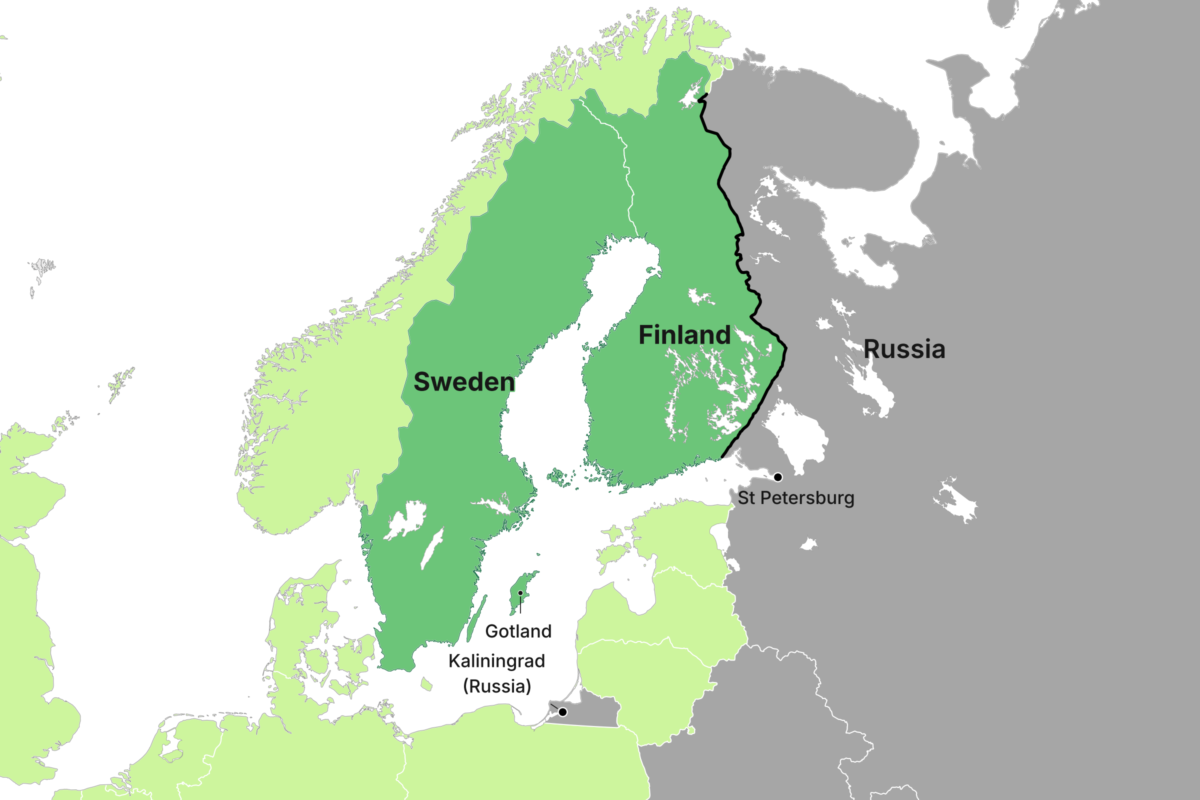
Russia is now the only country on the Baltic Sea outside Nato. Map: BISC.
3.1 Finland’s Strategic Depth
Finland’s accession to NATO transformed the Alliance’s northern land geography. With a border of more than 1,300 kilometres with Russia, Finland brings direct strategic exposure, territorial depth and a defence culture shaped by geography, national resilience and the long-standing requirement to prepare for high-intensity conflict close to home.
Key elements include:
- Border with Russia. Finland’s long eastern border changes the scale and geometry of NATO’s direct land exposure to Russia. This creates both opportunities and responsibilities, because Finnish territory increases allied depth in the north while also requiring careful planning for surveillance, mobility, reinforcement and escalation management across a large and demanding frontier.
- Land forces. Finland brings substantial land forces, a strong reserve model and experience in territorial defence under difficult geographic and climatic conditions. These capabilities strengthen NATO’s northern posture, but their value depends on how effectively they are integrated into wider allied planning, including logistics, command arrangements, air defence, sustainment and coordination with neighbouring states.
- Resilience. Finland’s comprehensive security model links national defence, civil preparedness, infrastructure resilience and societal continuity. This is operationally important because deterrence in Northern Europe depends not only on military units, but also on the ability of societies to function under pressure, protect critical services and support allied operations during crisis or conflict.
- Territorial defence model. Finland’s defence model is rooted in the assumption that geography, reserves, dispersed operations and national preparedness matter. This approach offers lessons for the wider region because it treats defence as a whole-of-society requirement rather than a narrow military function, while also reminding leaders that readiness must be built before crisis rather than improvised once pressure begins.
Finland’s strategic significance is therefore not only that it adds territory or forces to NATO. Its accession strengthens the northern defence architecture by connecting national resilience, land power, Arctic-adjacent geography and regional reinforcement planning in ways that directly affect the Baltic-Arctic system.
3.2 Sweden’s Strategic Position
Sweden’s accession changed the strategic balance around the Baltic Sea and strengthened NATO’s ability to think across the Nordic-Baltic region as a connected operating environment. Sweden’s geography, air and maritime capabilities, defence industry and control of key infrastructure make it central to regional deterrence.
Key elements include:
- Gotland. Gotland occupies a strategically important position in the Baltic Sea because it influences maritime access, air operations, surveillance and the defence of sea lines of communication. Control, protection and reinforcement of Gotland affect the wider balance in the Baltic Sea, especially because the island sits close to routes and operating areas that would be critical during a regional crisis.
- Air and maritime capabilities. Sweden brings advanced air and maritime capabilities that strengthen regional surveillance, air defence, anti-submarine warfare and naval coordination. These capabilities are particularly important in a constrained maritime environment where warning times are short, commercial traffic is dense and military activity must be coordinated across several national areas of responsibility.
- Defence industrial base. Sweden’s defence industrial base adds significant value to NATO and regional cooperation because it includes advanced capabilities in areas such as combat aircraft, submarines, sensors, ground systems and electronic warfare. Industrial strength matters operationally when it supports sustainment, adaptation and long-term capability development rather than remaining disconnected from regional defence planning.
Sweden’s accession also changes the practical logic of reinforcement. The Baltic states are no longer separated from the wider Nordic defence space in the same way, and NATO can plan with greater coherence across Norway, Sweden, Finland, Denmark, Poland and the Baltic states. This does not remove the operational challenges of the Baltic Sea, but it gives allied planners more depth, more options and more opportunities to connect air, maritime, land and logistics planning across the region.
3.3 The Baltic Sea Becomes a NATO-Centric Space
With Finland and Sweden inside NATO, the Baltic Sea has become a predominantly NATO-centred operating space, with Russia remaining present through Kaliningrad and the eastern Gulf of Finland. This changes the regional balance, but it does not make the Baltic Sea simple, secure or uncontested.
Key elements include:
- Increased operational coherence. NATO can now plan across the Baltic Sea with all littoral states except Russia inside the Alliance. This improves the potential for shared situational awareness, coordinated air and maritime operations, common planning assumptions and stronger links between Nordic and Baltic defence.
- New planning opportunities. Finnish and Swedish membership creates opportunities to integrate air defence, maritime surveillance, logistics, host nation support and reinforcement routes across the wider region. These opportunities require active planning because geographic advantage does not automatically become operational effect without command arrangements, interoperability, exercises and political decision-making.
- Remaining vulnerabilities. The Baltic Sea remains a constrained maritime environment exposed to long-range fires, hybrid activity, cyber operations, electronic warfare, mine warfare, submarine activity and attacks or sabotage against critical infrastructure. NATO’s improved geography therefore reduces some vulnerabilities while exposing the need to strengthen resilience, redundancy and coordination across military and civilian systems.
The Baltic Sea becoming NATO-centric does not mean it has become a NATO lake in any meaningful operational sense. Such language can be politically tempting but analytically misleading, because Russia retains military capabilities in Kaliningrad and around St Petersburg, while the region’s infrastructure density and geographic constraints create vulnerabilities that require sustained attention. The more serious conclusion is that NATO now has stronger conditions for integrated regional defence, but must still convert those conditions into readiness, resilience and credible response options.
3.4 New Responsibilities
Finland’s and Sweden’s accession strengthened NATO’s northern posture, but enlargement also created new responsibilities for the Alliance and for the states themselves. Membership changes political guarantees, but it also requires practical integration into NATO plans, command structures, exercises, capability development and regional defence arrangements.
Key elements include:
- Burden sharing. Finland and Sweden bring serious capabilities, but they also increase expectations for regional defence contributions and allied coordination. Burden sharing in Northern Europe should therefore be understood not only through defence spending percentages, but through readiness, mobility, infrastructure access, industrial capacity, stockpiles, sustainment and the ability to contribute to collective defence under pressure.
- Integration challenges. Integrating new allies into NATO planning requires more than political accession. It involves command relationships, classification rules, information sharing, communications systems, host nation support, logistics planning, operational procedures and regular exercising across national and alliance structures.
- Readiness requirements. The value of Finland’s and Sweden’s accession depends on the ability to generate usable forces and capabilities at the speed required by crisis conditions. Readiness is therefore not only a national military issue, but a regional requirement involving mobilisation, transport, sustainment, infrastructure protection and coordination with allies.
These responsibilities also apply to regional frameworks such as JEF. Finnish and Swedish membership in NATO does not reduce the relevance of JEF, because the framework can still support practical cooperation, early consultation and regional habits of coordination across the same geography. The difference is that JEF now operates in an environment where all of its members are also NATO allies, which increases the importance of complementarity, clarity and alignment with alliance planning.
The enlargement of NATO in the north therefore changed both the opportunity and the burden. It improved the strategic geometry of Northern European defence, connected the Nordic and Baltic spaces more coherently and strengthened the Alliance’s ability to plan across the Baltic-Arctic system. At the same time, it raised the standard for practical integration, because geography alone does not create deterrence unless it is supported by readiness, interoperability, infrastructure resilience and credible political-military decision-making.
4. Reinforcement Is the Central Strategic Problem
Reinforcement is the central strategic problem in the Baltic-Arctic system because deterrence depends on the credible ability to move forces, equipment, munitions and sustainment across a contested regional environment. Defence plans only become operationally meaningful when forces can reach the right place, at the right time, with the right support and under conditions shaped by adversary pressure.
The renewed emphasis on reinforcement is reflected in NATO’s post-2022 adaptation. At the 2023 Vilnius Summit, Allies approved a new generation of regional defence plans intended to improve readiness, enable high-intensity and multi-domain collective defence, and ensure the timely reinforcement of Allies. That commitment is directly relevant to Northern Europe because the Baltic-Arctic system contains the maritime routes, ports, airfields, railways, logistics hubs and infrastructure dependencies that determine whether reinforcement can be executed under pressure.
The Baltic-Arctic system exists as a practical security problem because reinforcement routes connect every part of Northern Europe. Forces moving into the Baltic region may depend on North Atlantic access, Norwegian and Danish infrastructure, Swedish and Finnish territory, Baltic ports and airfields, and civil transport networks that were not originally designed for sustained high-intensity military operations. If any part of that chain is delayed, degraded or disrupted, the credibility of deterrence is affected because political commitment must be matched by operational reach.
Reinforcement should therefore be understood as more than a logistics function. It is a political-military test of readiness, infrastructure resilience, civil-military coordination and decision-making speed. For commanders, policymakers, capability planners and procurement leaders, the question is not only whether forces exist on paper, but whether they can be moved, protected, sustained and integrated into a joint fight when time is limited and the operating environment is contested.
4.1 Moving Forces Across the Region
Moving forces across Northern Europe requires a combination of military planning, civilian infrastructure, host nation support and political coordination. The challenge is not simply distance, but the number of systems that must work together before combat power can be generated in the right place.
Key elements include:
- Ports. Ports are essential reinforcement nodes because heavy equipment, ammunition, fuel, engineering assets and sustainment resources usually arrive by sea. Their operational value depends on access, capacity, cranes, storage areas, onward transport links, cyber resilience and physical protection. A port that is commercially efficient in peacetime may still become a bottleneck in crisis if it lacks military handling capacity, secure staging areas or redundancy against disruption.
- Rail. Rail networks are central to moving heavy equipment inland from ports and across national borders. Their military value depends on axle-load capacity, gauge compatibility, availability of rolling stock, border procedures, repair capacity and protection against sabotage or cyber disruption. Leadership attention is required because rail mobility is not controlled by defence ministries alone and often depends on civilian operators, commercial schedules and infrastructure investment decisions made years before a crisis.
- Airfields. Airfields enable rapid deployment of personnel, high-value assets, air defence components, command elements, medical support and time-sensitive cargo. Their effectiveness depends on runway capacity, fuel availability, dispersal options, ground handling, air defence protection and the ability to operate under electronic warfare, cyber pressure or long-range strike threat. Air mobility provides speed, but it cannot compensate for weak sustainment or insufficient protection of air bases.
- Host nation support. Host nation support turns geography into usable operational access by enabling allied forces to enter, move through, stage, sustain and operate from national territory. It includes legal permissions, reception arrangements, logistics support, medical support, force protection, transport coordination and liaison mechanisms. If host nation support is underdeveloped, reinforcement can be slowed by administrative friction even when forces and transport assets are available.
These elements show why military mobility must be treated as a strategic enabler rather than a technical logistics issue. Moving forces across the Baltic-Arctic system requires defence organisations, transport ministries, infrastructure owners, border authorities, police, private companies and local governments to understand their role in collective defence before crisis conditions emerge.
The leadership challenge is to make reinforcement executable rather than aspirational. Plans must be exercised against realistic constraints, including damaged infrastructure, cyber disruption, limited transport assets, competing civilian demand and contested air or maritime access. Without that level of testing, reinforcement risks remaining a political assumption rather than an operational capability.
4.2 Protecting Sea Lines of Communication
Sea lines of communication are essential to the Baltic-Arctic system because maritime access underpins reinforcement, sustainment, trade, energy security and allied freedom of movement. In Northern Europe, these sea lines run through the North Atlantic, the GIUK Gap, the Norwegian Sea, the Danish Straits and the Baltic Sea, linking the movement of military forces with the resilience of civilian economies.
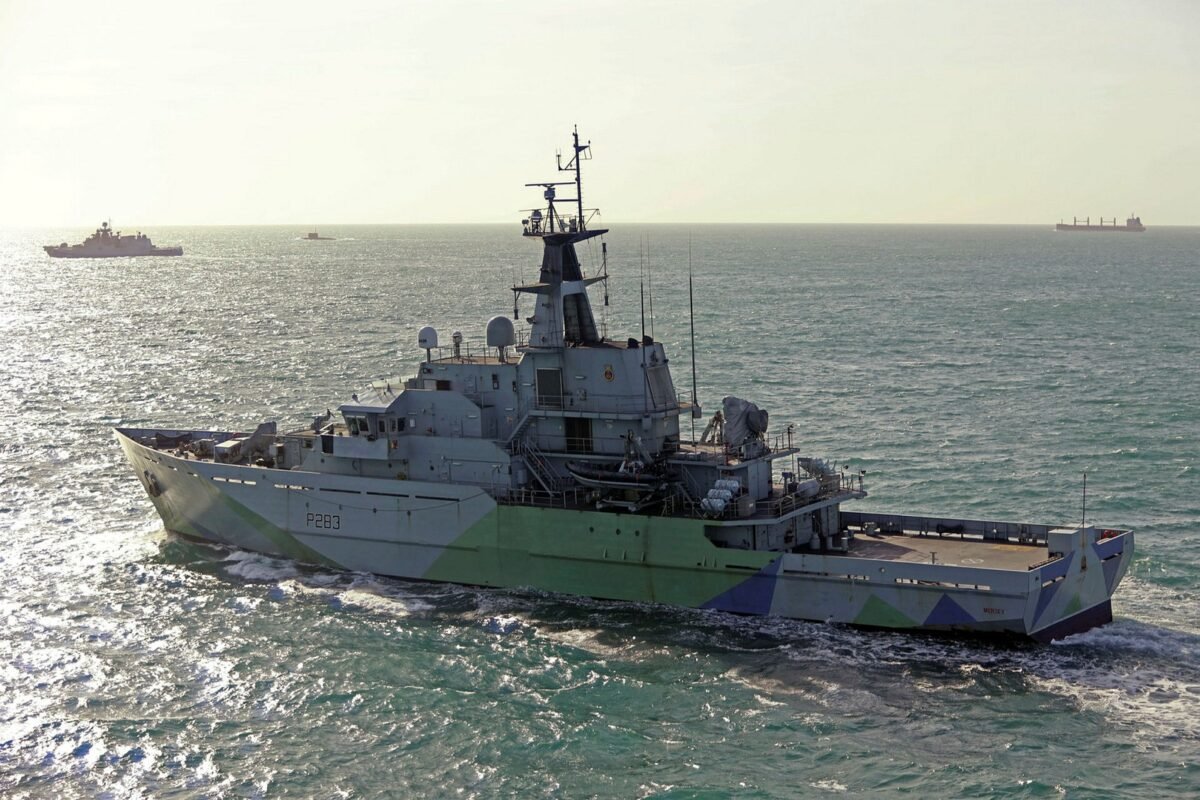
HMS Mersey monitors the Russian frigate Admiral Grigorovich and the submarine Krasnodar in the English Channel and the North Sea between March 29 and April 7, 2026. Image by Royal Navy; © Crown copyright 2026. Open Government Licence.
Protecting these routes requires more than naval presence. It requires maritime domain awareness, anti-submarine warfare, mine countermeasures, air and missile defence, intelligence sharing, cyber protection and coordination with civilian shipping and port authorities.
Key elements include:
- Maritime security. Maritime security protects the movement of forces, commercial shipping, energy supplies and critical infrastructure. Its operational value lies in preserving access and reducing uncertainty during crisis. The challenge is that civilian and military activity occur in the same maritime space, requiring coordination between navies, coast guards, intelligence services, port authorities and private operators.
- Submarine threats. Submarine activity poses a direct challenge to reinforcement routes, maritime infrastructure and allied freedom of manoeuvre. Russian submarine capabilities operating from the Northern Fleet can threaten the North Atlantic and Norwegian Sea, while undersea activity also complicates protection of cables and pipelines. Anti-submarine warfare requires persistent sensing, trained crews, maritime patrol aircraft, surface ships, submarines, undersea sensors and the ability to share information quickly across allies.
- Mine warfare. Mine warfare is particularly relevant in constrained maritime spaces such as the Baltic Sea and Danish Straits. Mines can delay movement, restrict access to ports, disrupt commercial traffic and impose disproportionate operational costs on defenders. Mine countermeasures require specialised vessels, trained crews, unmanned systems, hydrographic knowledge and sustained exercises, and their importance increases when reinforcement depends on predictable maritime routes.
- Air defence. Maritime movement in the Baltic-Arctic system cannot be protected by naval forces alone. Ships, ports, logistics hubs and staging areas may be exposed to aircraft, missiles, drones and long-range precision strike. Air defence must therefore be integrated with maritime planning, port protection and wider regional command arrangements because reinforcement flows can be disrupted before forces reach the battlefield.
The protection of sea lines of communication is therefore a joint and multi-domain task. It cannot be delegated solely to navies because maritime access depends on air cover, intelligence, cyber resilience, space-enabled services, infrastructure protection and political decision-making.
For leaders, the practical question is whether the region can maintain maritime movement under pressure. That requires testing the assumptions behind reinforcement plans, identifying chokepoints, strengthening mine countermeasure capacity, improving anti-submarine warfare readiness and ensuring that civil-military information sharing is fast enough to support operational decision-making.
4.3 Contested Logistics
Logistics in the Baltic-Arctic system must be planned as contested from the outset. Russia’s war against Ukraine has demonstrated that sustainment, ammunition supply, transport networks, repair capacity and command systems are not background functions, but central elements of military effectiveness under high-intensity conditions.
In Northern Europe, contested logistics would involve more than direct attacks on military units. Reinforcement could be slowed or disrupted through long-range strike, electronic warfare, cyber activity, sabotage, information operations, legal friction, commercial dependencies or pressure on civilian infrastructure.
Key elements include:
- Long-range strike. Long-range strike capabilities can threaten ports, airfields, logistics hubs, bridges, rail nodes, ammunition depots and command facilities. The operational risk is that reinforcement can be disrupted before forces reach the area where they are needed. This requires dispersal, redundancy, hardening, deception, air and missile defence, and realistic planning for damaged infrastructure.
- Electronic warfare. Electronic warfare can degrade communications, navigation, targeting, drone operations and situational awareness. In a region that depends heavily on maritime movement, air mobility, precision fires and coordination across dispersed forces, electronic disruption can slow decision-making and reduce operational effectiveness. Leaders must assume that satellite navigation, communications links and digital systems may be degraded rather than continuously available.
- Cyber disruption. Cyber activity can affect military systems, civilian transport networks, ports, rail operators, energy infrastructure, telecommunications and administrative processes. The challenge is that many critical systems supporting reinforcement are owned or operated outside defence organisations. Cyber resilience must therefore include civilian infrastructure, private-sector operators and cross-border coordination rather than focusing only on military networks.
Contested logistics changes the meaning of readiness. A unit may be trained and equipped, but still operationally constrained if ammunition cannot move, fuel cannot be delivered, ports are unavailable, communications are degraded or civilian systems fail under pressure.
This is where leadership determines whether capability creates operational effect. Technology, platforms and procurement programmes matter, but they do not produce deterrence unless supported by resilient logistics, realistic exercises, clear authorities, repair capacity, redundancy and the ability to operate when systems are degraded.
4.4 Time as a Strategic Variable
Time is a strategic variable in the Baltic-Arctic system because warning, decision-making, mobilisation, movement and response are compressed by geography and adversary methods. A crisis in the region may not unfold through clear stages, and hostile activity may begin below the threshold of armed conflict through infrastructure disruption, cyber operations, military signalling or ambiguous maritime incidents.
The operational challenge is that reinforcement depends on decisions being made early enough to matter. If political consultation, legal approval, movement orders, infrastructure preparation and force generation are delayed, the physical movement of forces may begin too late to shape deterrence.
Key elements include:
- Decision-making speed. Decision-making speed determines whether political intent can be translated into operational action before an adversary creates facts on the ground, at sea or in the information environment. Fast decisions do not require reckless decisions, but they do require pre-agreed procedures, rehearsed authorities, clear escalation pathways and trusted information flows.
- Warning time. Warning time may be short, ambiguous or deliberately manipulated. Hybrid activity, cyber disruption, military exercises, maritime incidents and information operations can blur the distinction between routine pressure and crisis preparation. Leaders must therefore plan for uncertain warning rather than waiting for perfectly clear indicators.
- Political consultation. Political consultation is essential in democratic alliances and regional frameworks, but it must be able to function under compressed timelines. Consultation mechanisms must support rapid alignment, information sharing and early signalling without waiting for every situation to become an obvious collective defence crisis.
Time links every part of the reinforcement problem. Forces must be generated, moved, protected and sustained faster than an adversary can exploit delay, confusion or fragmented authority.
For JEF and NATO, this creates a direct connection between regional frameworks and operational deterrence. JEF cannot replace NATO’s collective defence machinery, but it can support early consultation, regional familiarity and practical coordination in the period when warning signs are emerging and decisions still shape outcomes.
Reinforcement is therefore not a secondary technical matter within the Baltic-Arctic system. It is the operational expression of deterrence, because political commitments only become credible when allies can move, protect and sustain forces across the geography they have pledged to defend.
5. Critical Infrastructure as Strategic Terrain
Critical infrastructure has become strategic terrain in the Baltic-Arctic system because military operations now depend on networks that were largely designed, owned and operated for civilian purposes. Undersea cables, energy networks, ports, airports, rail systems, digital infrastructure and space-enabled services are no longer background conditions for defence planning. They are operational dependencies that determine whether forces can move, communicate, sustain themselves and maintain decision advantage under pressure.
Russia’s war against Ukraine and repeated incidents affecting undersea infrastructure in the Baltic Sea have reinforced the need to think differently about infrastructure protection. NATO created a Critical Undersea Infrastructure Coordination Cell in 2023, JEF has conducted activities such as Nordic Warden to monitor shipping activity near undersea energy and communications links, and NATO launched Baltic Sentry in 2025 to strengthen critical infrastructure security in the Baltic Sea. These developments show that the protection of infrastructure is no longer only a national resilience issue, because disruption can affect regional deterrence, allied reinforcement and political decision-making across the wider system.

A Finnish Navy sailor observes a U.S. Marine Corps RQ-20 Puma unmanned aircraft during Operation Baltic Sentry in southern Finland, March 2, 2025. Photo: Lance Cpl. Brian Bolin Jr., U.S. Marine Corps. Southern Finland, March 2, 2025. Public domain, via Wikimedia Commons.
The central challenge is that much of the infrastructure on which defence depends is not owned by defence organisations. It is operated by commercial companies, regulated by civilian authorities, insured through private markets, maintained by specialist contractors and often spread across several jurisdictions. Defence leaders therefore need to understand infrastructure not only as a protection problem, but as a governance, information-sharing and operational planning problem that crosses military, civilian and private-sector boundaries.
5.1 Critical Underwater Infrastructure
Critical underwater infrastructure has become one of the most exposed parts of the Baltic-Arctic system. Pipelines, telecommunications cables and electricity interconnectors cross maritime spaces where attribution can be difficult, monitoring is incomplete and damage can be caused by sabotage, accident, negligence or deliberately ambiguous activity.
Key elements include:
- Pipelines. Undersea pipelines support energy security, economic continuity and political stability. Damage to a pipeline can create immediate operational consequences by affecting energy supply, emergency response, maritime safety and public confidence. The difficulty for leaders is that pipelines are often commercially operated, cross national jurisdictions and require specialised repair capabilities, meaning that resilience depends on pre-agreed coordination between governments, operators, navies, coast guards and regulators.
- Data cables. Subsea telecommunications cables carry the digital traffic that supports finance, government services, military coordination, logistics, cloud services and daily civilian life. Their operational importance lies in the fact that modern command, control and economic activity depend on continuous connectivity, yet many routes remain physically vulnerable and difficult to monitor. Defence planning must therefore consider redundancy, rerouting capacity, repair timelines and the ability to operate when connectivity is degraded.
- Energy interconnectors. Electricity interconnectors improve regional energy efficiency and resilience by allowing states to share power across borders, but they also create shared vulnerabilities when damage affects more than one national system. In the Baltic Sea region, interconnectors are part of both energy security and strategic resilience because electricity supply supports civilian continuity, military infrastructure, ports, communications and transport networks. Leaders must treat their protection as a regional security task rather than a purely technical energy-sector responsibility.
Undersea cables and pipelines in the Baltic Sea
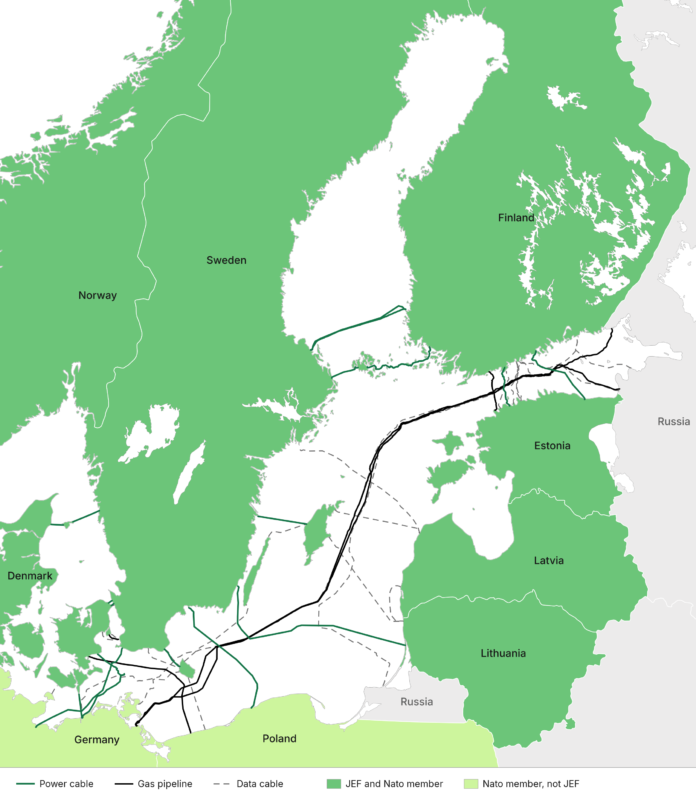
Map: BISC. Routes: OpenStreetMap contributors.
Critical underwater infrastructure is difficult to protect because it is dispersed, partly invisible, technically complex and often monitored through a mixture of military, commercial and civilian systems. The operational requirement is not to guard every metre of seabed, which is unrealistic, but to improve maritime domain awareness, identify suspicious patterns, strengthen deterrence, reduce repair timelines and build trusted information flows between states and operators.
For the Baltic-Arctic system, the leadership lesson is that infrastructure resilience must be planned before disruption occurs. Once a cable or pipeline is damaged, the response depends on prior mapping, legal authorities, repair contracts, spare capacity, surveillance data and political coordination that cannot be improvised at speed during crisis conditions.
5.2 Ports, Airports and Logistics Nodes
Ports, airports and logistics nodes are strategic assets because they determine whether reinforcement can move from political decision to operational effect. They are often treated as civilian infrastructure in peacetime, but in crisis they become part of the military mobility architecture that supports allied deterrence and defence.
Key elements include:
- Dual-use infrastructure. Dual-use infrastructure refers to civilian assets that can support military operations during crisis or conflict. Ports, airports, bridges, tunnels, roads, railways, warehouses and fuel facilities may all become relevant to reinforcement. Their operational value depends on whether they can handle military loads, support secure staging, provide fuel and maintenance, withstand disruption and remain usable when civilian demand is high.
- Military mobility. Military mobility is the ability to move forces, equipment and sustainment across borders and through civilian infrastructure quickly enough to meet operational timelines. In the Baltic-Arctic system, military mobility depends on port capacity, rail access, road networks, airfield availability, border procedures, host nation support and civil transport operators. If these elements are not planned and exercised together, reinforcement can be delayed by administrative, technical or infrastructure constraints before it encounters any direct military opposition.
Ports and airports create particular vulnerabilities because they concentrate activity, information and dependencies in identifiable locations. They can be affected by cyber disruption, labour shortages, physical sabotage, legal delays, fuel constraints, air defence gaps or damage to surrounding transport links. Leaders should therefore treat logistics nodes as defended systems rather than passive infrastructure, because their failure can slow reinforcement across the wider region.
The practical requirement is to connect infrastructure planning with operational planning. Defence ministries, transport ministries, port authorities, airport operators, rail companies, customs authorities, police and private contractors need clear roles before crisis conditions emerge. Exercises should test not only military movement, but also paperwork, access control, cyber resilience, emergency repair, traffic prioritisation and the ability to continue operating when civilian and military demands collide.
5.3 Digital Dependencies
Digital dependencies shape almost every aspect of military and civilian activity in the Baltic-Arctic system. Communications, navigation, intelligence, logistics, energy management, border control, port operations and financial services rely on digital systems that may be degraded by cyber activity, electronic warfare, physical disruption or failure of space-enabled services.
Key elements include:
- Satellite services. Satellite services support communications, intelligence, surveillance, reconnaissance, weather forecasting, navigation and timing. They are operationally important because Northern Europe includes large maritime spaces, sparse Arctic infrastructure and dispersed military activities that depend on beyond-line-of-sight connectivity. The constraint is that satellite services may be jammed, spoofed, degraded or targeted, requiring leaders to plan for redundancy and operations under degraded conditions.
- Navigation. Navigation systems are essential for maritime movement, air operations, logistics, precision fires, search and rescue, and the coordination of dispersed forces. Dependence on satellite navigation creates vulnerability when GNSS signals are jammed or spoofed, as has been repeatedly reported in the Baltic Sea region and near Russia’s borders. Defence and civilian operators must therefore maintain alternative navigation methods, training, procedures and technical resilience rather than assuming continuous access to accurate positioning data.
- Communications. Communications networks connect political decision-makers, military commanders, civilian authorities, infrastructure operators and allied partners. Their operational value lies in enabling shared situational awareness and coordinated response, but their weakness is that they depend on physical infrastructure, cyber security, spectrum access, classification rules and interoperability between systems. If communications degrade, decision-making slows and coordination becomes more difficult precisely when speed matters most.
Digital dependencies are not separate from physical infrastructure. A port can be physically intact but operationally constrained if its digital systems are compromised. A railway can exist but become difficult to use if scheduling, signalling or customs systems fail. A military unit can have modern platforms but lose effectiveness if communications, navigation or data access are degraded.
This is why digital resilience must be treated as an operational requirement rather than an information technology support function. Leaders must ask whether forces, civilian authorities and infrastructure operators can continue to function when digital systems are degraded, when information is incomplete and when adversaries deliberately target the seams between military and civilian networks.
5.4 Civil-Military Integration
Civil-military integration is essential because the defence of the Baltic-Arctic system depends on assets, authorities and expertise distributed across governments, armed forces, private companies, regulators and local authorities. Infrastructure protection cannot be solved by military means alone, because many critical systems are privately owned, commercially operated or governed through civilian legal frameworks.
Key elements include:
- Public-private cooperation. Public-private cooperation is necessary because infrastructure operators often hold the technical knowledge, access rights and operational data required to identify vulnerabilities and respond to incidents. Governments and militaries may understand the threat environment, but private operators understand the systems themselves. Effective cooperation requires trusted information-sharing mechanisms, clear legal frameworks and agreed procedures for crisis response.
- Resilience planning. Resilience planning means preparing systems to absorb disruption, maintain essential functions and recover quickly. In the Baltic-Arctic system, resilience planning must cover energy, transport, communications, ports, airports, digital services and space-enabled capabilities. The leadership challenge is to move beyond general resilience language and identify specific failure points, dependencies, repair timelines and decision authorities.
- Continuity of operations. Continuity of operations ensures that essential services, military functions and government decision-making can continue during disruption. It requires backup systems, alternative routes, redundant communications, trained personnel, spare parts, emergency contracts and exercised procedures. Without continuity planning, even limited disruption can produce wider operational consequences if critical functions depend on single points of failure.
Civil-military integration is difficult because the incentives, cultures and legal responsibilities of military and civilian actors differ. Companies may prioritise commercial continuity, governments may prioritise public reassurance, and military organisations may prioritise operational secrecy and speed. These differences can be managed only if relationships, authorities and information-sharing arrangements are established before crisis conditions begin.
The Baltic-Arctic system therefore requires leaders to expand the definition of defence. Defending territory remains essential, but deterrence also depends on protecting the systems that allow societies and armed forces to function. Infrastructure resilience, digital continuity and civil-military coordination are not secondary issues; they are conditions for credible reinforcement, sustained operations and political decision-making under pressure.
6. Why Regional Frameworks Matter
The Baltic-Arctic system requires both large alliances and focused regional frameworks. Large alliances provide scale, legitimacy, collective defence guarantees, force planning, command structures and political weight. Regional frameworks provide speed, familiarity, trust, shared geographic focus and practical coordination among states that face the same operating environment most directly.
This distinction is important because the problem is not whether NATO or regional frameworks matter more. The practical challenge is how to make them reinforce one another. NATO remains the foundation of collective defence for its members, but the Baltic-Arctic system contains security problems that often emerge quickly, ambiguously and across national boundaries. Critical infrastructure disruption, maritime incidents, cyber activity, hybrid pressure and military signalling may require early consultation and coordinated regional action before a situation becomes a clear alliance-wide crisis.
JEF matters in this context because it sits across the same geography this paper has examined. Its members are connected by the North Atlantic, the High North, the Nordic region, the Baltic Sea and the infrastructure and reinforcement routes that link them together. That does not make JEF a substitute for NATO, but it does make it a useful framework for building practical cooperation across the geography where deterrence, resilience and reinforcement increasingly depend on one another.
6.1 JEF as a Geographic Framework
JEF should be understood as a geographic framework before it is understood as an institutional one. Its value comes from the fact that its members share exposure to the same strategic environment, even though they experience that exposure differently.
Key elements include:
- Shared exposure. Shared exposure means that JEF members are affected by developments across the same interconnected security system. A crisis in the Baltic Sea may affect Nordic infrastructure, North Atlantic reinforcement and allied political signalling, while activity in the High North may influence maritime access, surveillance and deterrence across the wider region. This does not mean all members face identical risks, but it does mean their security problems increasingly overlap.
- Shared operating environment. A shared operating environment means that JEF members must operate across the same maritime, air, cyber, space and logistics dependencies. Their forces, infrastructure, communications and political decisions interact across the Baltic-Arctic system, making practical coordination more valuable than abstract alignment. Leaders should therefore treat JEF not simply as a political grouping, but as a mechanism for improving operational familiarity across a connected geography.
JEF’s geographic logic also explains why it has remained relevant after Finland and Sweden joined NATO. Their accession changed the Alliance’s northern map, but it did not remove the need for regional cooperation among states that must operate together across this environment. In fact, NATO enlargement increased the importance of frameworks that can help turn shared geography into shared planning habits, interoperability and early consultation.
6.2 Complementing NATO
JEF complements NATO when it strengthens regional preparedness, improves consultation among like-minded states and supports deterrence without creating parallel command arrangements or competing political structures. Its value lies in helping members act earlier, coordinate more naturally and prepare more practically within the wider NATO framework.
Key elements include:
- Faster consultation. Faster consultation is valuable because many security problems in the Baltic-Arctic system may begin below the threshold of open conflict. Infrastructure damage, suspicious maritime activity, cyber disruption or military signalling may require rapid political-military alignment before NATO’s full collective defence machinery is engaged. JEF can support this by providing a smaller, trusted forum for early discussion among states directly affected by the same regional problem.
- Regional focus. Regional focus allows JEF members to concentrate on the specific geography, infrastructure, military mobility requirements and threat patterns of Northern Europe. NATO must manage the full Alliance area, while JEF can focus on the High North, North Atlantic and Baltic Sea region where its members have immediate interests. This focus supports practical cooperation because exercises, planning assumptions and response options can be tied to real regional constraints.
- Political signalling. Political signalling matters because deterrence is shaped not only by forces, but also by the clarity and credibility of political intent. JEF activity can signal that regional states are consulting, coordinating and prepared to act together. That signal is most useful when it reinforces NATO’s posture and demonstrates allied cohesion without implying an alternative security guarantee.
Complementarity requires discipline. If JEF tries to become a separate alliance, it would weaken its own usefulness and risk creating confusion. If it becomes only a discussion forum, it would lose operational relevance. Its strongest role is as a practical regional layer that helps members prepare, coordinate and signal in ways that support NATO’s wider deterrence and defence posture.
6.3 Building Habits Before Crisis
Regional frameworks matter because effective cooperation cannot be improvised during crisis. Trust, information-sharing, interoperability, command familiarity and civil-military coordination must be built before pressure begins, because decision timelines in the Baltic-Arctic system may be compressed and the information environment may be deliberately ambiguous.
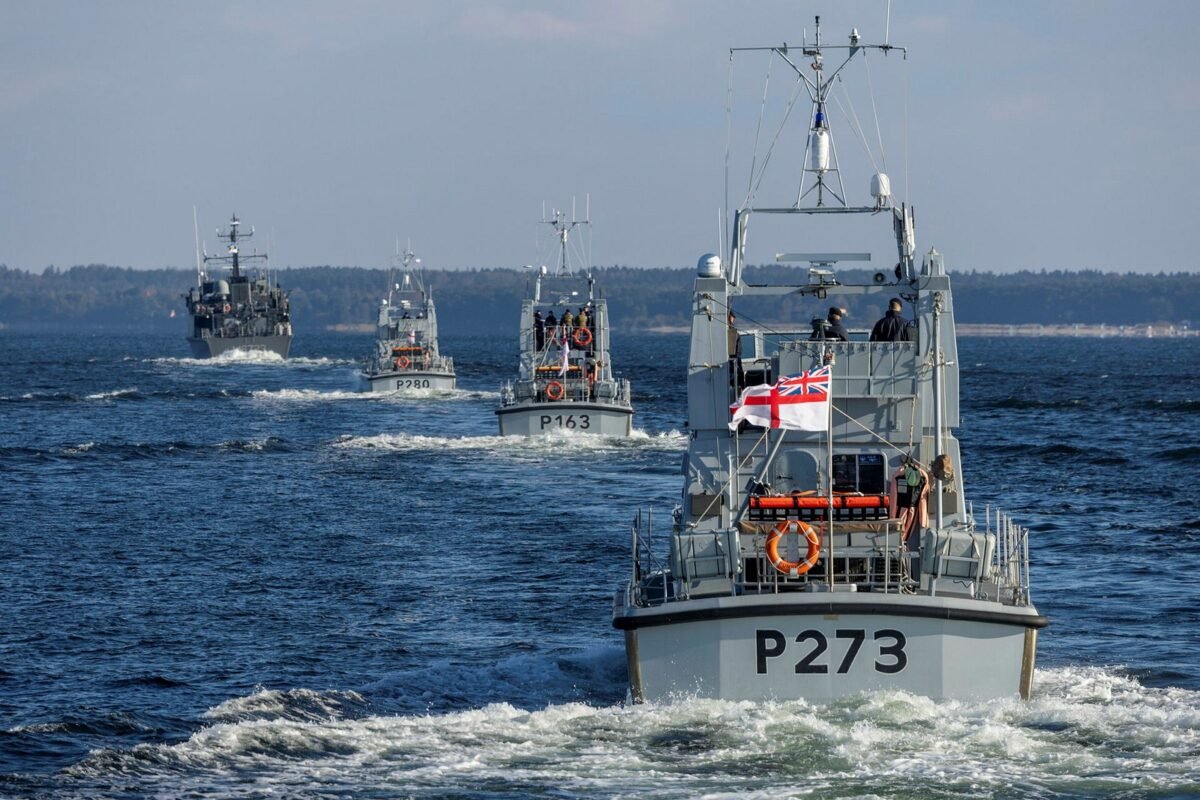
The Estonian Navy ship EML Ugandi takes operational control of four Royal Navy patrol vessels in a passage exercise in Tallinn Bay during TARASSIS, October 2, 2025. Image by AS1 Leo Moharram; © Crown copyright 2025. Open Government Licence.
Key elements include:
- Exercises. Exercises build practical familiarity by testing plans, procedures, communications and command relationships under realistic conditions. Their value is not only that forces train together, but that weaknesses are exposed before crisis. Exercises should test movement, logistics, information sharing, degraded communications, infrastructure disruption and civil-military coordination rather than only demonstrating planned activity under favourable conditions.
- Shared understanding. Shared understanding means that political leaders, commanders, planners and operators develop a common view of the regional problem. In the Baltic-Arctic system, this includes understanding reinforcement routes, infrastructure dependencies, Russian military activity, hybrid threats, legal authorities and escalation risks. Shared understanding reduces friction because states that interpret the operating environment similarly can consult and act more quickly.
- Operational relationships. Operational relationships are built through repeated interaction between people, units, headquarters, ministries and agencies. These relationships matter because crisis response depends on trust, judgement and the ability to reach the right counterpart quickly. Formal mechanisms are important, but practical relationships often determine whether coordination works under time pressure.
Building habits before crisis is particularly important in a region where many critical dependencies are civilian, commercial or cross-border. Defence organisations cannot wait until an incident occurs to discover who owns a cable, who operates a port, who controls a rail route, who can authorise access or who holds the data needed for maritime awareness. Regional frameworks can help bring these actors into planning and exercising earlier, provided leaders treat civil-military integration as part of deterrence rather than as an administrative afterthought.
6.4 Avoiding Institutional Competition
Regional frameworks strengthen security when they are clear about their role. They become problematic when they duplicate existing structures, compete for political attention or create uncertainty about responsibilities during crisis.
Key elements include:
- Complementarity. Complementarity means that JEF should strengthen NATO rather than compete with it. Its activities should support NATO standards, doctrine, readiness and regional defence plans while preserving the flexibility that makes JEF useful. Leaders should judge JEF by whether it improves operational preparedness and political-military coordination, not by whether it grows into a more formal institution.
- Clear roles. Clear roles are necessary because ambiguity can create friction during crisis. NATO provides collective defence, command structures and alliance-wide planning, while JEF can support early consultation, regional exercises, practical coordination and political signalling among a smaller group of states. The clearer this division of labour becomes, the less likely JEF is to be misunderstood as either redundant or competitive.
- Shared objectives. Shared objectives ensure that JEF activity remains aligned with wider allied deterrence and defence. Regional frameworks should not generate activity for its own sake, because exercises, statements and response options only matter if they support identifiable operational outcomes. In the Baltic-Arctic system, those outcomes should include improved reinforcement, better maritime awareness, infrastructure resilience, faster consultation and stronger regional readiness.
Avoiding institutional competition does not mean reducing JEF’s ambition. It means focusing ambition on the areas where JEF can add practical value. The framework is most useful when it strengthens the habits, relationships and regional readiness that NATO can then draw upon in a wider crisis.
The Baltic-Arctic system requires this kind of layered approach. NATO provides the strategic foundation, while JEF can help strengthen the regional connective tissue between national action and alliance-wide response. That connective tissue matters because deterrence in Northern Europe depends not only on formal guarantees, but also on whether states can understand the same problem, consult quickly, move forces, protect infrastructure and act together before crisis conditions harden.
7. Challenges and Limitations
Recognising the Baltic-Arctic system as a connected strategic environment does not automatically solve the problems it reveals. The value of the concept lies in clarifying dependencies, not in removing constraints. Northern European defence still faces significant political, operational, industrial and governance challenges that cannot be resolved by better maps or stronger language alone.
The central difficulty is that the Baltic-Arctic system connects states, infrastructures and military requirements that are not controlled through a single authority. NATO provides the collective defence framework, national governments retain sovereign decision-making, regional formats such as JEF support practical cooperation, and much of the infrastructure on which operations depend is owned or operated by civilian and commercial actors. This creates a layered operating environment where alignment must be built deliberately rather than assumed.
Key challenges include:
- National priorities differ. States across the Baltic-Arctic system share exposure to Russian military pressure, critical infrastructure vulnerability and reinforcement dependencies, but they do not experience these challenges in identical ways. Norway’s High North concerns, Denmark’s responsibilities through Greenland and the Faroe Islands, Finland’s long border with Russia, Sweden’s Baltic and Nordic position, the Baltic states’ direct exposure to Russia and Belarus, and the United Kingdom’s wider global commitments all shape national priorities differently. This variation does not prevent cooperation, but it does require political leaders to recognise that regional alignment must be maintained through continuous consultation, not assumed from shared membership in NATO or JEF.
- Command relationships remain complex. The Baltic-Arctic system cuts across geography, domains and institutional responsibilities. NATO command arrangements, national chains of command, JEF consultation mechanisms, European Union responsibilities, civilian authorities and private-sector operators all have roles in different parts of the same operating environment. Complexity becomes operationally relevant when decision-making timelines are compressed, because unclear responsibilities can delay response during incidents involving maritime activity, infrastructure disruption, cyber operations or ambiguous military signalling. Leaders therefore need to ensure that command relationships, liaison arrangements and escalation pathways are exercised before crisis rather than clarified during crisis.
- Infrastructure vulnerabilities persist. Critical underwater infrastructure, ports, railways, energy networks, digital systems and space-enabled services remain difficult to monitor, protect and repair. The challenge is not only physical vulnerability, but also governance fragmentation, because responsibility is divided among national governments, commercial operators, regulators, local authorities and alliance structures. Improved surveillance helps, but it does not by itself solve questions of ownership, attribution, repair capacity, legal authority or public communication. Resilience requires redundancy, faster repair mechanisms, trusted information sharing and realistic planning for degraded conditions.
- Defence industrial fragmentation continues. European states are increasing defence spending, but national procurement priorities, industrial protection, export controls, production bottlenecks and differing timelines still limit the speed at which shared capability can be generated. In the Baltic-Arctic system, this affects munitions, air defence, maritime surveillance, anti-submarine warfare, mine countermeasures, electronic warfare, unmanned systems, logistics and infrastructure protection. The operational problem is that national rearmament does not automatically produce regional interoperability. Leaders must therefore connect procurement decisions to shared operational requirements rather than treating capability development as a purely national process.
- Reinforcement timelines remain challenging. Reinforcement requires political approval, force generation, transport capacity, port access, rail movement, host nation support, air and maritime protection, fuel, maintenance and sustainment. Each step can be delayed by administrative friction, damaged infrastructure, cyber disruption, contested airspace, submarine activity, mine threats or limited availability of transport assets. The risk is that political commitments appear credible in principle but become difficult to execute at the speed required by crisis conditions. Exercises must therefore test reinforcement under realistic disruption rather than assuming smooth movement across ideal conditions.
- Arctic governance is evolving. The High North includes sensitive legal, environmental, economic and military issues that cannot be managed through defence planning alone. Svalbard, Arctic sea routes, resource access, indigenous communities, environmental protection, search and rescue, and increasing military activity all create overlapping governance challenges. Russia’s behaviour has further complicated regional cooperation, while NATO’s northern posture has become more important after Finland and Sweden joined the Alliance. Leaders must manage deterrence and escalation carefully because activity in the Arctic can carry strategic significance beyond the immediate operational environment.
- Critical dependencies on US capabilities remain. European allies are investing more in defence, but many critical capabilities remain heavily dependent on the United States. These include strategic lift, intelligence, surveillance and reconnaissance, missile defence, high-end command and control, space-enabled services, long-range fires, munitions production, logistics depth and nuclear deterrence. The issue is not whether the United States remains central to NATO, because it does, but whether European allies can strengthen regional readiness enough to reduce avoidable vulnerabilities and act effectively when US attention, assets or political bandwidth are stretched across multiple theatres.
These challenges do not invalidate the Baltic-Arctic system argument. They make it more important. A connected operating environment creates strategic advantages only if states understand the dependencies that bind it together and invest in the relationships, infrastructure, capabilities and decision-making processes needed to manage them.
For JEF, NATO and national governments, the leadership requirement is to avoid mistaking conceptual agreement for operational readiness. Recognising that the Baltic Sea, North Atlantic and High North are connected is only the starting point. The harder task is turning that recognition into exercised plans, interoperable capabilities, resilient infrastructure, faster consultation and credible reinforcement across a contested regional environment.
8. Conclusion
Northern European security increasingly depends on understanding the Baltic Sea, the High North and the North Atlantic as a connected strategic system rather than as separate regions. The geography is different in each area, and the operational requirements are not identical, but deterrence, reinforcement, infrastructure resilience and military mobility now bind them together in ways that cannot be ignored by commanders, policymakers or capability planners.
The central argument of this paper is that geography has become operationally indivisible. The Baltic Sea cannot be defended without secure access through the Danish Straits, Nordic territory and wider North Atlantic reinforcement routes. The High North cannot be treated as a distant Arctic concern when Russian military activity, Norwegian infrastructure, maritime surveillance and access to the North Atlantic affect the same deterrence architecture. The North Atlantic cannot be understood only as a transatlantic corridor when its sea lines of communication, undersea infrastructure and command arrangements directly influence the defence of Northern Europe.
This connected environment changes how leaders should think about readiness. Military capability remains essential, but capability alone does not create deterrence unless forces can move, communicate, sustain themselves and operate across contested infrastructure and degraded systems. Ports, railways, airfields, undersea cables, energy networks, digital systems and satellite-enabled services are therefore part of the operational terrain. Many of these systems are civilian-owned, commercially operated or governed through national and cross-border arrangements, which means defence planning must be connected to civil preparedness, private-sector coordination and political decision-making before crisis conditions emerge.
NATO enlargement in the north strengthened the Alliance by bringing Finland and Sweden fully into collective defence planning, but it also raised the standard for practical integration. Their accession changed the military geography of the Baltic Sea, improved the coherence of Nordic-Baltic defence and created new opportunities for shared planning across the Baltic-Arctic system. Those opportunities will produce operational effect only if they are matched by interoperability, exercised reinforcement, resilient infrastructure, compatible command arrangements and sustained political attention.
JEF’s relevance stems from the fact that it already operates across this strategic reality. Its members are connected by the North Atlantic, the High North, the Nordic region and the Baltic Sea, and its value lies in building practical habits of cooperation across the same geography that increasingly determines deterrence and resilience. JEF does not replace NATO, and it should not try to become a parallel institution. Its contribution is more specific: it can support early consultation, regional familiarity, operational relationships and practical coordination among states that share the same strategic exposure.
Recognising the Baltic-Arctic system does not remove the challenges facing Northern European defence. National priorities still differ, command relationships remain complex, infrastructure vulnerabilities persist, defence industrial fragmentation continues, reinforcement timelines are difficult, Arctic governance is evolving and critical dependencies on US capabilities remain. These challenges make the regional argument more important, because they show that conceptual alignment must be converted into exercised plans, usable capabilities and trusted decision-making mechanisms.
The Baltic-Arctic security bridge should therefore be understood as an operational reality rather than a rhetorical device. It describes the way reinforcement, infrastructure, geography and military operations now connect Northern Europe across traditional regional boundaries. In this environment, deterrence depends not only on the ability to defend territory, but also on the ability to preserve access, sustain operations, protect critical systems and coordinate action before disruption becomes crisis.
The next paper in this series will examine how JEF fits within NATO’s evolving security architecture. It will consider why regional frameworks and Alliance-wide planning should be understood as complementary rather than competing approaches, and why the future of Northern European defence depends on making that relationship clearer, more practical and more operationally useful.
The JEF Papers
Paper 2: The Baltic-Arctic Security Bridge
Paper 3: JEF and NATO
Paper 4: The Expansion Question
Paper 5: Capability Integration Across JEF
Paper 6: The Future of Regional Defence Cooperation
References and Suggested Reading
Previous Paper in the Series
Sula, Eva. The JEF Papers, Paper 1: Why JEF Works.
LinkedIn article: https://www.linkedin.com/pulse/jef-papers-paper-1-why-works-eva-sula-bya6f/
LinkedIn post introducing the paper: https://www.linkedin.com/posts/eva-sula-02b9a73_jef-defence-nato-ugcPost-7466369611756814336-5xhJ/
Official Documents and Primary Sources
NATO. NATO 2022 Strategic Concept. https://www.nato.int/strategic-concept/
NATO. Vilnius Summit Communiqué, 2023. https://www.nato.int/cps/en/natohq/official_texts_217320.htm
NATO. Washington Summit Declaration, 2024. https://www.nato.int/cps/en/natohq/official_texts_227678.htm
NATO. Deterrence and Defence. https://www.nato.int/cps/en/natohq/topics_133127.htm
NATO. Joint Force Command Norfolk. https://jfcnorfolk.nato.int/
NATO. Joint Force Command Brunssum. https://jfcbs.nato.int/
NATO. Allied Command Transformation. https://www.act.nato.int/
NATO. Baltic Sentry. https://www.nato.int/cps/en/natohq/topics_228255.htm
NATO. Critical Undersea Infrastructure Coordination Cell. https://www.nato.int/cps/en/natohq/news_211919.htm
NATO. Critical Undersea Infrastructure Protection. https://www.nato.int/cps/en/natohq/topics_210979.htm
Joint Expeditionary Force. Official JEF Website. https://jefnations.org/
UK Government. Joint Expeditionary Force Collection. https://www.gov.uk/government/collections/joint-expeditionary-force-jef
UK Ministry of Defence. Joint Expeditionary Force Policy Direction. https://www.gov.uk/government/publications/joint-expeditionary-force-policy-direction-july-2021
Finnish Ministry of Defence. Reports and Reviews. https://www.defmin.fi/en/tasks_and_activities/security_and_defence_policy/reports_and_reviews
Finnish Defence Forces. https://puolustusvoimat.fi/en/frontpage
Government of Sweden. Defence Policy. https://www.government.se/government-policy/defence/
Swedish Armed Forces. https://www.forsvarsmakten.se/en/
Norwegian Government. Defence. https://www.regjeringen.no/en/topics/defence/
Norwegian Government. The High North. https://www.regjeringen.no/en/topics/high-north/
Danish Ministry of Defence. https://www.fmn.dk/en/
Danish Ministry of Foreign Affairs. Foreign and Security Policy. https://um.dk/en/foreign-policy
European Commission. Military Mobility. https://transport.ec.europa.eu/transport-modes/military-mobility_en
European Union. Joint Communication on the EU Arctic Policy. https://eur-lex.europa.eu/legal-content/EN/TXT/?uri=JOIN:2021:27:FIN
Think Tank Research and Analytical Reading
Center for Strategic and International Studies, CSIS. https://www.csis.org/
Royal United Services Institute, RUSI. https://rusi.org/
International Institute for Strategic Studies, IISS. https://www.iiss.org/
Atlantic Council. https://www.atlanticcouncil.org/
Chatham House. https://www.chathamhouse.org/
Wilton Park. https://www.wiltonpark.org.uk/
The Alphen Group. https://thealphengroup.org/
International Centre for Defence and Security, ICDS. https://icds.ee/en/
Finnish Institute of International Affairs, FIIA. https://fiia.fi/en/
Norwegian Institute of International Affairs, NUPI. https://www.nupi.no/en
Swedish Defence Research Agency, FOI. https://www.foi.se/en.html
Suggested Reading Themes for Further Research
- NATO’s evolving regional defence plans.
- Reinforcement and military mobility across Northern Europe.
- The strategic implications of Finnish and Swedish NATO membership.
- Protection of critical underwater infrastructure.
- Maritime security in the Baltic Sea and North Atlantic.
- The GIUK Gap and anti-submarine warfare.
- Arctic governance and military competition in the High North.
- Civil-military integration and societal resilience.
- JEF as a model for regional defence cooperation.
- Defence industrial integration and munitions resilience.
Eva Sula is an independent defence and security strategic advisor specialising in NATO and European defence cooperation, regional security, emerging technologies and operational capability development. She is a NATO DIANA Defence Mentor, a Senior Fellow for Estonia at the Council on Strategic and Foreign Intelligence (CSFI), and a member of The Alphen Group.
© Eva Sula
First published on LinkedIn on June 23, 2026. Read the original article or the LinkedIn post.
All opinions expressed are those of the author alone and may not represent those of the institutions they represent or the Baltic International Security Centre (BISC). BISC maintains a strict intellectual independence policy across all its projects and publications.