
Image by PO Phot Barry Swainsbury; © Crown copyright 2026. Open Government Licence.
By Eva Sula
Editor’s note: BISC added the maps and the visuals to this article. They are not part of Eva Sula’s original paper, which appears here as she wrote it.
All opinions expressed are those of the author alone and may not represent those of the institutions they represent or the Baltic International Security Centre (BISC). BISC maintains a strict intellectual independence policy across all its projects and publications.
© Eva Sula
First published on LinkedIn on July 18, 2026. Read the original article.
Why Regional Agility Strengthens Alliance Deterrence
0. Author’s Note
This paper is the third in a six-paper sequence examining the Joint Expeditionary Force and its place within the changing security architecture of Northern Europe. Paper 1, Why JEF Works, examined the political trust, shared geography, operational cooperation and institutional restraint that have allowed JEF to develop into an effective regional defence framework. Paper 2, The Baltic-Arctic Security Bridge, considered the operating environment beneath that cooperation, arguing that the Baltic Sea, the North Atlantic and the High North can no longer be treated as separate security theatres when reinforcement routes, military mobility, critical infrastructure and Russian military activity connect them into a single strategic system.
Paper 3 turns from geography to institutional and operational relationships. It examines how JEF fits within NATO now that all ten JEF participant nations are Alliance members and the northern command geography has changed through the transfer of Denmark, Finland and Sweden into the area of responsibility of Allied Joint Force Command Norfolk. The resulting security environment crosses NATO command boundaries, national jurisdictions, military domains and civil-military responsibilities, while the threats, infrastructure dependencies and reinforcement requirements affecting the region do not conform neatly to any of them.
The purpose of this paper is not to propose a separate alliance, a European army or an alternative military command structure. NATO remains the foundation of collective defence, the source of formal Alliance authority and the structure through which large-scale military operations would be planned, commanded and sustained. JEF has neither the legal status nor the operational purpose to replace those functions, and any attempt to develop it in that direction would weaken rather than strengthen its value.
The more relevant question is whether a smaller regional framework can make NATO’s political commitments more operationally usable. JEF may be able to contribute by improving consultation among directly exposed allies, building familiarity before crisis, identifying coordination gaps, exercising transitions between national, regional and NATO activity, and strengthening preparedness across the institutional seams created by the necessary division of responsibilities inside a large Alliance. Such a role would not reduce NATO’s authority, but could help ensure that the Alliance enters a northern crisis with greater regional understanding, stronger political alignment and fewer avoidable coordination failures.
This distinction between command authority and connective capacity is central to the argument developed throughout the paper. NATO commands, while JEF can help its members prepare, consult and coordinate across a shared regional operating environment. NATO provides scale, legitimacy, military mass and the formal machinery of collective defence, while JEF can provide regional concentration, trusted relationships and earlier political-military coordination where an emerging incident has not yet produced an agreed Alliance-wide response.
The paper therefore addresses three closely connected issues: political-military complementarity between JEF and NATO, the command and coordination relationships affecting Northern Europe, and the role of regional responsiveness in strengthening deterrence. It considers how JEF could help connect rather than duplicate existing structures, how responsibilities could be distributed more effectively among participating nations, and how expertise already present within NATO-accredited centres and national institutions could be used without constructing another permanent bureaucracy.
The boundaries of the analysis are equally important. Paper 4 will examine the expansion question in full, including the strategic cases for and against deeper participation by Canada, Belgium, Germany, Poland, Ireland and other possible partners. Paper 5 will address capability integration across JEF, including command and control, intelligence, surveillance and reconnaissance, logistics, autonomy, electronic warfare, artificial intelligence, maritime awareness, resilience and the digital backbone required to connect them.
Those subjects will appear in this paper only where they illuminate the relationship between JEF and NATO. Keeping that boundary allows Paper 3 to answer one strategic question with sufficient discipline: whether JEF is an unnecessary institutional competitor or a regional force multiplier that can strengthen NATO by connecting political intent, operational preparation and regional expertise across the seams of Northern European defence.
1. Introduction: The Wrong Question
Debate about the Joint Expeditionary Force often begins with a question that appears sensible but is analytically incomplete: does JEF duplicate NATO? The question assumes that two organisations addressing some of the same geography, threats or military activities must be institutional competitors. It directs attention towards structures and labels before establishing the operational problem that cooperation is intended to solve.
NATO and JEF do not possess the same authority, scale, membership, command arrangements or strategic purpose. NATO is a treaty-based political and military alliance that provides collective defence, formal political decision-making through the North Atlantic Council, an integrated military command structure, Alliance-wide defence planning and the legitimacy required to direct and sustain multinational operations. JEF is a voluntary, UK-led framework through which ten Northern European allies can consult, prepare and undertake activity together, while every participating state retains national control over whether and how it contributes.
The distinction is fundamental because JEF cannot provide an Article 5 guarantee, assign NATO forces, replace the NATO Command Structure or exercise Alliance-wide operational authority. It does not possess the political mandate, military scale or permanent command responsibilities required to perform those functions. Any attempt to present JEF as an alternative source of collective defence would misrepresent its design and create precisely the institutional competition that its official policy direction seeks to avoid.
The more useful question is whether JEF helps NATO operate with greater regional understanding, political cohesion and military readiness before and during crisis. Northern Europe contains an interconnected operating environment stretching from the North Atlantic and High North into the Baltic Sea, while the political, military, civil and commercial responsibilities supporting that environment remain distributed across several NATO commands, national governments, regional frameworks and private infrastructure owners. A smaller group of geographically connected allies may therefore add value when it reduces the friction between those layers rather than attempting to replace them.
Institutional Duplication and Functional Overlap
Institutional duplication occurs when organisations create competing authorities, parallel command arrangements, redundant planning processes or overlapping structures without producing additional operational value. It can consume scarce personnel, fragment accountability and force nations to support multiple processes addressing the same requirement. In a region already constrained by limited headquarters capacity, specialist shortages and competing readiness demands, unnecessary duplication would weaken rather than improve collective defence.
Functional overlap is different because some activities must occur at several levels if forces and institutions are expected to work together. NATO, JEF, national headquarters and bilateral or Nordic arrangements may all exercise reinforcement, maritime awareness, infrastructure protection, logistics and political consultation, but they do so from different positions and with different authorities. The relevant test is not whether two organisations touch the same subject, but whether their activity produces compatible plans, stronger readiness and a clearer path from national preparation to Alliance response.
Exercises provide a practical example of useful overlap. NATO must exercise collective defence across a large and diverse Alliance, while JEF can concentrate on the geography, relationships and operating conditions affecting its ten participants. When JEF activity uses NATO doctrine and standards, identifies regional vulnerabilities and rehearses how participating forces or information would transfer into NATO-led operations, the overlap strengthens preparedness. When separate exercises create conflicting procedures, incompatible data or unclear command relationships, the same overlap becomes a liability.
The distinction requires leaders to judge activity by operational outcome rather than institutional ownership. A meeting, exercise or coordination mechanism is not useful merely because it carries a NATO or JEF label. It is useful when it improves the ability to understand an emerging situation, make decisions, move and sustain forces, protect critical dependencies or transition responsibility without avoidable delay.
Command Authority, Consultation and Coordination
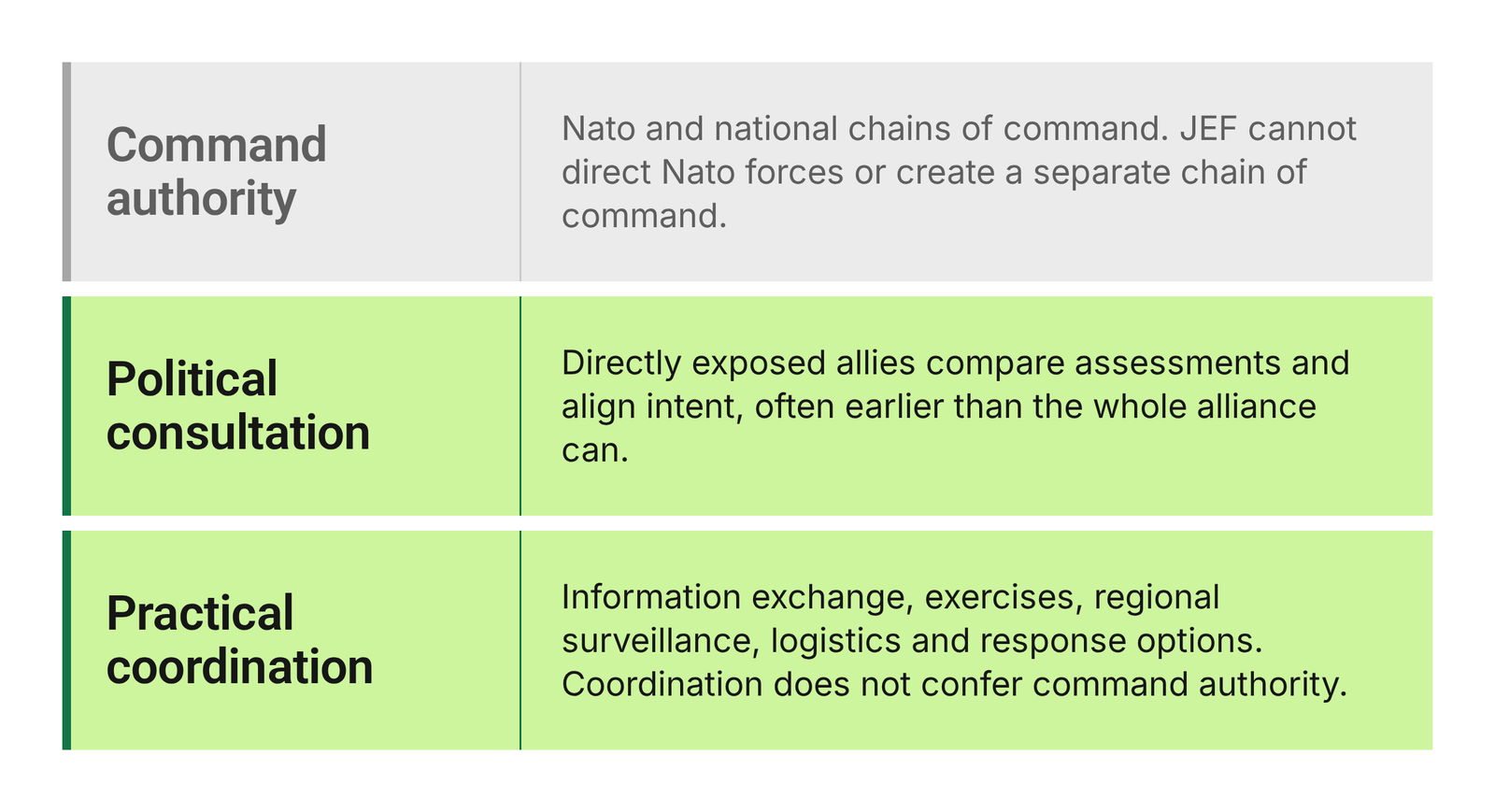
Confusion about duplication also arises when command authority, political consultation and practical coordination are treated as interchangeable. They are related, but each solves a different part of the crisis-response problem and carries different legal and political consequences.
Command authority belongs to established national and NATO chains of command. NATO’s operational-level Joint Force Commands plan, conduct and sustain Alliance operations under the authority of the North Atlantic Council and the Supreme Allied Commander Europe. JEF cannot insert itself above or between those commands, direct NATO forces or create a separate chain of command across Northern Europe, because doing so would obscure accountability and weaken the unity of command required during crisis and conflict.
Political consultation allows participating governments to compare assessments and align intent. A suspicious maritime incident, cyber campaign, infrastructure failure or pattern of military signalling may affect several JEF members before it produces an agreed Alliance-wide interpretation. Earlier consultation among directly exposed states can help them establish what is known, identify national concerns, coordinate public communication and prepare options without prejudging decisions that remain the responsibility of NATO or national governments.
Practical coordination connects political intent to preparation and activity. It includes information exchange, exercises, force integration, infrastructure planning, regional surveillance, logistics and the preparation of response options. Coordination does not confer command authority, but it can reduce the time and friction required when national forces later operate together or move under NATO command.
These distinctions allow regional responsiveness to strengthen NATO without eroding NATO’s authority. JEF can help participating nations consult and prepare earlier, while operational command remains where political mandates and established military responsibilities place it. The model fails only when regional activity lacks a clear relationship to NATO plans or when political language suggests authorities that JEF does not possess.
Command, consultation and coordination
Graphic: BISC.
Why NATO Enlargement Did Not Remove JEF’s Purpose
Finland’s and Sweden’s accession to NATO prompted some observers to question whether JEF had completed its purpose. Before accession, JEF provided Finland and Sweden with an established framework for military cooperation and political solidarity alongside NATO allies, including during the vulnerable period between their applications and full membership. Once both became allies, the argument followed that NATO could now perform everything JEF had previously enabled.
That conclusion underestimates the difference between Alliance membership and regional preparedness. Joining NATO provides collective-defence guarantees and access to the Alliance’s planning and command structures, but it does not automatically create mature relationships across every headquarters, national authority, infrastructure operator or regional contingency. Integration requires continuous work on plans, communications, force availability, logistics, host-nation support, information sharing and political consultation.
The enlargement of NATO in Northern Europe also increased rather than reduced the need for coordination. Finland and Sweden brought substantial territory, infrastructure and military capability into the Alliance, while NATO subsequently adjusted the northern command geography by adding Denmark, Finland and Sweden to JFC Norfolk’s area of responsibility. The Baltic-Arctic operating environment nevertheless continues across command boundaries, including the relationship between the Nordic area, the Baltic states, continental reinforcement routes and specialist functional commands.
JEF remains relevant because all ten participants now approach regional cooperation from within the same Alliance, using NATO doctrine and standards as a common baseline. Its role is no longer partly to connect militarily non-aligned Finland and Sweden with close NATO partners, but to help ten allies develop regional familiarity and preparedness across a geography that NATO must manage as part of a much larger strategic area. This is an evolution of purpose rather than evidence of redundancy.
Why the Baltic-Arctic System Still Needs a Connective Layer
The Baltic Sea, North Atlantic and High North form a connected operating system, but no single institution owns every dependency within it. NATO commands military operations, national governments retain sovereign authority, JEF supports regional cooperation, European institutions influence infrastructure and mobility, and civilian companies operate much of the transport, energy, digital and undersea infrastructure on which deterrence depends.
The resulting seams are not evidence of institutional failure, because complex systems require divisions of responsibility. They become operational vulnerabilities when information cannot cross them, responsibilities are misunderstood or organisations assume that another actor has addressed the problem. Regional connective capacity is therefore required to make legitimate institutional boundaries function under pressure rather than to abolish those boundaries.
JEF can contribute to that connective role in several ways:
- Developing shared regional understanding. Participating states can compare national assessments of military activity, infrastructure risk, cyber pressure and reinforcement constraints. The operational value lies in identifying where apparently national problems are connected, while the limitation is that shared understanding depends on trust, classification rules and the willingness to disclose uncertainty rather than only finished national positions.
- Identifying planning and information seams. Exercises and consultations can reveal where responsibilities between commands, ministries, agencies and private operators remain unclear. Leaders should use those findings to improve existing NATO and national processes rather than creating a separate JEF solution for every gap.
- Preparing regional response options. JEF members can examine political signalling, surveillance, presence, infrastructure protection and mutual support below the threshold of a full NATO operation. Such options require clear national authorities and must remain compatible with Alliance plans so that early action does not complicate subsequent escalation or transfer of responsibility.
- Rehearsing transition into NATO command. Regional activity should test how information, forces, logistics and responsibilities move from national or JEF coordination into NATO-led operations. The measure of success is not whether JEF retains control, but whether NATO can assume responsibility with a better operational picture, prepared forces and fewer procedural delays.
- Connecting military preparation with civil resilience. Ports, transport networks, telecommunications, energy systems and undersea infrastructure cross military and civilian ownership. JEF can help frame regional requirements and exercise cooperation, but national governments must provide authorities, investment and accountability because regional discussion cannot substitute for domestic implementation.
This connective function is deliberately narrower than command. It prepares the relationships and conditions upon which formal authority depends, while leaving operational decisions within NATO and national structures. Its value should be measured by whether the Alliance becomes better able to understand, decide and act across the northern region, not by whether JEF acquires more permanent bodies or an expanding institutional identity.
What Belongs Only to NATO
Several functions belong unambiguously to NATO and should remain there. NATO provides the collective-defence guarantee, takes political decisions through the North Atlantic Council, directs Alliance military operations through the NATO Command Structure, conducts Alliance-wide defence planning and coordinates the generation of forces at the scale required for major conflict. It also connects Northern European defence to the Mediterranean, Black Sea region, North America and the wider strategic responsibilities of the Alliance.
JEF cannot reproduce those functions with ten states, nor would doing so improve security. Its contribution must begin from acceptance that NATO supplies the authority, scale and strategic integration that a regional framework cannot. The purpose of regional agility is to help those mechanisms work more effectively in a particular operating environment, not to demonstrate independence from them.
What Ten States May Be Able to Do Faster
A smaller group can often consult more quickly because fewer governments are involved and their geographic exposure is more closely aligned. JEF members may be able to share preliminary assessments, coordinate national activities, prepare force contributions and agree regional messages while a wider Alliance process continues. Speed remains conditional, however, because voluntary frameworks still depend on national decisions and political disagreement cannot be solved by organisational size alone.
JEF may also develop greater familiarity with the infrastructure, weather, maritime conditions, mobility routes and adversary patterns specific to Northern Europe. That concentration can improve exercises and planning, but only if knowledge is transferred into NATO rather than retained within a regional circle. A fast regional process that produces information or procedures NATO cannot use would create the appearance of agility without strengthening collective defence.
The operational boundary should therefore be defined by mandate and transition. JEF can consult, prepare and coordinate within the authorities granted by participating nations, while NATO assumes command when the North Atlantic Council authorises Alliance activity and established command arrangements apply. The exact transition will vary by scenario, which is why it must be planned and exercised rather than left to improvised negotiation during crisis.
Measuring Whether JEF Strengthens NATO
Institutional growth is an inadequate measure of JEF’s success. Additional meetings, permanent posts, headquarters functions or public statements may demonstrate political attention, but they do not prove that regional defence has become more credible. In some circumstances, institutional expansion could reduce the flexibility that made JEF useful while increasing competition for the same limited personnel and funding.
A more demanding assessment would ask whether JEF activity produces observable improvements in deterrence and readiness:
- Faster and better-informed consultation. Participating governments should be able to establish a shared understanding of an incident without suppressing legitimate national differences. Success requires both speed and analytical quality because rapid agreement based on poor information can be as damaging as delay.
- Improved interoperability and preparedness. Forces, headquarters and agencies should understand how to work together, exchange information and operate under degraded conditions. Exercise lessons must lead to changes in plans, authorities, training or investment rather than remaining within post-exercise reporting.
- Clearer transition into NATO activity. Political and military leaders should know when and how national or JEF-coordinated activity moves into NATO command. Ambiguity over responsibility, information ownership or force transfer would indicate that overlap has not been converted into complementarity.
- Greater resilience across civil-military dependencies. Regional planning should improve the readiness of ports, transport systems, digital networks and critical infrastructure that support reinforcement. JEF cannot deliver these outcomes alone, but it can reveal whether national implementation is keeping pace with regional commitments.
- Reduced vulnerability at institutional seams. NATO commands, national headquarters and regional actors should possess clearer liaison arrangements, information pathways and escalation procedures. The relevant result is not the elimination of organisational boundaries, but the ability to operate across them without losing time, understanding or accountability.
The question confronting JEF is therefore not whether it resembles NATO in selected functions, but whether those functions help NATO fulfil responsibilities that only the Alliance can carry. When regional activity strengthens readiness, improves shared understanding and prepares a clean transition into NATO command, functional overlap becomes a force multiplier. When it produces parallel processes, confused authority or institutional self-preservation, the criticism of duplication becomes justified.
Paper 3 proceeds from this distinction. JEF should neither compete with NATO nor remain a ceremonial layer of political consultation. Its credible purpose is to ensure that NATO does not approach every northern crisis from a standing start, with regional relationships, infrastructure dependencies and coordination seams still waiting to be understood after pressure has already begun.

HMS Prince of Wales leads a 15-ship formation as Finnish and Swedish jets fly past during Nato Exercise Steadfast Defender 2024, March 13, 2024. Image by LPhot Belinda Alker; © Crown copyright 2024. Open Government Licence.
2. What JEF Is Within the NATO System
The debate surrounding the Joint Expeditionary Force is often framed as a choice between regional frameworks and alliance structures. In practice, the two perform different functions and operate at different levels of political and military responsibility. Understanding where JEF sits within the wider NATO architecture is therefore essential before considering how regional frameworks should evolve in response to the changing security environment in Northern Europe.
JEF should not be understood as a smaller version of NATO, nor should it be treated as a political initiative seeking institutional growth for its own sake. It is a voluntary, UK-led coalition of ten Northern European NATO allies designed to facilitate political consultation, practical military cooperation and regional responsiveness among states that share a common strategic geography and many of the same security challenges.
Its relevance does not derive from possessing authorities that belong to NATO. Rather, it stems from its ability to organise high-readiness cooperation among geographically coherent allies without creating another treaty organisation, integrated military command structure or additional layer of collective defence obligations.
This distinction matters because regional defence frameworks are increasingly criticised or assessed against criteria they were never designed to fulfil. JEF should not be expected to provide Alliance-wide deterrence, nor should NATO be expected to optimise exclusively for the Baltic-Arctic operating environment. The strategic question is therefore not whether one framework can replace the other, but whether both are performing the functions for which they are best suited.
2.1 Different Authorities
NATO’s authority derives from the Washington Treaty, collective defence obligations, established political decision-making processes and the NATO Command Structure. Through Article 5, the North Atlantic Council, NATO Defence Planning Process and integrated military commands, the Alliance possesses legal and political authorities that no regional framework can replicate. These arrangements underpin NATO’s legitimacy, strategic depth and ability to conduct large-scale multinational operations across the Euro-Atlantic area.
JEF possesses none of these authorities, nor should it seek to. Its activities cannot substitute Alliance decisions, establish independent collective defence guarantees or present themselves as alternatives to NATO’s political and military responsibilities. Attempting to expand JEF into such a role would undermine both its flexibility and its political credibility.
Political consultation represents one of JEF’s most valuable contributions to the wider security architecture. Smaller groups of geographically exposed allies can often establish shared situational understanding more rapidly than larger institutions when the operational and political picture remains ambiguous. Hybrid activities, infrastructure incidents, maritime disruptions and coordinated influence operations frequently emerge gradually and do not necessarily present immediate Article 5 questions. Early consultation among directly affected states can therefore provide valuable political and operational context before wider Alliance processes are fully engaged.
National sovereignty remains another defining characteristic of JEF. Participation in activities, exercises and potential response options remains voluntary and nationally controlled. This preserves political flexibility and enables pragmatic cooperation, but it also imposes limitations. Regional responsiveness ultimately depends upon political will, force availability and national priorities rather than automatic mobilisation mechanisms.
These limitations should not be viewed as weaknesses of the framework. They are deliberate design choices that enable JEF to operate with greater agility while remaining politically acceptable to its members. The challenge for policymakers is therefore not to replicate NATO’s authorities within JEF, but to determine how regional consultation and preparedness can best support existing Alliance structures.
2.2 Different Scales
NATO and JEF operate at fundamentally different scales, and their respective advantages emerge precisely because of those differences.
NATO provides strategic depth, military mass and Alliance-wide coherence. It connects North America and Europe, integrates more than thirty allies, conducts theatre-wide defence planning and maintains the command structures required for crisis and conflict. Collective defence across multiple strategic theatres demands institutional processes capable of balancing diverse national priorities and geographic requirements.
JEF provides regional concentration. Its membership reflects shared strategic geography rather than institutional ambition. The Baltic Sea, High North, North Atlantic and Arctic operating environment present common challenges relating to reinforcement, maritime security, infrastructure protection and regional deterrence. A smaller framework allows participating states to concentrate discussions on operational realities specific to Northern Europe without carrying the broader political and military responsibilities assigned to NATO.
Scale and speed produce different advantages. NATO’s size provides legitimacy, political weight and military capability on a scale that regional frameworks cannot match. At the same time, institutional complexity inevitably creates consultation requirements and decision-making processes appropriate for an alliance of NATO’s size and responsibilities.
JEF’s narrower design allows discussions to remain focused on shared geography, common vulnerabilities and practical regional cooperation. Smaller membership does not automatically guarantee faster decisions, but it can reduce consultation friction and improve regional familiarity when participating states maintain strong political commitment.
This distinction is particularly relevant following Finland’s and Sweden’s accession to NATO. Enlargement has significantly strengthened Northern European defence, but it has also introduced new planning requirements across command boundaries, reinforcement routes and infrastructure dependencies. Geography has become more integrated, not less. Consequently, the need for regional understanding and practical coordination has increased alongside NATO’s expanding role within the region.
2.3 Different Measures of Success
The effectiveness of NATO and JEF should be assessed against different criteria because they were established to solve different strategic problems.
NATO should be judged by its ability to provide credible collective defence, generate and sustain military forces, maintain effective command relationships and preserve political cohesion across the Alliance. Its success ultimately rests upon deterrence credibility and its capacity to defend allied territory during crisis and conflict.
JEF should be judged by whether it improves political consultation, operational readiness, regional interoperability and shared situational awareness among its members. Its value lies in strengthening regional preparedness, identifying operational seams and facilitating practical cooperation that can support NATO activity or provide coherent responses during situations that fall below an obvious Article 5 threshold.
Institutional growth should never be confused with operational value. Additional meetings, declarations or permanent structures are not indicators of success unless they contribute meaningfully to deterrence, readiness or regional resilience. The creation of new bureaucratic arrangements merely because they are politically attractive risks undermining the agility that makes regional frameworks valuable in the first place.
The more appropriate measure of success is whether NATO and JEF together improve Northern Europe’s ability to understand emerging situations, consult rapidly, reinforce effectively and maintain freedom of action across an increasingly interconnected operating environment.
Ultimately, NATO’s strength lies in its scale, legitimacy and military capabilities. JEF’s strength lies in its agility, regional familiarity and political flexibility. Treating these characteristics as competing alternatives misunderstands the role both frameworks play within Northern European security. The more relevant strategic question is how regional frameworks can strengthen Alliance deterrence by reducing institutional seams and improving preparedness before larger Alliance mechanisms are required.
3. NATO’s Command Geography and the Northern Seam
The Baltic-Arctic operating environment does not align neatly with organisational charts, command boundaries or national responsibilities. Northern European security increasingly depends upon reinforcement routes, maritime access, critical infrastructure and multi-domain activities that span the North Atlantic, High North and Baltic Sea simultaneously. Geography has become more integrated, while institutional responsibilities necessarily remain distributed across multiple commands, governments and organisations.
NATO’s command arrangements are both legitimate and necessary for managing an alliance of its size and complexity. Operational responsibilities must be divided if collective defence is to remain politically and militarily coherent. Command geography is therefore not a flaw within the NATO system. Rather, it reflects the practical realities of planning and conducting Alliance operations across a vast strategic area.
The challenge is that adversaries, infrastructure dependencies and operational effects do not recognise those same administrative and command boundaries. Reinforcement routes, maritime incidents, cyber operations, electronic warfare activities and political signalling routinely produce effects that extend across multiple areas of responsibility. The question is therefore not whether NATO’s command geography is correct, but how regional actors improve coordination across the seams where responsibilities intersect.
3.1 Why the Seam Exists
NATO deliberately divides responsibilities to make a large alliance operationally manageable. Strategic and operational headquarters exist to provide clarity of authority, planning responsibilities and military accountability across different theatres and missions.
Since December 2025, Denmark, Finland and Sweden have joined Iceland, Norway and the United Kingdom within Joint Force Command Norfolk’s area of responsibility. This development reflects the growing importance of transatlantic reinforcement, the North Atlantic and Arctic security within NATO’s collective defence posture. JFC Norfolk’s responsibilities are inherently linked to maritime security, reinforcement routes and maintaining freedom of manoeuvre across the northern approaches to Europe.
At the same time, Joint Force Command Brunssum continues to hold operational responsibilities affecting continental and eastern European defence. NATO’s wider command arrangements necessarily reflect the strategic reality that the Alliance must simultaneously consider challenges extending from the Arctic to the Black Sea and from North America to the Mediterranean.
Nato’s northern command geography since December 2025
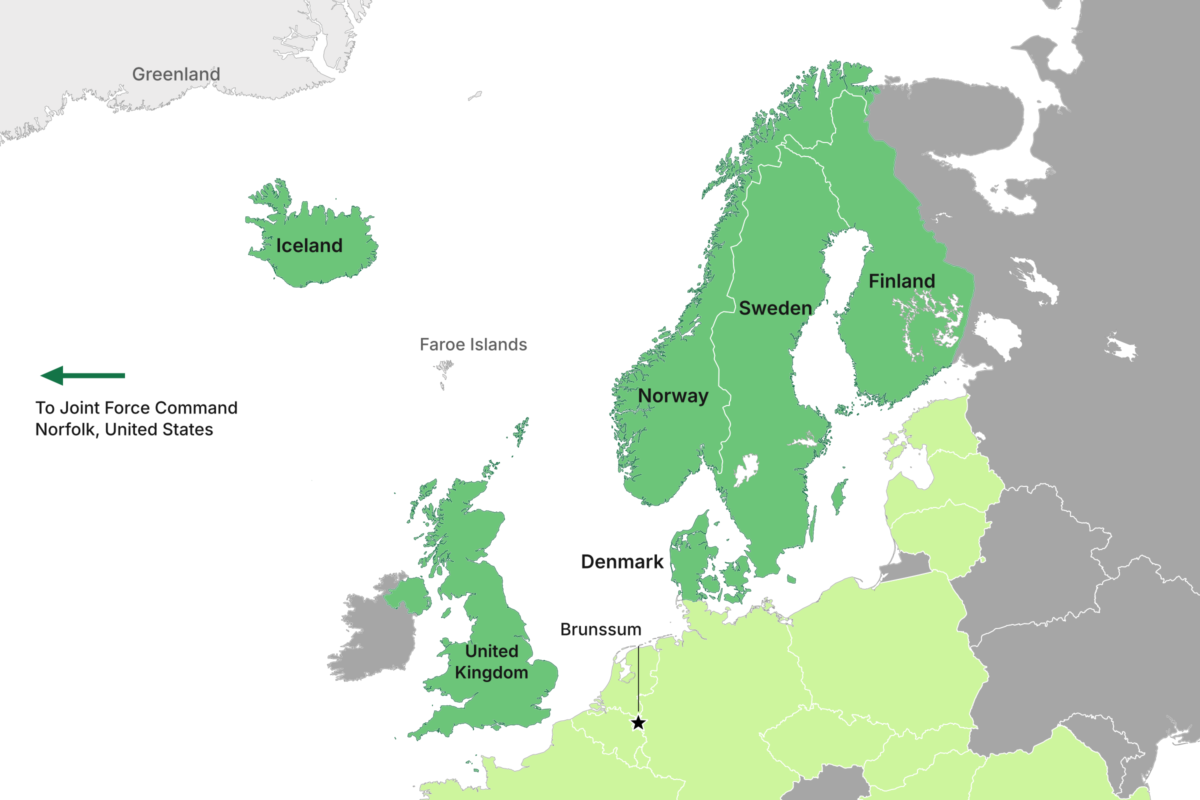
The five Nordic countries and the United Kingdom now all sit in Joint Force Command Norfolk’s area. Map: BISC. Brunssum location: OpenStreetMap contributors.
These arrangements are operationally sound. However, the Baltic-Arctic operating environment does not stop where one command’s responsibilities end and another’s begin. Maritime infrastructure, airspace management, logistics networks, cyber effects and military mobility corridors create operational dependencies that routinely cross institutional boundaries.
The Northern European security environment is therefore characterised not by competing command structures, but by overlapping operational realities that require close coordination between institutions designed for different purposes and responsibilities.
3.2 Why the Seam Matters Operationally
The existence of institutional seams becomes particularly relevant when considering how modern military operations are conducted across Northern Europe.
Shared situational awareness
One of the most significant challenges facing modern defence organisations is not simply collecting information, but developing a coherent understanding of what information means across multiple domains and institutions. Different headquarters, nations and agencies may possess different elements of the same operational picture. Military organisations, coast guards, intelligence services, civilian infrastructure operators and alliance structures frequently hold complementary information that may not naturally converge within a single process.
The issue is therefore not merely one of data availability. Classification policies, technical interoperability, national authorities, institutional trust and differing operational priorities all influence whether information can be translated into timely and effective decision-making. Shared situational awareness remains fundamentally a people, process and governance challenge before it becomes a technology problem.
Cross-boundary reinforcement
Reinforcement planning illustrates why Northern European security cannot be understood solely through command responsibilities. Personnel, equipment, ammunition and sustainment resources may move across multiple national territories and operational areas before reaching their final destination. Maritime and air corridors supporting reinforcement frequently intersect with different national responsibilities and command arrangements.
Operational success therefore depends not only upon military mobility capabilities, but also upon political coordination, infrastructure readiness and common understanding of regional priorities. Reinforcement is inherently a multinational and cross-domain activity that cannot be reduced to a single command responsibility.
Multi-domain effects
Cyber disruption, electronic warfare activities, maritime incidents and long-range strike capabilities routinely create operational effects that extend beyond geographic or institutional boundaries. An incident affecting undersea infrastructure in one part of Northern Europe may have implications for reinforcement planning, intelligence collection or critical national capabilities elsewhere.
Similarly, electronic warfare activities or disruptions affecting satellite-enabled services do not recognise command boundaries. Operational effects increasingly move faster than institutional processes designed to address them. This reality reinforces the importance of establishing mechanisms that improve regional understanding and preparedness before a crisis develops.
Political consultation
Military operations are ultimately shaped by political decisions. States exposed to the same emerging risks may require rapid political consultation before NATO’s wider operational response has been fully defined or authorised. Hybrid activities and ambiguous incidents rarely present themselves as straightforward collective defence questions during their earliest stages.
Regional consultation among directly affected allies can therefore improve preparedness, align political messaging and identify potential response options without challenging NATO’s political authority or command responsibilities.
3.3 What JEF Can and Cannot Do
The discussion surrounding regional defence frameworks frequently becomes unnecessarily polarised because proposals for improved coordination are mistakenly interpreted as proposals for new command structures.
JEF cannot command NATO forces across Joint Force Command boundaries. It cannot replace Supreme Headquarters Allied Powers Europe, establish a separate Article 5 mechanism or create an independent military chain of command for Northern Europe. Such proposals would duplicate existing Alliance structures and undermine the very complementarity that makes regional frameworks valuable.
What JEF can do is considerably more practical and arguably more useful. JEF can:
- Develop shared regional understanding before a crisis emerges by facilitating political and military consultation among geographically exposed allies.
- Exercise cross-boundary coordination among its members and improve familiarity with regional operating conditions, infrastructure dependencies and reinforcement requirements.
- Identify information, planning and institutional seams that may affect regional preparedness and feed lessons learned into national and NATO processes.
- Rehearse political consultation mechanisms and national response options in situations where operational realities develop more quickly than wider Alliance decision-making processes.
- Support NATO by providing regional perspectives, operational lessons and practical requirements relevant to Northern European security.
- Facilitate the transition from national and JEF activities into NATO-led operations when political and military circumstances require Alliance involvement.
The distinction is important because connective functions should not be confused with command functions. Modern defence increasingly depends upon institutions that can connect expertise, responsibilities and operational understanding across traditional boundaries without creating additional bureaucracy or competing authorities.
The Baltic-Arctic system requires precisely this type of connective capacity. Geography has already integrated the region. Military mobility, critical infrastructure and reinforcement routes are shared realities regardless of institutional arrangements. The challenge for Northern European defence is therefore not to create another command structure, but to ensure that existing institutions are able to cooperate effectively across the seams where their responsibilities intersect.
JEF’s greatest contribution within the NATO system may ultimately be its ability to improve regional understanding, preparedness and coordination among allies that are already deeply interconnected by geography and shared strategic exposure. Its value lies not in becoming an overarching command structure, but in strengthening the connective tissue that allows larger institutions to operate more effectively when they are needed most.
4. Speed Versus Scale
One of the greatest strengths of NATO is also one of its greatest operational challenges. An alliance comprising more than thirty nations provides strategic depth, political legitimacy and military mass that no regional framework could replicate. Collective defence on this scale inevitably requires political consultation, military coordination and institutional processes that reflect the responsibilities of the Alliance as a whole.
These requirements should not be viewed as weaknesses of NATO. They are necessary consequences of maintaining a treaty-based alliance capable of conducting large-scale multinational operations across multiple strategic theatres simultaneously. Scale creates legitimacy, capability and resilience, but it also creates consultation requirements that smaller frameworks do not face.
Regional responsiveness exists to complement that reality rather than to circumvent it.
JEF’s smaller membership, shared strategic geography and political familiarity can support earlier consultation and practical cooperation among directly exposed allies. Speed, however, should never be understood as an objective in isolation. Effective regional responsiveness depends upon clear political authorities, disciplined decision-making and an explicit understanding of where regional activities support broader Alliance objectives.
The strategic question is therefore not whether regional frameworks can act faster than NATO. The more relevant question is whether they can improve preparedness and reduce friction without creating ambiguity regarding political authority or command responsibility.
4.1 Early Consultation
Modern security challenges rarely arrive in forms that immediately produce political consensus or clearly defined military responses.
Maritime incidents, suspicious activity affecting critical infrastructure, coordinated cyber operations and influence campaigns often develop gradually over days or weeks. During their early stages, attribution may remain uncertain, legal authorities may differ between nations and policymakers may hold different assessments of both intent and risk.
Early consultation among directly exposed states therefore provides important operational advantages. It allows participating nations to compare national assessments, identify information gaps and establish a more coherent understanding of the developing situation. Political messaging can be better aligned, practical response options considered and unnecessary misunderstandings between allies reduced before wider Alliance mechanisms are fully engaged.
The value of early consultation should not be confused with early escalation. Rapid consultation does not imply rapid military responses. Strategic patience frequently remains the most appropriate course of action when evidence remains incomplete or when adversaries deliberately seek political overreaction.
Leadership decisions during ambiguous situations therefore require balancing competing priorities simultaneously:
- Acting quickly enough to maintain preparedness and situational awareness.
- Avoiding political or military responses based upon incomplete information.
- Preserving Alliance cohesion and maintaining strategic discipline.
- Ensuring national actions remain compatible with wider NATO objectives and authorities.
Regional consultation provides an opportunity to improve understanding before decisions are required. It should never be viewed as a mechanism for bypassing Alliance consultation or accelerating escalation.
4.2 Response Below the Article 5 Threshold
Public discussions surrounding collective defence frequently assume that security challenges naturally progress towards Article 5 scenarios. Operational reality is considerably more complex.
Much of the contemporary security environment in Northern Europe exists below obvious collective defence thresholds. Hybrid activities, cyber operations, critical infrastructure incidents, maritime disruptions and coordinated influence campaigns are frequently designed precisely because they complicate attribution and political decision-making.
Regional frameworks therefore possess particular value within this space. JEF can support activities such as:
- Maritime surveillance and domain awareness.
- Regional exercises and interoperability development.
- Enhanced military presence and reassurance measures.
- Critical infrastructure protection initiatives.
- Political signalling and consultation.
- Information sharing and operational preparedness.
Practical examples already exist. Activities associated with the Balticconnector incident, Nordic Warden, TARASSIS and continuing maritime cooperation initiatives demonstrate that regional mechanisms can support preparedness and resilience without creating parallel collective defence arrangements or competing military authorities.
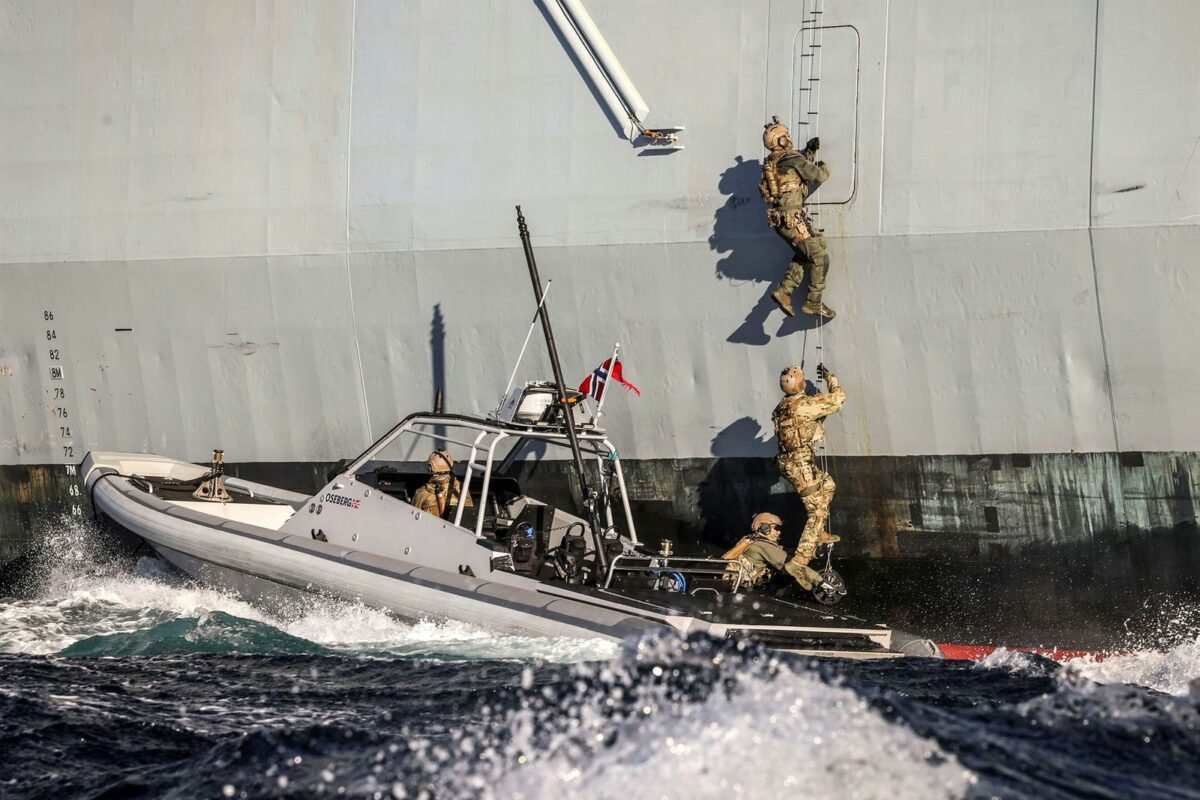
Norwegian Coastal Ranger Commandos practise boarding drills on RFA Lyme Bay in Norway during exercise TARASSIS, October 4, 2025. Image by LPhot Stainer-Hutchins; © Crown copyright 2025. Open Government Licence.
At the same time, regional frameworks should not be presented as solutions to grey-zone deterrence. Hybrid threats remain politically and operationally difficult precisely because attribution, proportionality and legal authorities are rarely straightforward. Regional cooperation improves preparedness and resilience, but it does not eliminate the inherent complexity of responding to ambiguous activities conducted below traditional conflict thresholds.
The challenge facing policymakers is therefore not to create mechanisms that automatically trigger responses. Rather, it is to improve the ability of allies to understand emerging situations, prepare proportionate options and preserve political cohesion during periods of uncertainty.
4.3 Transition to NATO
Regional responsiveness only strengthens collective defence when it supports effective transition into wider Alliance activity.
One of the least discussed aspects of regional defence cooperation is the practical question of transition. Political consultation, information sharing and national activities may begin long before NATO assumes operational responsibilities. Without clearly understood transition mechanisms, however, regional preparedness risks becoming disconnected from Alliance planning and command arrangements.
Early regional activity should therefore be accompanied by explicit transition logic. Political and military planning should identify:
- When national activities become regionally coordinated activities.
- When wider NATO consultation becomes necessary.
- What information can be shared immediately and through which mechanisms.
- How forces and capabilities are transferred into NATO-led operations.
- Which authorities apply at different stages of escalation.
- How command relationships evolve during a crisis.
Exercises provide an important opportunity to test these questions before they become operational requirements. Information sharing arrangements, command relationships, force packages and political consultation mechanisms should all be rehearsed under realistic conditions that reflect the ambiguity characteristic of modern security challenges.
The objective is not to develop rigid escalation models. Every crisis will present unique political and operational considerations. Nevertheless, organisations that have not considered transition requirements in advance frequently discover institutional seams only when operational timelines are already compressed.
Regional speed becomes strategically valuable only when it reduces friction as the response scales. Faster consultation, stronger regional understanding and improved preparedness should ultimately make it easier for NATO to perform the functions that only NATO can fulfil.
Questions for Policymakers and Military Leaders
Several practical questions emerge from this discussion and deserve greater attention across Northern European defence planning:
- Who determines that a regional incident requires JEF consultation?
- What information can participating nations share immediately during ambiguous situations?
- Which response options can be prepared without prejudging NATO political decisions?
- How should national and regional activities transition into NATO-led operations?
- How are forces, information and responsibilities transferred across institutional boundaries?
- Which lessons identified through regional exercises are systematically incorporated into NATO planning processes?
These questions do not challenge NATO’s role within collective defence. They recognise that preparedness begins long before operational command is required. Regional frameworks provide the greatest value when they improve understanding, strengthen political cohesion and reduce the practical friction that inevitably exists within complex multinational security arrangements.
5. Distributed Regional Responsibility
One of the recurring assumptions in European defence cooperation is that emerging operational challenges require the creation of new institutions, headquarters or organisational frameworks. While institutional innovation occasionally becomes necessary, Northern European security is not currently suffering from a lack of organisations. Rather, it suffers from fragmentation, institutional seams and the persistent tendency to discuss capabilities in isolation from one another.
The Baltic-Arctic operating environment already possesses considerable expertise, infrastructure and institutional capacity. NATO centres of excellence, national capabilities, regional initiatives, operational headquarters and specialised military communities collectively represent decades of investment in knowledge, doctrine and practical experience. The strategic challenge is therefore less about creating additional structures and more about recognising how existing strengths can complement one another across national and institutional boundaries.
Regional defence cooperation should begin with a simple question: before creating a new capability, coordination mechanism or institution, does the required expertise already exist somewhere within the region?
A distributed model of regional responsibility begins from the recognition that not every capability must sit within a single headquarters, nation or framework nation. Geography, existing investments and national expertise have already created considerable strengths across Northern Europe. Connecting those strengths in ways that improve resilience, preparedness and Alliance effectiveness represents a far more practical and politically sustainable approach than building parallel structures.
This paper does not propose a parallel JEF headquarters, a new military chain of command or additional institutional layers. Rather, it examines how existing centres of expertise, national capabilities and regional initiatives could contribute to a more resilient and practically connected Northern European security architecture while preserving NATO’s authorities and JEF’s political flexibility.
Three principles underpin this approach.
- New institutions should not be created if existing structures can perform the required function.
- Expertise that already exists across the region should not be unnecessarily centralised or duplicated.
- Strategic fragility should be avoided by concentrating political, intellectual or functional responsibility within a single nation, institution or budget cycle.
Taken together, these principles support a broader argument running throughout this paper. Northern European security increasingly depends upon recognising that geography creates shared responsibilities whether or not institutions have fully adapted to them. Distributed regional responsibility therefore seeks to strengthen NATO and JEF alike by connecting existing capabilities more effectively rather than attempting to reinvent them.
5.1 United Kingdom: Framework Leadership Without Framework Centralisation
The United Kingdom should remain JEF’s Framework Nation. British political leadership, military expertise and the Standing Joint Force Headquarters remain central to the framework’s success and its credibility within the wider Alliance.
Framework leadership, however, should not require framework centralisation. A resilient regional framework should not depend upon a single nation’s budget cycle, political priorities or personnel capacity. Distributing functional responsibilities across member states strengthens rather than weakens the Framework Nation’s position by improving resilience and reducing single points of failure.
The United Kingdom is uniquely positioned to maintain responsibility for political leadership, deployability, overall coherence and relationships with NATO’s command structures. That leadership role does not preclude other members from leading specific areas of regional expertise where they already possess established capabilities or institutions.
A distributed model of regional responsibility therefore reinforces British leadership by ensuring that JEF remains operationally relevant and politically sustainable over time.
5.2 The Netherlands: Multi-Domain Coordination and Operational Experimentation
The question facing Northern European defence cooperation is not whether a new command-and-control institution should be established for JEF. The more useful question is whether expertise relevant to regional coordination already exists within the framework’s member states.
The NATO Command and Control Centre of Excellence in Utrecht provides NATO and Allied nations with expertise relating to command-and-control concepts, multi-domain coordination, experimentation and operational challenges associated with modern military operations. It is not an operational headquarters and should not become one.
Its value lies elsewhere. Operational challenges across Northern Europe increasingly involve the interaction of national authorities, NATO command structures, civilian infrastructure and multi-domain military effects. The Baltic-Arctic operating environment does not align neatly with institutional or geographic boundaries, making transition mechanisms, information sharing and command relationships increasingly important.
Potential areas of contribution include:
- multi-domain coordination concepts;
- cross-headquarters information exchange;
- command-post experimentation;
- transition mechanisms between national, regional and NATO-led activity;
- command and control under degraded communications;
- civil-military coordination in contested environments.
A broader leadership question naturally follows. Why create a new institution to explore these challenges when a NATO-accredited centre of excellence already exists within a JEF member state and possesses expertise directly relevant to them?
Strengthening regional preparedness does not necessarily require creating new capabilities. In many cases, it requires better connecting existing ones.
5.3 Estonia: Cyber Expertise and Regional Resilience
Estonia has established itself as one of Europe’s leading contributors in cyber defence and resilience. The NATO Cooperative Cyber Defence Centre of Excellence in Tallinn represents one of NATO’s most recognised centres for cyber-related doctrine, legal analysis, exercises and education.
The next strategic question is whether Europe’s recognised cyber expertise is sufficiently connected to operational regional requirements.
Cyber effects do not remain confined within institutional boundaries. Critical infrastructure protection, military mobility, logistics resilience, maritime operations and command-and-control arrangements increasingly depend upon secure and resilient digital systems. Northern European security therefore requires closer integration between cyber expertise and operational planning across multiple domains.
Potential areas of contribution include:
- cyber situational-awareness methodologies;
- resilience standards and operational lessons;
- legal and policy analysis supporting collective responses;
- exercises linking military networks and critical infrastructure;
- coordination mechanisms involving civilian authorities and private-sector operators;
- incorporation of lessons emerging from contemporary Russian cyber campaigns.
Estonia’s recognised position within cyber defence brings both opportunities and responsibilities. Regional resilience will increasingly depend not only upon possessing expertise, but also upon ensuring that expertise is connected to the practical requirements of deterrence and operational preparedness.
5.4 Germany: Geography Does Not Recognise Membership Categories
Geography does not ask whether a nation belongs to JEF. Germany is a Baltic Sea nation. Germany is a NATO ally. Germany serves as the Framework Nation for Lithuania and hosts NATO-accredited centres of excellence directly relevant to Northern European security. Operational realities therefore exist independently of political membership arrangements.
The NATO Centre of Excellence for Operations in Confined and Shallow Waters in Kiel provides expertise directly applicable to the Baltic Sea, Danish Straits and wider Northern European maritime operating environment.
Potential areas of contribution include:
- maritime operations in confined and shallow waters;
- mine warfare and port-access challenges;
- maritime law and civilian shipping interactions;
- unmanned and undersea systems;
- critical maritime infrastructure protection;
- reinforcement and logistics planning within congested maritime environments.
This paper deliberately avoids making arguments regarding German membership of JEF. Those questions are addressed in Paper 4. It nevertheless remains appropriate to recognise that geography creates shared operational challenges regardless of institutional boundaries.
5.5 Denmark: The Forgotten Maritime Chokepoint
Few maritime concepts are better understood within NATO than the strategic significance of the GIUK Gap. Far less attention is typically given to the Danish Straits despite their importance for access to and from the Baltic Sea.
The question therefore deserves to be asked: why do the Danish Straits not yet possess the same strategic visibility within Northern European defence discussions as the GIUK Gap?
Denmark occupies a unique geographic position linking the Baltic Sea, North Sea and North Atlantic approaches. Maritime access, reinforcement planning, civilian shipping, critical infrastructure protection and mine countermeasure operations all intersect within this operating environment.
The Danish Straits
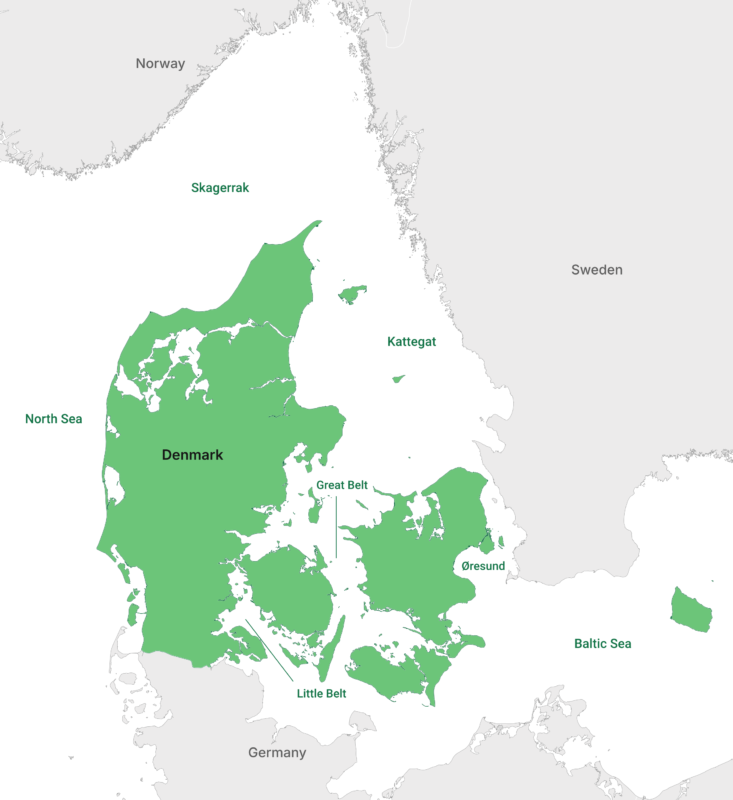
Map: BISC. Coastline: OpenStreetMap contributors.
Potential leadership areas include:
- maritime access and denial planning;
- mine warfare and route assurance;
- civil-shipping coordination;
- regional maritime infrastructure protection;
- maritime testing and experimentation;
- connecting Baltic, North Sea and Arctic responsibilities.
Denmark’s geography creates strategic responsibilities that extend beyond national considerations. Northern European security increasingly depends upon recognising the Danish Straits not merely as a geographic feature, but as critical infrastructure for regional deterrence and reinforcement.
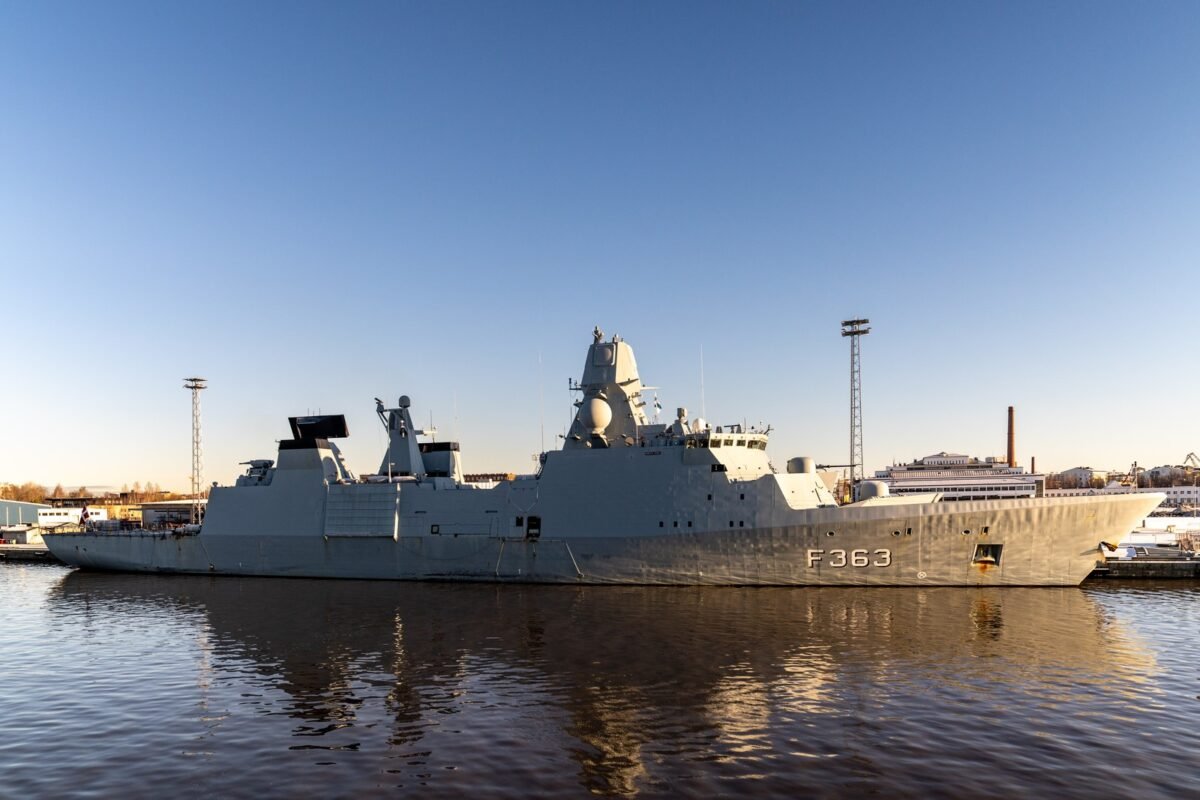
The Danish frigate HDMS Niels Juel docks at the port of Turku, Finland, as it prepares for exercise Freezing Winds, November 26, 2025. Photo: Nato, via Flickr. CC BY-NC-ND 4.0.
5.6 Finland: Testing Capability in Contested Conditions
Europe’s ability to develop operationally credible military capabilities increasingly depends upon its ability to test those capabilities realistically.
The question is not whether contested environments matter. Contemporary conflicts have already answered that question. The more difficult questions concern where, how and under what legal and practical conditions Europe intends to conduct realistic testing and experimentation.
Several strategic questions remain insufficiently addressed.
- Where can Europe realistically test GNSS-denied operations?
- Where can electronic warfare resilient capabilities be validated?
- Which environments are suitable for testing autonomous systems operating under contested conditions?
- Which nations possess the geography and expertise required to support such activities?
Finland’s geography, expertise and operating conditions position it as a credible contributor to regional experimentation and capability validation.
Potential areas of contribution include:
- dispersed operations;
- EW-resilient communications and navigation;
- Arctic and austere-environment testing;
- logistics under climate and distance constraints;
- host nation support exercises;
- validation of unmanned systems operating in contested environments.
Operational credibility ultimately depends upon validating capabilities under realistic conditions rather than assuming they will perform as intended when deployed.
5.7 Canada: Strategic Depth Across the Atlantic and Arctic
Canada occupies a uniquely relevant position within Northern European security discussions despite not currently being a member of JEF.
Its geography connects the Arctic and North Atlantic. Its military contributions continue to support NATO’s collective defence commitments. Its participation in recent JEF exercises demonstrates practical engagement with the framework, while Canadian leadership relating to the Defence, Security and Resilience Bank introduces additional opportunities concerning defence financing and industrial resilience.
Potential areas of contribution include:
- North Atlantic and Arctic expertise;
- transatlantic reinforcement;
- defence industrial resilience;
- dual-use infrastructure financing;
- regional exercises and military mobility;
- strengthening links between strategic requirements and financing mechanisms.
Canada represents an example of how geography, shared strategic interests and operational requirements can naturally support deeper regional cooperation without requiring institutional duplication.
5.8 Ukraine: Operational Adaptation at Scale
Ukraine should not be understood merely as Europe’s drone laboratory. Over the past several years, Ukraine has become one of the most significant sources of contemporary operational lessons relating to modern warfare. Its experience extends across electronic warfare, logistics, resilience, mobilisation, infrastructure protection, software-enabled military adaptation and contested-environment operations.
Potential mechanisms for cooperation include:
- permanent lessons exchanges;
- participation in selected exercises and experimentation activities;
- operational red teaming;
- procurement and adaptation-cycle analysis;
- infrastructure resilience planning;
- integration of validated operational lessons where security conditions permit.
Reducing Ukrainian expertise to individual technologies risks overlooking the broader strategic value that contemporary operational experience provides.
Cooperation with Ukraine must therefore be approached as a partnership between practitioners rather than a process of extracting lessons. Operational adaptation remains one of Ukraine’s most valuable contributions to European security, and its relevance extends well beyond any single capability area.
6. Shared Regional Understanding Without a Parallel Headquarters
Northern European security does not primarily suffer from a shortage of sensors, information or technological capability. NATO, national armed forces, civilian authorities and private industry collectively generate vast amounts of data across every operational domain. The greater challenge lies in transforming fragmented information into sufficiently shared and timely understanding that supports political and military decision-making during periods of ambiguity and crisis.
The discussion surrounding situational awareness often defaults to technological solutions. New platforms, dashboards and information-sharing systems are regularly presented as answers to operational challenges that are fundamentally organisational in nature. Experience across both military operations and contemporary conflicts increasingly demonstrates that technology alone cannot create shared understanding when authorities remain unclear, information cannot be exchanged appropriately or organisations lack confidence in one another’s processes and outputs.
Regional responsiveness therefore depends not only upon the ability to collect information, but also upon the ability to determine what information matters, who requires it, under what conditions it can be shared and how decisions are made when information remains incomplete or contradictory.
This paper does not propose a regional headquarters or a single common operating picture for Northern Europe. Rather, it argues for a federated approach to regional understanding that preserves national sovereignty and existing command arrangements while improving the practical ability of nations and institutions to act coherently when required.
6.1 The Problem Is Organisational Before It Is Technical
The barriers preventing effective regional understanding are rarely technological in isolation. They are more commonly rooted in organisational arrangements, governance frameworks and institutional behaviour.
Several challenges continue to constrain information sharing and decision-making across Northern Europe:
- fragmented data ownership;
- incompatible classification frameworks;
- differing national operational pictures;
- limited access to commercial and dual-use data sources;
- unclear authorities and responsibilities;
- slow validation mechanisms;
- mistrust in AI-supported outputs;
- the absence of agreed minimum information requirements.
Each of these challenges carries operational consequences. Information that exists but cannot be shared offers limited value during a rapidly evolving incident. National authorities operating from different assumptions may reach different conclusions regarding the same event. Commercially generated information can provide valuable insights, but questions concerning ownership, validation and legal authorities frequently remain unresolved.
Similarly, artificial intelligence increasingly offers opportunities to process information at speed and scale. However, AI-generated outputs do not eliminate the need for human judgement, nor do they resolve disagreements relating to classification, accountability or political risk. Trust in decision-making processes remains a prerequisite for trust in the information itself.
The organisational dimension of shared understanding is therefore at least as important as the technological one.
6.2 A Federated Regional Understanding Model
A federated model provides a practical alternative to both excessive centralisation and fragmented national approaches.
The objective is not to establish a single regional database or a permanently shared operational picture. Rather, it is to enable participating nations and institutions to develop sufficiently shared understanding when circumstances require coordinated political or military action.
Key principles should include:
- nations retain ownership of their information and authorities;
- common interface and data standards where appropriate;
- role-based and mission-based access arrangements;
- agreed regional information requirements;
- resilient information exchange mechanisms;
- traceable provenance and auditability;
- human validation of critical outputs;
- the ability to operate under degraded communications conditions.
Federation offers several practical advantages. It preserves sovereignty while improving interoperability. It reduces the political and legal challenges associated with large-scale information centralisation. It also provides greater resilience by avoiding unnecessary single points of failure.
The operational objective should not be perfect information sharing. It should be timely and sufficiently shared understanding that enables better political and military decision-making during periods of uncertainty.
6.3 Existing Centres as Enablers Rather Than Owners
Northern Europe already possesses considerable institutional expertise relevant to regional coordination and information-sharing challenges.
The NATO Command and Control Centre of Excellence in Utrecht contributes expertise relating to multi-domain command and control, operational experimentation and cross-headquarters coordination. The NATO Cooperative Cyber Defence Centre of Excellence in Tallinn provides internationally recognised expertise in cyber resilience, exercises, legal frameworks and cyber doctrine. The NATO Centre of Excellence for Operations in Confined and Shallow Waters in Kiel contributes operational understanding directly relevant to the Baltic Sea and Northern European maritime operating environment.
These institutions do not require new mandates or command authorities in order to contribute meaningfully to regional preparedness.
Their potential value lies in supporting:
- doctrine development;
- experimentation activities;
- lessons integration;
- exercise design;
- resilience planning;
- operational concepts;
- multi-domain coordination;
- civil-military cooperation.
NATO’s operational commands appropriately retain command authority and responsibilities for military operations. JEF, in turn, benefits from improved regional understanding and preparedness without assuming responsibilities that properly belong elsewhere.
The question facing policymakers is therefore not whether another institution should be established, but whether existing expertise is being connected effectively enough to support the operational realities of Northern Europe.
6.4 Leadership and Accountability
Regional understanding ultimately remains a leadership challenge. Information sharing arrangements are only as effective as the governance mechanisms supporting them. Political leaders, commanders and national authorities must therefore address a number of practical questions before assuming that technological solutions alone will improve regional responsiveness.
These questions include:
- Who owns the regional information requirements?
- Who determines what information is shared and at which classification levels?
- Who validates information originating from commercial, open-source or AI-supported systems?
- Who maintains situational understanding during ambiguous incidents?
- How does information transition into NATO’s operational command structures when required?
- Who remains accountable when information is incomplete, contradictory or deliberately manipulated?
These questions do not yet possess universally agreed answers across Northern Europe, which is precisely why they merit greater attention.
Contemporary defence discussions frequently focus on sensors, data platforms and emerging technologies. While these capabilities are important, they do not remove the need for governance, leadership and institutional trust. Expensive technology cannot create shared understanding when organisations remain unwilling or unable to exchange information appropriately, when authorities are unclear or when institutional seams prevent timely decision-making.
Regional responsiveness therefore begins not with additional headquarters or larger databases, but with a clear understanding of how nations intend to build trust, define responsibilities and make decisions together when ambiguity inevitably emerges.

A Latvian sailor aboard LVNS Virsaitis, flagship of Standing Nato Mine Countermeasures Group One, studies a map while sailing during exercise Freezing Winds, November 28, 2025. Photo: Nato, via Flickr. CC BY-NC-ND 4.0.
7. Political Signalling and Deterrence
Political signalling is frequently discussed as a matter of strategic communications or public declarations. In practice, however, credible signalling is rarely achieved through words alone. Adversaries assess political cohesion, military preparedness and institutional resilience by observing how states organise themselves, where they invest resources and whether political commitments can be translated into operational action.
Northern European security increasingly depends upon demonstrating that regional actors are capable of coordinating effectively across institutional and geographic boundaries. A distributed and coherent model of regional responsibility would therefore communicate far more than administrative efficiency. It would demonstrate that nations sharing a common operating environment are capable of recognising common challenges and organising themselves accordingly.
Deterrence is ultimately strengthened when political intent, military preparedness and institutional arrangements reinforce one another. Regional responsiveness, resilient infrastructure and effective coordination all contribute to reducing uncertainty for allies while increasing uncertainty for potential adversaries.
7.1 Signalling to Russia
Russia’s military posture in Northern Europe spans multiple geographic and operational axes extending from the Kola Peninsula and Murmansk to Saint Petersburg and Kaliningrad. These areas influence maritime access, reinforcement planning, air operations, critical infrastructure protection and the wider security environment across the Baltic-Arctic system.
A more coherent regional approach strengthens deterrence by demonstrating that Northern European nations increasingly understand their shared operating environment and are preparing accordingly. Operational readiness does not require every nation to possess identical capabilities. It requires an understanding of how national strengths contribute to collective resilience and how institutional seams can be reduced before they become operational vulnerabilities.
Several practical effects contribute to deterrence in this context:
- improved coordination across land, maritime, air, cyber and infrastructure domains;
- greater understanding of regional dependencies and reinforcement requirements;
- reduced opportunities to exploit political, institutional or command-related seams;
- improved readiness during ambiguous or rapidly evolving incidents;
- increased resilience across critical infrastructure and logistics networks.
Potential adversaries routinely seek to exploit ambiguity, uncertainty and organisational fragmentation. Demonstrating the ability to coordinate regionally and transition effectively between national, regional and NATO-led responses complicates adversarial planning and strengthens deterrence without requiring new military authorities or institutional arrangements.
The objective is not to create additional military structures, but to ensure that existing structures are sufficiently connected to respond coherently when circumstances demand it.
7.2 Signalling Within NATO
Political signalling within NATO matters no less than signalling externally. The Alliance’s collective defence posture depends upon member states demonstrating that they are prepared not only to invest in defence capabilities, but also to organise themselves effectively in support of Alliance objectives.
Regional frameworks are sometimes portrayed as potential competitors to NATO when, in practice, they often address challenges that are difficult for larger institutions to address with equal speed or regional specificity. Properly designed regional cooperation can reduce rather than increase the burden placed upon Alliance structures by improving preparedness before NATO’s larger mechanisms are required.
A distributed model of regional responsibility also offers an opportunity to demonstrate that burden sharing extends well beyond defence spending percentages. Expertise, infrastructure, operational knowledge and institutional capacity all contribute meaningfully to Alliance effectiveness.
Examples include:
- contributing operationally relevant expertise through existing NATO-accredited centres of excellence;
- strengthening military mobility and reinforcement planning across Northern Europe;
- improving regional consultation and preparedness;
- supporting NATO’s operational command structures rather than duplicating them;
- connecting national investments to shared operational requirements.
This broader understanding of burden sharing more accurately reflects the realities of contemporary defence cooperation. Geography creates responsibilities that cannot always be measured through spending targets alone. Nations contribute to deterrence through capabilities, infrastructure, expertise and preparedness that collectively strengthen the Alliance.
Regional initiatives should therefore be judged not by whether they create additional institutions, but by whether they improve NATO’s ability to deter aggression and respond effectively across the operating environments it is expected to defend.
7.3 Signalling to Domestic Institutions and Industry
Political signalling is not directed exclusively towards allies or adversaries. Governments, industry partners and critical infrastructure operators also require a clear understanding of their respective roles within contemporary defence planning.
Modern military operations depend upon capabilities and infrastructure that are increasingly owned, operated or supported by civilian organisations. Ports, energy networks, telecommunications systems, logistics providers, commercial satellite services and dual-use technologies all contribute to operational effectiveness. Treating these dependencies as background considerations rather than strategic assets risks creating vulnerabilities that become visible only during crisis.
A more coherent regional approach should therefore strengthen the relationship between operational requirements and national decision-making.
This includes:
- defining the roles and responsibilities of critical infrastructure owners and operators;
- aligning procurement priorities with validated regional operational requirements;
- ensuring that experimentation activities contribute to capability adoption rather than remaining isolated demonstrations;
- connecting financing mechanisms to identified capability gaps and resilience requirements;
- recognising the strategic implications of national geography and associated responsibilities.
Political leaders cannot meaningfully discuss resilience, deterrence or regional cooperation without understanding what their geography obliges them to provide. Maritime nations carry maritime responsibilities. Arctic nations carry Arctic responsibilities. Nations occupying critical reinforcement routes carry obligations relating to access, mobility and infrastructure protection.
Operational credibility ultimately depends upon aligning political ambition, institutional arrangements and practical capability development. Regional deterrence is strengthened not simply by acquiring new technologies or publishing additional strategies, but by demonstrating that nations understand both the advantages and responsibilities created by the geography they collectively inhabit.
8. The Risks of Getting Complementarity Wrong
Regional defence cooperation is often presented as inherently beneficial. In practice, however, complementarity is not an automatic outcome of bringing institutions, nations and capabilities together. Poorly designed cooperation can introduce new layers of complexity, duplicate existing arrangements and create uncertainty regarding authorities and responsibilities. The purpose of this section is therefore not to criticise regional defence initiatives, but to recognise that operational effectiveness depends as much upon what is deliberately avoided as upon what is actively developed.
The proposals outlined throughout this paper are intended to strengthen NATO, improve regional responsiveness and make better use of existing capabilities. Achieving those objectives nevertheless requires acknowledging the risks associated with institutional overlap, political divergence and organisational complexity. Failure to address these challenges would risk replacing existing seams with entirely new ones.
8.1 Parallelism
One of the greatest risks facing regional defence cooperation is the accidental creation of parallel planning, coordination and information-sharing processes. Institutions frequently emerge with good intentions but gradually begin reproducing functions that already exist elsewhere.
From an operational perspective, duplicate processes rarely increase effectiveness. Instead, they consume limited personnel resources, complicate decision-making and increase uncertainty regarding which mechanisms should be used during periods of crisis. The objective of complementarity should therefore be to simplify cooperation wherever possible rather than introducing additional institutional layers.
Political and military leaders should continuously ask whether proposed capabilities or coordination mechanisms genuinely address identified gaps or merely recreate existing functions under a different organisational label.
8.2 Authority Confusion
Regional responsiveness should never come at the expense of clarity regarding authorities and responsibilities.
A distributed model of regional responsibility may improve preparedness and coordination, but it must not create ambiguity concerning command relationships or political authorities. JEF cannot and should not assume responsibilities that properly belong to NATO’s command structures or national governments.
Operational effectiveness depends upon leaders understanding where consultation ends and command authority begins. The distinction is particularly important during ambiguous incidents when military, political and legal considerations evolve simultaneously.
Complementarity succeeds only when responsibilities are clearly defined and consistently exercised during both peacetime activities and crisis response.
8.3 Framework Nation Dilution
The United Kingdom’s role as JEF’s Framework Nation remains fundamental to the framework’s success. Distributed regional responsibility should therefore not be interpreted as an attempt to dilute British leadership or transfer political ownership elsewhere.

UK Carrier Strike Group units assembled for the start of Exercise Joint Warrior, a UK-led exercise forming part of Nato Exercise Steadfast Defender, February 24, 2024. Image by AS1 Amber Mayall RAF; © Crown copyright 2024. Open Government Licence.
There is nevertheless a practical difference between distributed responsibility and fragmented leadership. Assigning functional responsibilities across the region without clear governance arrangements risks weakening coherence rather than strengthening resilience.
Framework leadership provides strategic direction, political credibility and continuity. Distributed responsibility should complement that leadership by strengthening regional resilience and reducing overdependence upon any single nation’s resources or political priorities.
The challenge is therefore not whether leadership should be distributed, but rather how distributed contributions can reinforce existing leadership arrangements.
8.4 Institutional Capture
Existing institutions are not immune to institutional incentives. Centres of excellence, organisations and national initiatives naturally seek to demonstrate their relevance and secure continued political support and funding.
This is neither unusual nor inherently problematic. Difficulties arise when institutional interests begin to drive operational requirements rather than the reverse.
Regional defence cooperation should remain driven by validated operational challenges and strategic requirements. Institutions should contribute because they possess relevant expertise, not because participation strengthens institutional visibility or supports organisational survival.
The fundamental question should remain straightforward: does the proposed contribution measurably improve regional preparedness, resilience or operational effectiveness?
8.5 National Resistance
Political agreement regarding regional cooperation does not automatically translate into practical implementation.
Nations may support common concepts and political declarations while remaining reluctant to share information, invest in infrastructure or commit personnel and capabilities. These constraints are neither surprising nor necessarily unreasonable. National sovereignty remains a defining feature of both NATO and JEF.
Operational realities nevertheless require acknowledging that regional resilience depends upon practical commitments rather than shared terminology alone.
Political leaders should therefore remain realistic regarding what cooperation requires in practice and avoid assuming that conceptual agreement automatically produces operational outcomes.
8.6 Overexpansion
Regional frameworks derive much of their effectiveness from shared geography, political familiarity and operational trust.
Expanding responsibilities, functions or membership too quickly risks reducing many of the characteristics that make regional cooperation valuable in the first place. Larger frameworks inevitably introduce additional political considerations, divergent priorities and increased coordination requirements.
Questions regarding future membership deserve serious consideration and will be addressed in Paper 4. For the purposes of this paper, however, it remains sufficient to recognise that institutional growth should never become an objective in itself.
Regional cooperation should expand only where doing so demonstrably improves deterrence, readiness or operational effectiveness.
8.7 Technology-First Thinking
Technology continues to occupy a disproportionate amount of attention within contemporary defence discussions.
Shared operational pictures, digital platforms and information-sharing solutions are frequently presented as relatively straightforward answers to challenges that are fundamentally organisational in nature. Experience consistently demonstrates that technology cannot compensate for unclear governance arrangements, poorly defined authorities or insufficient institutional trust.
A federated regional understanding model requires users, governance mechanisms, operational concepts and leadership long before it requires additional software.
Political and military leaders should therefore remain cautious of initiatives that promise technological solutions before adequately defining the operational problems they are intended to address.
8.8 Political Divergence
Northern European nations share many strategic interests. They do not, however, always share identical threat perceptions, escalation preferences or political priorities.
Ambiguous incidents involving critical infrastructure, cyber operations or military signalling rarely provide immediate political consensus regarding appropriate responses. Regional responsiveness must therefore accommodate the reality that political decision-making remains inherently national.
Effective consultation mechanisms cannot eliminate political disagreement. They can, however, improve the quality and speed of decision-making when disagreements emerge.
Complementarity should therefore be designed with political diversity in mind rather than assuming perfect alignment across all circumstances.
8.9 Resource Mismatch
Finally, responsibilities that are not supported by personnel, funding and political sponsorship remain little more than paper architecture.
Regional defence cooperation has historically suffered from ambitious concepts that failed to survive contact with organisational realities. Assigning responsibilities without providing appropriate resources risks creating additional expectations without improving operational capability.
Leadership ultimately requires difficult prioritisation decisions. Strategic ambitions must therefore remain aligned with available resources and demonstrable operational requirements.
The objective of complementarity is not to create additional obligations for their own sake. It is to ensure that existing capabilities, expertise and investments contribute more effectively to regional preparedness and Alliance deterrence.
9. A Practical Agenda for JEF-NATO Complementarity
The purpose of this paper has not been to propose new institutions, permanent headquarters or additional command structures. Rather, it has examined how regional cooperation can strengthen Alliance preparedness by improving consultation, coordination and operational understanding across Northern Europe.
The recommendations presented below deliberately favour practical and incremental improvements that build upon existing structures, capabilities and expertise across the region. They are not intended to redesign Northern European security architecture or to expand JEF beyond its political mandate. Instead, they seek to improve the ability of nations and institutions to work together more effectively across command, geographic and institutional boundaries while preserving NATO’s authorities and JEF’s political flexibility.
Operational challenges rarely align neatly with organisational charts. Geography, critical infrastructure, military mobility and reinforcement requirements create dependencies that extend across national borders and institutional responsibilities. Improving regional responsiveness therefore depends less on creating new structures and more on strengthening the practical connections between those that already exist.
Recommendation 1: Establish a JEF-NATO Complementarity Framework
One of the recurring themes throughout debates surrounding regional defence initiatives is the assumption that complementarity emerges automatically whenever organisations share broadly similar objectives. In practice, institutional overlap is frequently confused with functional duplication, particularly when discussing NATO and JEF. Questions regarding whether JEF duplicates NATO frequently arise because complementarity has been treated as an assumed outcome rather than something that must be deliberately designed, exercised and periodically reassessed.
A practical framework defining how JEF supports NATO within Northern Europe would provide greater clarity regarding consultation mechanisms, information exchange, transition arrangements and support for NATO’s regional defence plans. The objective would not be to create additional authorities or institutional layers, but to ensure that participating nations share a common understanding of where regional cooperation creates operational value and where NATO’s responsibilities properly begin and end.
Developing such a framework would require participation from JEF member states, NATO political and military authorities and relevant national headquarters. The greatest challenges are unlikely to be technical. Political alignment, institutional culture and differing national priorities will ultimately determine whether complementarity becomes operationally meaningful or remains largely rhetorical.
Successful implementation should be reflected in improved regional preparedness, greater clarity during exercises and crises, and a demonstrable reduction in uncertainty regarding how regional activities contribute to NATO’s wider deterrence and defence objectives. The measure of success is not the number of meetings held or documents produced, but whether political and military leaders understand how regional cooperation strengthens Alliance preparedness in practice.
Recommendation 2: Map the Northern Command and Coordination Seams
The Baltic-Arctic operating environment spans multiple NATO commands, national authorities and civilian institutions. Geography does not recognise administrative boundaries, yet military organisations necessarily rely upon them to function effectively. Reinforcement routes, maritime approaches, critical infrastructure networks and hybrid activities frequently cross command and institutional seams that become particularly relevant during periods of ambiguity and crisis.
A structured mapping effort should therefore identify where command responsibilities, reinforcement routes, information requirements and institutional authorities intersect across NATO’s northern operating environment. Particular attention should be given to the relationships between operational commands, national headquarters and civilian stakeholders responsible for critical infrastructure protection, military mobility and resilience planning.
The value of such an effort lies not in producing another static map or planning document. The more significant challenge is developing a shared understanding of where operational seams exist and how they influence decision-making during crisis. Mapping those seams provides an opportunity to identify friction points before they emerge during real-world contingencies and allows exercises and planning activities to address them proactively.
Success should be measured through improved planning assumptions, more realistic multinational exercises and a greater understanding of how responsibilities intersect across national and institutional boundaries. Northern European security depends increasingly upon the ability to move information, forces and political decisions across those boundaries without unnecessary delay or uncertainty.
Recommendation 3: Develop a Distributed Functional Support Network
Northern Europe already possesses significant expertise relevant to command and control, cyber resilience, maritime operations, infrastructure protection and contested-environment capability development. The region does not require another permanent bureaucracy to begin connecting these strengths more effectively.
A distributed functional support model would build upon existing national expertise, accredited centres of excellence and regional initiatives while preserving current institutional responsibilities. The objective is not to create subordinate organisations within JEF or establish a parallel headquarters structure, but rather to strengthen practical cooperation where operational requirements overlap.
Modern defence cooperation should begin with a simple question: before creating a new institution, capability or coordination mechanism, does the required expertise already exist somewhere within the region? Northern Europe has already invested heavily in centres of excellence, national capabilities and operational expertise. The strategic challenge is less about creating new organisations and more about recognising and connecting existing strengths in ways that improve resilience and preparedness.
Implementation will require participating nations to identify where regional expertise can most effectively support collective objectives while avoiding duplication or institutional competition. Contributions should remain voluntary, operationally relevant and tied to clearly defined outputs rather than institutional ambitions.
Success should be measured through demonstrable improvements in exercises, doctrine development, experimentation activities and regional preparedness. Functional cooperation should make existing institutions more valuable rather than creating additional layers of complexity.
Recommendation 4: Develop a Federated Regional Understanding Concept
Contemporary defence challenges increasingly require nations and institutions to make decisions based upon information originating from military, civilian, commercial and digital sources. Regional responsiveness therefore depends upon establishing mechanisms that enable sufficiently shared understanding without creating unnecessary centralisation.
A federated model should define regional information requirements, ownership arrangements, classification principles, information provenance requirements and degraded-mode operating concepts. The objective is not to establish a single database or operational headquarters. Rather, it is to improve the practical ability of nations and institutions to develop a sufficiently shared understanding of events to support timely political and military decision-making.
Implementation challenges extend well beyond technology. Governance arrangements, legal considerations, interoperability requirements and institutional trust remain equally important. Experience has repeatedly demonstrated that information-sharing challenges are often organisational and cultural before they become technical problems. Expensive digital platforms cannot compensate for unclear authorities, incompatible classifications or the absence of agreed information requirements.
Success should ultimately be measured by improved decision-making during exercises and enhanced resilience during contested and degraded operating conditions. A shared understanding does not require everyone to possess identical information at all times. It requires leaders and institutions to possess sufficient confidence in the information available to make timely and coordinated decisions when circumstances demand it.
Recommendation 5: Exercise Transition Rather Than Activity Alone
Exercises frequently validate activities while paying insufficient attention to the transition points that occur between national, regional and Alliance-level responses. Operational reality is rarely characterised by clear boundaries separating peacetime activities from military operations. Contemporary crises evolve through periods of ambiguity involving political consultation, infrastructure incidents, hybrid activity and gradual military escalation.

A Royal Netherlands Navy NH90 helicopter and a British Army Apache fly in formation with a Royal Navy Merlin near Bardufoss, Norway, February 2024. Image by POPhot Kyle Heller; © Crown copyright 2024. Open Government Licence.
Future exercises should therefore explicitly test how information, responsibilities and capabilities transition between national authorities, regional coordination mechanisms and NATO operational command structures. Questions surrounding authorities, information-sharing arrangements and political consultation should be exercised alongside more traditional military objectives.
Implementation will require a willingness to test politically and operationally uncomfortable scenarios. The greatest challenges often emerge not when military forces begin operating, but during the period when institutions attempt to determine who is responsible for acting, what information can be shared and how existing plans should adapt to evolving circumstances.
Success should be measured by reductions in friction associated with transition processes and an improved understanding of responsibilities across participating organisations. Regional responsiveness becomes significantly more valuable when it facilitates NATO’s ability to scale its response rather than creating additional complexity during crisis.
Recommendation 6: Align Regional Responsibilities With Resources
Regional cooperation frequently produces ambitious concepts that are insufficiently supported by personnel, funding or political sponsorship. Assigning responsibilities without corresponding resources risks creating expectations that cannot be translated into operational capability.
Regional responsibilities should therefore be linked to clearly defined outputs, appropriate funding mechanisms and national commitments. Contributions may take many forms, including infrastructure, expertise, experimentation activities or operational capabilities. What matters is that political commitments are accompanied by realistic assessments of the resources required to sustain them over time.
The implementation challenges are both political and practical. Defence priorities inevitably compete with broader national objectives, while budgetary pressures and differing approaches to defence investment will continue to influence the pace at which regional initiatives develop. Strategic ambition without sustained political and financial commitment rarely survives contact with operational reality.
Success should be measured through practical outputs rather than the number of initiatives announced. Regional cooperation strengthens deterrence only when commitments are sufficiently resourced to produce operational effects rather than political symbolism.
Recommendation 7: Institutionalise Operational Lessons and Strategic Partnerships
Northern European security does not exist in isolation from the wider transatlantic and European security environment. Contemporary operational lessons and emerging partnerships therefore represent valuable opportunities for strengthening regional preparedness and resilience.
Ukraine’s operational experience provides unparalleled lessons concerning adaptation, resilience and contested-environment operations across domains that extend far beyond unmanned systems and electronic warfare. Ukrainian expertise increasingly encompasses logistics, infrastructure protection, mobilisation, command relationships, procurement adaptation and military innovation under sustained operational pressure. Reducing Ukrainian contributions to individual technologies risks overlooking the broader institutional lessons that Europe and NATO continue to absorb.
Canadian participation similarly provides relevant expertise relating to Arctic security, transatlantic reinforcement, industrial resilience and emerging defence financing initiatives. Canada’s geography, political alignment and operational interests position it as a particularly relevant partner for Northern European security discussions without requiring immediate decisions regarding future membership arrangements.
Institutionalising operational lessons and strategic partnerships will require careful consideration of political sensitivities, security requirements and practical mechanisms for sustaining meaningful cooperation over time. Strategic partnerships should not become symbolic exercises or politically attractive announcements disconnected from operational requirements.
Success should be measured by whether validated operational lessons and strategic partnerships are effectively incorporated into regional preparedness activities. Operational experience is only valuable when institutions possess both the willingness and the mechanisms required to translate lessons identified into lessons learned and, ultimately, into capability and preparedness improvements across the region.
10. Conclusion: NATO’s Regional Force Multiplier
Throughout this paper, JEF has been examined not as an alternative to NATO, nor as a future military institution seeking greater authority or a broader mandate. Its value lies elsewhere. JEF’s greatest strength is its ability to strengthen NATO’s political and operational preparedness across Northern Europe by improving regional consultation, shared understanding and practical cooperation among allies that share both geography and strategic interests.
The debate surrounding JEF has too often focused on institutional questions rather than operational realities. Asking whether JEF duplicates NATO assumes that both organisations are attempting to solve the same problem. They are not. NATO provides collective defence, strategic depth, command authority and Alliance-wide planning across multiple theatres and domains. JEF’s contribution is considerably narrower and, precisely because of that, potentially highly valuable. It provides a politically flexible and geographically coherent framework that can support earlier consultation, improve regional preparedness and strengthen the transition between national activities and Alliance-level responses.
Northern European security challenges do not neatly follow institutional boundaries. Reinforcement routes cross multiple NATO commands and national jurisdictions. Critical infrastructure networks connect civilian and military stakeholders across borders. Hybrid activities exploit ambiguity and frequently remain below traditional military thresholds. Decisions made in one part of the Baltic-Arctic operating environment rapidly influence operational options elsewhere. Regional responsiveness therefore requires mechanisms that improve coordination without creating unnecessary institutional complexity.
The recommendations presented in this paper have deliberately reflected that reality. They do not propose a new headquarters, additional command structures or another permanent bureaucracy. Instead, they argue that Northern Europe should make better use of the expertise, institutions and capabilities that already exist across the region. NATO-accredited Centres of Excellence, national capabilities and regional initiatives provide considerable strengths that can contribute to a more resilient and operationally relevant approach to regional defence cooperation when connected effectively.
The future value of JEF will not be determined by whether it becomes larger, more institutionalised or more politically visible. It will instead be determined by whether it helps Northern European allies develop a sufficiently shared understanding of emerging challenges, improve consultation before crises escalate, exercise transitions between national, regional and Alliance-level responses, and strengthen NATO’s ability to act across a complex and increasingly interconnected operating environment.
Ultimately, JEF should be understood as a regional force multiplier for NATO rather than a regional alternative to it. Regional agility and Alliance scale are not competing concepts. They are complementary capabilities that become increasingly important as the strategic environment grows more complex and operational timelines continue to compress. The practical challenge for Northern European security is therefore not deciding whether NATO or JEF matters more, but ensuring that both are organised in ways that maximise their respective strengths while preserving clear authorities and responsibilities.
Paper 3 has deliberately focused on the functions that JEF can perform most effectively within the wider NATO system and the practical measures that could strengthen NATO-JEF complementarity across Northern Europe. Understanding those functions is essential before broader questions regarding future membership or expansion can be considered.
Paper 4 will therefore examine whether and how JEF should expand, what strategic considerations should guide future membership decisions, and which states could strengthen or potentially weaken the framework’s ability to fulfil its intended purpose. Expansion is ultimately a strategic choice rather than a political opportunity, and should follow clearly defined operational requirements rather than precede them.
The central question is not how large JEF should become. The more important question is whether future membership arrangements strengthen the functions that have made JEF operationally relevant in the first place. Geography, strategic interests, political cohesion and practical military cooperation should remain the starting points for answering that question.
The JEF Papers
Published Papers
LinkedIn Article: https://www.linkedin.com/pulse/jef-papers-paper-1-why-works-eva-sula-bya6f/
LinkedIn Post: https://www.linkedin.com/feed/update/urn:li:ugcPost:7466369611756814336/
Paper 2: The Baltic-Arctic Security Bridge
LinkedIn Article: https://www.linkedin.com/pulse/jef-papers-paper-2-baltic-arctic-security-bridge-eva-sula-dzf1f/
LinkedIn Post: https://www.linkedin.com/feed/update/urn:li:ugcPost:7474339985178144768/
Upcoming Papers
Paper 3: JEF and NATO: Complement or Competitor?
Why regional agility strengthens Alliance deterrence.
Paper 4: The Expansion Question
Should JEF expand, and if so, which strategic considerations should guide future membership?
Paper 5: Capability Integration Across JEF
What practical military capabilities should JEF integrate next, and how can regional capability development strengthen NATO preparedness?
Paper 6: The Future of Regional Defence Cooperation
What lessons does JEF offer for the future of European and transatlantic defence cooperation?
Related Reading
The JEF C2 Papers
The JEF C2 Papers examine command-and-control challenges, situational awareness and regional coordination across Northern Europe’s increasingly interconnected operating environment.
JEF C2 Paper 1: Why Northern Europe Must Be Commanded Together
LinkedIn Article: https://www.linkedin.com/pulse/jef-c2-commanding-northern-flank-paper-1-why-must-commanded-eva-sula-vrmbf/
References and Suggested Reading
NATO Publications and Primary Sources
NATO Strategic Concept 2022 https://www.nato.int/strategic-concept/
Vilnius Summit Communiqué (2023) https://www.nato.int/cps/en/natohq/official_texts_217320.htm
Washington Summit Declaration (2024) https://www.nato.int/cps/en/natohq/official_texts_227678.htm
Deterrence and Defence of the Euro-Atlantic Area https://www.nato.int/cps/en/natohq/topics_133127.htm
NATO Regional Defence Plans https://www.nato.int/cps/en/natohq/topics_50090.htm
Allied Joint Doctrine (AJP-01) https://www.coemed.org/files/stanags/03_AJP/AJP-01_EDC_V1_E_2561.pdf
Allied Joint Doctrine for the Conduct of Operations (AJP-3) https://assets.publishing.service.gov.uk/media/5a7f8f2ced915d74e33f8c39/doctrine_nato_conduct_of_ops_ajp_3.pdf
Joint Force Command Norfolk https://jfcnorfolk.nato.int/
Joint Force Command Brunssum https://jfcbs.nato.int/
Allied Command Transformation https://www.act.nato.int/
Baltic Sentry https://www.nato.int/cps/en/natohq/topics_228255.htm
Critical Undersea Infrastructure Coordination Cell
https://www.nato.int/cps/en/natohq/news_211919.htm
Critical Undersea Infrastructure Protection https://www.nato.int/cps/en/natohq/topics_210979.htm
Joint Expeditionary Force
UK Ministry of Defence - Joint Expeditionary Force https://www.gov.uk/government/publications/joint-expeditionary-force-framework
JEF Leaders’ Statements and Summit Declarations https://www.gov.uk/government/collections/joint-expeditionary-force-jef
National Defence Publications
Finland
Finnish Ministry of Defence - Defence Reports https://www.defmin.fi/en/tasks_and_activities/security_and_defence_policy/reports_and_reviews
Finnish Defence Forces https://puolustusvoimat.fi/en/frontpage
Sweden
Swedish Government - Defence Policy https://www.government.se/government-policy/defence/
Swedish Armed Forces https://www.forsvarsmakten.se/en/
Norway
Norwegian Ministry of Defence https://www.regjeringen.no/en/topics/defence/
Norwegian High North Policy https://www.regjeringen.no/en/topics/high-north/
Denmark
Danish Ministry of Defence https://www.fmn.dk/en/
Kingdom of Denmark - Foreign and Security Policy https://um.dk/en/foreign-policy
European Union
Military Mobility https://transport.ec.europa.eu/transport-modes/military-mobility_en
EU Arctic Policy https://eur-lex.europa.eu/legal-content/EN/TXT/?uri=JOIN:2021:27:FIN
Recommended Think Tank Reading
Center for Strategic and International Studies (CSIS)
Recommended topics:
- Northern European security
- NATO reinforcement
- Critical infrastructure protection
- Baltic Sea security
- Military mobility
Royal United Services Institute (RUSI)
Recommended topics:
- High North security
- Baltic Sea security
- Maritime deterrence
- Undersea infrastructure protection
- Reinforcement and military mobility
International Institute for Strategic Studies (IISS)
Recommended publications:
- The Military Balance
- Strategic Survey
Atlantic Council
Recommended topics:
- NATO adaptation
- Arctic security
- Transatlantic relations
- Northern European defence
https://www.atlanticcouncil.org/
Chatham House
Recommended topics:
- European security
- Arctic governance
- NATO-Russia relations
Wilton Park
Recommended topics:
- Northern European security
- Defence innovation
- Critical infrastructure resilience
- NATO adaptation
https://www.wiltonpark.org.uk/
The Alphen Group
Recommended topics:
- Military mobility
- Logistics resilience
- Reinforcement
- NATO adaptation
- Civil preparedness
International Centre for Defence and Security (ICDS)
Recommended topics:
- JEF
- Baltic Sea security
- Nordic-Baltic cooperation
- Russian military developments
Finnish Institute of International Affairs (FIIA)
Recommended topics:
- Finland in NATO
- Northern European security
- Arctic strategy
Norwegian Institute of International Affairs (NUPI)
Recommended topics:
- Arctic security
- High North strategy
- Norwegian defence policy
Swedish Defence Research Agency (FOI)
Recommended topics:
- Baltic Sea security
- Russian military capabilities
- Nordic defence cooperation
Suggested Reading Themes
- NATO’s evolving regional defence plans.
- JEF and NATO complementarity.
- Northern European reinforcement and military mobility.
- The strategic implications of Finnish and Swedish NATO membership.
- Shared situational awareness across commands and domains.
- Protection of critical underwater infrastructure.
- Maritime security in the Baltic Sea, North Sea and North Atlantic.
- The GIUK Gap and the Danish Straits as strategic access corridors.
- Arctic governance and military competition in the High North.
- Civil-military integration and societal resilience.
- Distributed regional responsibility and defence cooperation.
- Capability integration across regional frameworks.
- Lessons from Ukraine on adaptation, resilience and contested-environment operations.
Eva Sula is an independent defence and security strategic advisor specialising in NATO and European defence cooperation, regional security, emerging technologies and operational capability development. She is a NATO DIANA Defence Mentor, a Senior Fellow for Estonia at the Council on Strategic and Foreign Intelligence (CSFI), and a member of The Alphen Group.
© Eva Sula
First published on LinkedIn on July 18, 2026. Read the original article.
All opinions expressed are those of the author alone and may not represent those of the institutions they represent or the Baltic International Security Centre (BISC). BISC maintains a strict intellectual independence policy across all its projects and publications.