
Photo: Sgt. Eliezer Meléndez, U.S. Army National Guard. Ādaži, Latvia, May 6, 2022. Public domain, via Wikimedia Commons.
By Eva Sula
Editor’s note: BISC added the maps and the visuals to this article. They are not part of Eva Sula’s original paper, which appears here as she wrote it.
All opinions expressed are those of the author alone and may not represent those of the institutions they represent or the Baltic International Security Centre (BISC). BISC maintains a strict intellectual independence policy across all its projects and publications.
© Eva Sula
First published on LinkedIn on August 20, 2026. Read the original article.
Author’s Note
The first three papers in The JEF Papers established the strategic foundations upon which this discussion now builds. Paper 1 examined why the Joint Expeditionary Force has developed into one of Europe’s most effective regional defence frameworks, identifying political trust, shared strategic interests and practical military cooperation as the principal reasons for its success. Paper 2 argued that the Baltic Sea, the High North and the North Atlantic should be understood as a single interconnected security system rather than as separate regional theatres. Paper 3 then examined the relationship between JEF and NATO, concluding that JEF derives its value not by duplicating Alliance authorities, command structures or collective defence responsibilities, but by strengthening regional consultation, preparedness and responsiveness within Northern Europe.
This paper examines the next logical question. If JEF has demonstrated its value as a geographically coherent and politically agile framework, should it expand beyond its current membership, and if so, according to which strategic principles?
The purpose of this paper is not to advocate expansion for its own sake, nor to promote a larger institutional framework because larger organisations are often assumed to be more influential. Equally, it does not propose an alternative to NATO, a European army, or a significantly enlarged “Super JEF” designed to assume responsibilities that properly belong elsewhere. The question is considerably narrower and, for that reason, strategically more important. Expansion is treated as a design problem rather than a political aspiration. Every additional member has the potential to increase capability, expertise and strategic reach, but also introduces additional consultation requirements, national priorities and political complexity. The central issue is therefore not how many countries JEF could include, but whether any expansion would strengthen the characteristics that have made the framework successful in the first place.
Throughout this paper, membership is assessed against operational function, strategic geography, political trust and practical contribution rather than prestige, size or institutional ambition. Detailed questions concerning capability integration, command-and-control architecture, autonomy, logistics, electronic warfare and the digital backbone are intentionally reserved for Paper 5, where they can be examined in the operational depth they require without obscuring the strategic purpose of this discussion.
1. Introduction: Expansion Is Not a Measure of Success
Institutional growth is frequently treated as evidence of strategic relevance. Organisations acquire additional members, responsibilities and structures, and expansion itself begins to be presented as proof that the underlying model is succeeding. For the Joint Expeditionary Force, that assumption deserves considerably more scrutiny. JEF currently brings together ten sovereign states, all of them NATO allies, within a framework explicitly designed around rapid political and military cooperation among like-minded nations. Its official description continues to emphasise high readiness, regional focus and the ability to integrate into larger operations, including those led by NATO. Those characteristics are not incidental to JEF’s success. They are part of the reason it has remained useful.
Expansion could undoubtedly increase military capacity, geographic reach and political weight. Germany could bring substantial military, industrial and logistical capacity. Poland would add considerable land power and direct exposure to the eastern flank. Belgium offers a different proposition based on North Sea geography, maritime expertise and continental reinforcement routes, while Canada would extend the framework more deeply into the North Atlantic and Arctic. These are not interchangeable cases, and treating them as though they were would obscure the central question. A country can be militarily important to Northern European security without full JEF membership necessarily being the most effective mechanism for incorporating that contribution.
The relevant question is therefore not which states are sufficiently important to deserve membership. It is what operational problem their accession would solve that cannot already be addressed through NATO, bilateral arrangements, exercises, structured partnerships or other forms of cooperation with JEF. Expansion should follow an identified strategic requirement rather than become a substitute for defining one. Where the problem is unclear, full membership is unlikely to be the right instrument because accession introduces political and organisational costs alongside any additional capability.
Those costs are easy to underestimate. Military mass and political agility do not always reinforce one another. Larger coalitions can generate more forces, infrastructure and political influence, but they also require governments with different domestic constraints, threat perceptions and strategic priorities to reach agreement. JEF was designed partly to reduce precisely this type of friction by allowing a comparatively small group of geographically connected states to consult and act together quickly. Official JEF material continues to describe the framework as a coalition of ten like-minded nations sharing a common focus on the High North, Northern Europe and the Baltic region. Adding members may strengthen that model, but only for as long as the additional capability does not erode the political trust and decision speed on which the model depends.
The expansion debate has become more complicated since Finland and Sweden joined NATO. Finland became an Ally in April 2023 and Sweden followed in March 2024, meaning that all ten JEF participants are now NATO members. Before accession, JEF provided Finland and Sweden with an especially valuable mechanism for deep military cooperation with close NATO partners outside the Alliance’s formal collective-defence arrangements. Their NATO membership removed that particular distinction, but it did not remove the regional operating environment or the practical value of a smaller framework. Instead, it sharpened the question of what JEF should now provide that NATO already does not provide on the same scale or at the same speed.
That distinction matters because membership is only one form of strategic cooperation. JEF has already demonstrated that relationships can be deepened without automatically expanding the membership list. Its Enhanced Partnership with Ukraine, launched in 2025, includes training, operational learning and closer cooperation on areas such as critical underwater infrastructure, drones and battlefield medicine without making Ukraine a JEF member. The existence of such arrangements should caution against treating accession as the default answer whenever another state becomes strategically relevant.
Paper 4 therefore approaches expansion as a question of institutional design rather than prestige. Does JEF require more territory, more forces, greater political weight or simply better use of the members and partnerships it already possesses? Would adding a major military power improve regional responsiveness, or begin importing the consultation complexity that JEF was partly created to avoid? At what point would a broader membership cease reinforcing NATO and instead begin reproducing parts of the Alliance on a smaller and less authoritative scale?
These questions do not support an argument for keeping JEF permanently fixed at ten members. They support a more demanding standard for deciding when enlargement is justified. Expansion should solve a defined strategic problem, strengthen the geographic and operational coherence of the framework and produce benefits that outweigh the additional decision-making burden it creates. If those conditions cannot be demonstrated, deeper partnership may offer considerably more strategic value than another flag around the table.
2. What Must Be Preserved Before Anything Is Expanded
Before considering whether additional states should join the Joint Expeditionary Force, it is necessary to establish what makes the framework effective today. Expansion should never become an objective in itself. Every successful security arrangement is built upon a set of characteristics that create practical value, and enlargement should be assessed against whether those characteristics are strengthened, preserved or gradually weakened. If membership decisions are driven primarily by political symbolism or institutional ambition, the qualities that originally made the organisation useful can slowly disappear beneath increasing complexity.
Paper 1 argued that JEF’s effectiveness is rooted in trust, shared strategic interests, operational familiarity and the ability to translate political consultation into practical military cooperation. Paper 3 demonstrated that these characteristics complement NATO precisely because they reduce friction before Alliance mechanisms need to operate at scale. Paper 4 therefore begins by identifying the principles that should remain intact regardless of whether JEF remains at ten members or expands in the future.
These principles are not admission criteria in a legal sense. Rather, they provide an analytical framework against which every future membership discussion should be tested.
2.1 Geographic Coherence
JEF was not created around an abstract political identity. It developed around a shared strategic geography that links the Baltic Sea, the High North and the North Atlantic into a single operating environment. That geography has become even more significant following Finland’s and Sweden’s accession to NATO and NATO’s subsequent adaptation of its northern command arrangements. Reinforcement routes, maritime infrastructure, undersea cables, air and missile threats, logistics networks and Arctic access all cross national borders and cannot be understood as isolated regional problems.
This interconnected geography should remain the foundation of any future expansion discussion. The question is not simply whether a prospective member is located in Northern Europe, but whether its inclusion strengthens the operational coherence of the region that JEF already exists to support.
There is also a tendency within European security discussions to divide Northern Europe into separate categories such as the Nordics, the Baltics, the North Sea, the Arctic or the North Atlantic. Those distinctions are administratively convenient, but operationally they are often misleading. Military reinforcement moving towards the Baltic States depends upon North Sea ports, maritime corridors, Danish straits, transatlantic shipping and Arctic surveillance. Likewise, threats affecting the High North increasingly influence the security of the Baltic Sea and vice versa. The operating environment does not recognise the organisational boundaries that institutions often impose upon it.
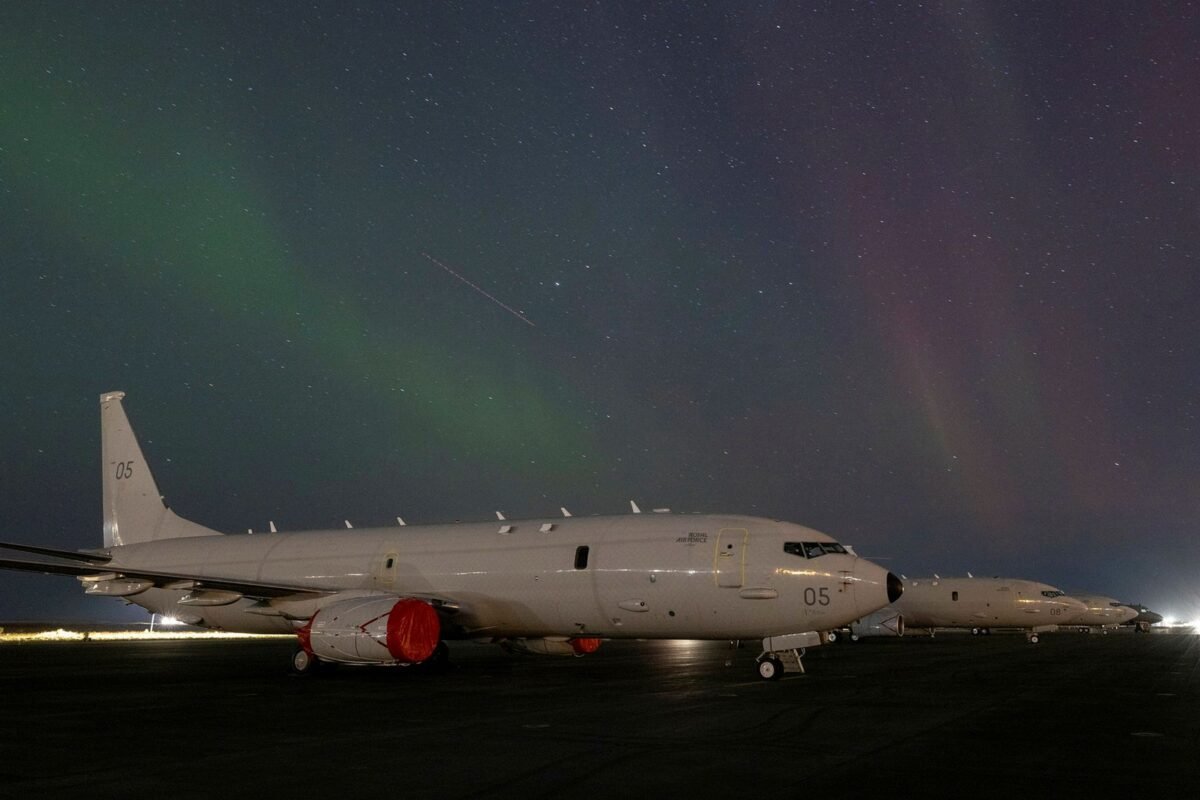
A Royal Air Force P-8 Poseidon maritime patrol aircraft under the northern lights at Keflavík Air Base, Iceland, November 13, 2025. Image by AS1 Christian Sparks; © Crown copyright 2026. Open Government Licence.
Future expansion should therefore reinforce this connected strategic geography rather than encourage further fragmentation into separate regional conversations. The objective is not to create a larger geographical footprint, but to improve the ability of the existing strategic system to function as a coherent whole.
2.2 Political Trust and Threat Perception
Political trust has always been one of JEF’s defining strengths. Although the member states differ in size, military capability and national priorities, they broadly share similar assessments of Northern European security and have developed habits of consultation through repeated exercises, operational cooperation and political engagement.
That does not mean every member holds identical policies regarding Russia, escalation management or the use of military force. Complete uniformity is neither realistic nor desirable among sovereign democracies. However, JEF’s ability to move quickly depends upon participating governments reaching political understanding without prolonged negotiation whenever regional crises begin to emerge.
Every additional member introduces another national political process, another parliament, another strategic culture and another set of domestic priorities. None of these factors should automatically exclude enlargement, but they represent genuine operational considerations rather than administrative details. Consultation mechanisms that function efficiently among ten governments may become progressively more demanding as membership grows, particularly if new members possess significantly different regional priorities or strategic assumptions.
For that reason, like-mindedness should not be interpreted as ideological agreement. It should be understood as sufficient strategic alignment that consultation remains practical under time pressure.
2.3 Operational Contribution
Membership should deliver capabilities that improve the framework’s ability to respond to regional challenges. Political support alone is valuable, but JEF exists primarily to enable practical defence cooperation rather than symbolic diplomacy.
Operational contribution may take many forms. A prospective member could strengthen the framework through deployable military forces, strategically important geography, critical infrastructure, intelligence capabilities, logistics networks, maritime access, industrial capacity, specialist expertise or political influence that materially improves regional deterrence and preparedness. Different states naturally contribute different combinations of these strengths.
The important question is not whether a country is militarily significant in general terms. It is whether its membership would improve JEF’s ability to fulfil its existing purpose. Some states may possess considerable capabilities that are already effectively integrated through NATO structures, bilateral defence agreements or other multinational arrangements. In such cases, structured partnership or enhanced cooperation may produce many of the operational benefits without introducing the additional political complexity associated with full membership.
Membership should therefore remain a functional instrument rather than a diplomatic reward. The framework is strengthened when each participant contributes capabilities that improve the effectiveness of the whole rather than simply increasing the number of participating flags.
2.4 Decision Speed
The ability to respond rapidly has been one of JEF’s principal advantages since its establishment. Smaller frameworks can often compare assessments, coordinate political messaging and prepare military options more quickly than larger multinational organisations because fewer governments are involved in the consultation process.
Expansion inevitably changes that balance. Every additional member introduces another political leadership, another defence establishment and another national decision-making process. These additional perspectives can improve the quality of discussion, but they also increase the time and coordination required before consensus begins to emerge.
Recognising this reality is not an argument against enlargement. It is an acknowledgement that decision speed carries strategic value and that preserving it requires conscious institutional design. Enlargement should therefore be evaluated not only according to the capabilities it adds, but also according to the consultation burden it creates. If additional members contribute more operational value than political complexity, expansion may strengthen the framework. If the opposite occurs, the characteristics that distinguish JEF from larger institutions may gradually erode.
2.5 NATO Complementarity
Paper 3 established that JEF derives much of its strategic value by helping NATO function more effectively within Northern Europe rather than by creating parallel authorities or competing institutional structures. That principle remains equally important when considering future membership.
A prospective member may already play a major role within NATO through force generation, regional command responsibilities, logistics, defence industry or specialist capabilities. Those contributions should certainly be recognised, but they do not automatically justify JEF membership. The relevant question is whether accession would improve JEF’s ability to support regional consultation, preparedness and transition into NATO activities beyond what existing mechanisms already achieve.
This distinction is important because complementarity is already part of JEF’s practical record rather than merely a theoretical aspiration. Before Finland and Sweden became NATO members, JEF provided an important framework through which both countries could deepen operational cooperation with neighbouring Allies while remaining outside the Alliance’s formal command structure. More recently, JEF has coordinated regional activities relating to maritime security, critical underwater infrastructure and the protection of key sea lines of communication in ways that support wider NATO objectives rather than duplicate them. These examples demonstrate that regional frameworks can help reduce operational friction before larger Alliance processes assume their full role.
Future enlargement should be assessed against the same principle. Membership should improve NATO’s effectiveness by strengthening regional preparedness, facilitating earlier consultation and improving operational coherence across Northern Europe. If expansion merely reproduces capabilities and relationships that already exist elsewhere without improving those outcomes, the case for enlargement becomes significantly less persuasive.
3. Membership Is Not the Only Model
Debates about JEF expansion are often framed too narrowly. A state is either imagined as a future member or treated as being outside the framework, even though contemporary defence cooperation rarely operates through such clean categories. NATO itself relies upon different forms of partnership, bilateral agreements coexist with multinational frameworks, and military forces routinely participate in exercises and operations without every participant belonging to every organisation involved. JEF has increasingly developed along similar lines, creating relationships that allow strategically important partners to contribute without automatically enlarging the core decision-making group.
That flexibility is particularly important because the strategic relevance of a state does not automatically establish a case for membership. Ukraine is indispensable to understanding contemporary European warfare, Canada is directly relevant to the North Atlantic and Arctic, and Germany is central to Baltic reinforcement and maritime security, but those facts alone do not answer whether each should hold an identical institutional relationship with JEF. A more useful model distinguishes between different levels of participation according to the purpose the relationship is intended to serve.
Joint Expeditionary Force membership, 2012 to 2024
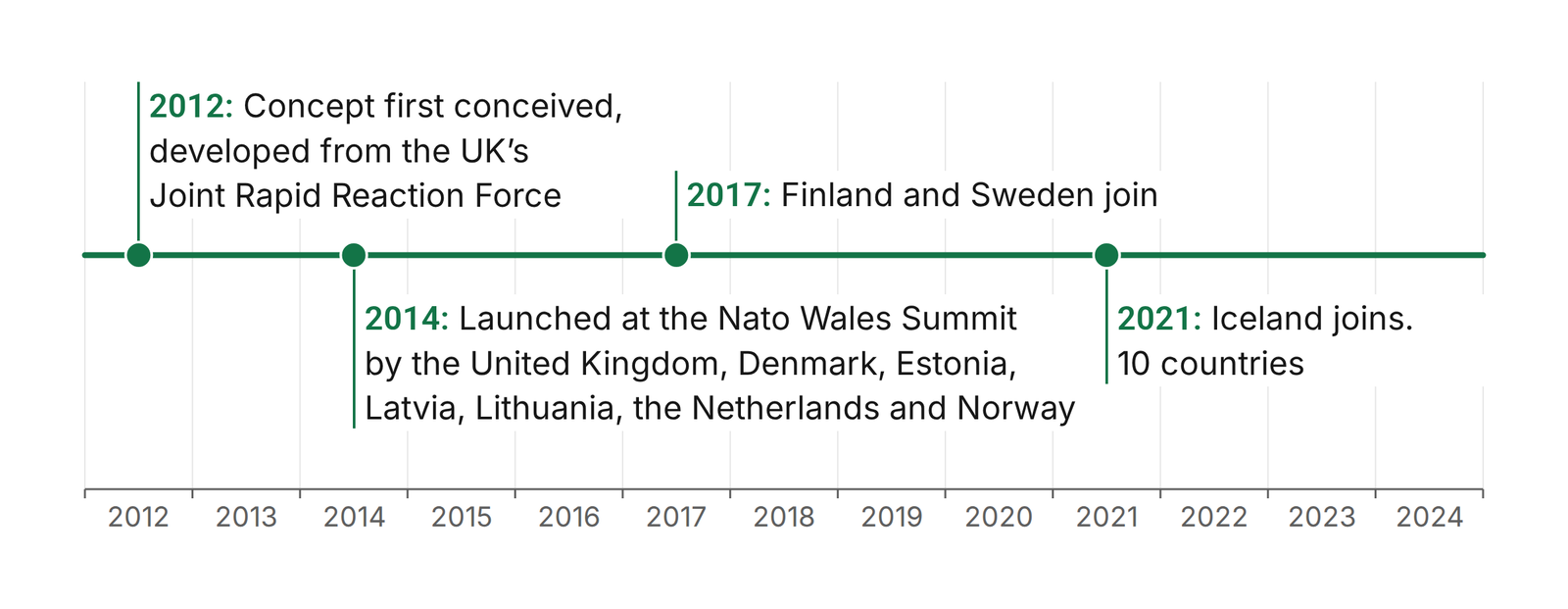
Graphic: BISC.
3.1 Full Membership
Full membership remains appropriate where strategic geography, political trust, operational contribution and willingness to assume the responsibilities of JEF participation align sufficiently closely. Membership brings more than access to exercises or political discussions. It places another government inside a framework designed to consult rapidly, generate military options and maintain a relatively high degree of political familiarity among participating states.
The threshold should therefore remain demanding. A prospective member should contribute to JEF’s core geographical area, provide capabilities or access that materially improve regional security, demonstrate sufficient political alignment to participate in rapid consultation and be willing to commit personnel, forces and institutional attention over time. Full membership should also produce additional value beyond relationships already available through NATO or bilateral arrangements. Otherwise, accession risks becoming symbolic expansion rather than an operational improvement.
This distinction becomes increasingly important as the number of strategically relevant states grows. JEF does not need to incorporate every ally whose forces might contribute to the defence of Northern Europe. NATO already provides the larger framework for doing exactly that. Full JEF membership should therefore remain reserved for cases where inclusion strengthens the characteristics that distinguish JEF from NATO rather than recreating NATO on a smaller scale.
3.2 Enhanced Partnership
Ukraine has provided JEF with an important precedent for a relationship that is deeper than ad hoc cooperation but deliberately different from membership. In November 2025, JEF formally launched an Enhanced Partnership with Ukraine, covering training, critical underwater infrastructure, drones, battlefield medicine and counter-disinformation activity while explicitly recognising the reciprocal value of Ukrainian battlefield experience for JEF nations.
By March 2026, JEF leaders were already moving the partnership further into operational practice. They committed to expanding tactical and operational knowledge exchange, integrating Ukraine more broadly into JEF activity and including Ukrainian units in the JEF LION exercise series. The arrangement therefore demonstrates that JEF can institutionalise a strategically significant relationship, create continuity and deepen operational cooperation without automatically changing its formal membership.
That precedent matters well beyond Ukraine. It creates an alternative for relationships in which a state is strategically indispensable but where membership is unnecessary, premature or politically inappropriate. Enhanced partnership can preserve access to expertise, operational learning and selected activities while avoiding the assumption that every deepening relationship must ultimately culminate in accession.
For JEF, this is particularly useful because it allows the framework to grow functionally without automatically growing institutionally. It also provides a mechanism for adapting relationships over time as political circumstances, military requirements and regional threats evolve.
3.3 Structured Participation
Canada illustrates another form of cooperation. Canadian forces participated in TARASSIS 2025, a JEF-led multinational activity in which Royal Canadian Air Force assets operated from Ämari Air Base in Estonia and across Finland, Latvia and Lithuania. Canada therefore contributed directly to a JEF activity despite not being a formal member.
Political engagement has developed alongside military participation. In March 2026, JEF leaders welcomed the Canadian Prime Minister’s remote participation in their summit while reaffirming the Baltic Sea, High North and North Atlantic as JEF’s interconnected area of strategic concern. Canada is therefore already demonstrating that meaningful participation can occur before, and potentially without, a membership decision.
Germany offers a different version of the same principle. Its military importance to Baltic security, reinforcement and maritime operations does not depend upon JEF membership. German forces, NATO structures hosted in Germany and wider regional exercises already interact with JEF members through NATO and multinational activity. This allows practical cooperation to deepen around identified operational requirements without requiring every relationship to be settled first through institutional enlargement.
Taken together, these examples suggest a more sophisticated participation spectrum: full membership where strategic alignment and contribution justify political inclusion; enhanced partnership where sustained cooperation requires institutional continuity without membership; structured participation where exercises, operational activities or regional functions provide the appropriate level of engagement; and narrower capability partnerships where expertise is required for a specific purpose. The advantage is not administrative tidiness but the ability to match the institutional relationship to the operational requirement.
3.4 Why This Matters
The distinction becomes particularly important when considering proposals for a substantially stronger JEF. John Allen, Julian Lindley-French and Jim Townsend have argued for a “Super JEF” capable of operating as a much more powerful British-led first responder across NATO’s Northern Flank, motivated by concern about European military mass, changing assumptions regarding American involvement and the need for greater high-end deployable capability. Their argument identifies genuine weaknesses in European defence and deserves to be treated as a serious strategic proposition rather than reduced to a slogan.
The question, however, is whether greater military strength necessarily requires a substantially larger political framework. JEF may be able to generate more strategic effect by building a network of differentiated partnerships around a comparatively coherent core than by bringing every operationally relevant state inside the same consultation structure. Enhanced partnerships, structured participation and capability-specific cooperation can increase access to forces, geography and expertise while preserving the political familiarity that allows JEF to move relatively quickly.
That approach also keeps the distinction between strengthening European responsibility and creating an alternative European security architecture where it belongs. JEF does not need to become a European army, a replacement for NATO or a political umbrella for every state capable of contributing to Northern European defence. Its comparative advantage lies in connecting the right actors at the right level for a defined strategic purpose. Expansion therefore should not be treated as the only route to greater relevance, because in some cases the strongest relationship may be the one that stops deliberately short of membership.
4. The Admission Test
Any serious discussion of JEF enlargement requires a consistent admission test. Without one, expansion risks becoming a collection of political preferences, bilateral sympathies and arguments about national importance rather than an assessment of whether a prospective member would strengthen the framework itself. That would be particularly damaging for JEF because its comparative advantage has never depended on representing every strategically relevant European state. It has depended on a narrower combination of geography, trust, readiness and practical cooperation.
The purpose of an admission test is therefore not to create a formal accession mechanism where none currently exists, but to impose analytical discipline on the debate. Every prospective member should be examined against the same criteria, regardless of its size, political influence or military reputation. A large state should not be assumed to qualify simply because it possesses substantial forces, just as a smaller state should not be dismissed if its geography, infrastructure or specialist capabilities provide disproportionate operational value.
4.1 Geography
The first test is geographic relevance. A prospective member should either sit within, or directly enable, the interconnected Baltic Sea, North Sea, North Atlantic and High North security system that gives JEF its strategic coherence.
This does not require every member to share identical exposure to Russia or occupy the same type of terrain. It does require a credible relationship between national geography and the operating environment JEF is intended to support. Ports, maritime approaches, reinforcement corridors, airspace, Arctic access and undersea infrastructure can all create strategic relevance even where a state is not geographically adjacent to the Baltic Sea itself.
Geographic relevance should therefore be assessed functionally rather than cartographically. The important question is whether the candidate improves access, reinforcement, resilience or freedom of action across the wider Northern European system.
4.2 Threat Perception
JEF has benefited from relatively compatible assessments of the regional threat environment. New members do not need identical defence policies, but significant divergence over Russia, escalation management, military preparedness or the use of force would introduce friction into a framework whose value depends partly on rapid consultation.
Threat perception matters operationally because political decisions rarely begin from perfectly clear circumstances. Maritime incidents, cyber operations, infrastructure disruption and military signalling often require governments to compare assessments before attribution or intent is fully established. If participating states begin from fundamentally different strategic assumptions, consultation may become slower precisely when JEF is supposed to provide added value.
The appropriate standard is therefore broad strategic alignment rather than ideological uniformity. Political disagreement is normal; incompatible understandings of the core regional threat are more difficult to absorb.
4.3 Military Contribution
A prospective member should add deployable capability that JEF can realistically use. This may include land forces, naval assets, air power, air and missile defence, intelligence, special operations forces, mine countermeasures, logistics or other capabilities relevant to regional defence.
The important distinction is between possessing military strength and being able to contribute it within JEF’s operating context. Forces committed elsewhere, unavailable at relevant readiness levels or difficult to integrate may add less practical value than their headline numbers suggest.
Military contribution should therefore be assessed according to availability, readiness, interoperability and regional relevance rather than national inventory alone.
4.4 Infrastructure Contribution
Modern reinforcement depends heavily on infrastructure outside military ownership. Ports, airfields, rail corridors, roads, logistics hubs, energy networks, communications infrastructure and seabed systems can be as strategically important as combat formations.
A prospective member that controls critical access routes or infrastructure may therefore add significant value even without possessing large armed forces. This is particularly relevant to North Sea and continental European candidates whose ports, logistics systems and transport corridors support movement towards the Nordic and Baltic regions.
Infrastructure contribution should also include resilience. Access is only valuable if facilities can continue operating under cyber disruption, sabotage, long-range strike or sustained military demand.

A backhoe loader on the airfield at Vaiņode, Latvia, during TARASSIS, a Joint Expeditionary Force exercise, October 7, 2025. Photo: Sgt Ē. Kukutis, Latvian National Armed Forces, via Flickr. CC BY-NC-ND 4.0 (https://creativecommons.org/licenses/by-nc-nd/4.0/).
4.5 Political Reliability
Membership requires confidence that governments can consult and make decisions under pressure. This does not mean expecting automatic agreement, because JEF remains a framework of sovereign states. It does mean that participating governments should possess sufficient political trust and strategic familiarity to discuss difficult issues without every crisis reopening basic questions about the purpose of the framework.
Political reliability should be judged over time rather than through one government or electoral cycle. Defence cooperation survives political change only when institutional relationships, public commitments and strategic interests are sufficiently durable.
For JEF, this criterion is particularly important because speed depends as much on political confidence as on military readiness.
4.6 Interoperability
New members should be able to integrate their forces, information and procedures without creating disproportionate additional work for existing participants. NATO membership can help because doctrine, standards and communications requirements already provide a common baseline, but NATO membership alone does not guarantee seamless interoperability.
Interoperability includes technical systems, command procedures, classification rules, logistics, training practices and the ability to operate under degraded conditions. It also includes familiarity between people and headquarters, which cannot be created instantly through formal accession.
A candidate requiring years of additional integration before contributing effectively may still become suitable, but that cost should be acknowledged rather than hidden behind political enthusiasm.
4.7 NATO Added Value
Every candidate must also pass the most important institutional test: what would JEF membership deliver that NATO cooperation does not already provide?
This question is especially relevant for major NATO allies that already hold significant command, reinforcement or regional responsibilities. Their military importance may be beyond dispute while the additional value of JEF membership remains less obvious.
Accession should improve regional consultation, preparedness, responsiveness or integration in ways that existing NATO mechanisms do not already achieve efficiently. If the same outcome can be produced through NATO planning, bilateral cooperation or structured JEF participation, full membership may add complexity without sufficient benefit.
4.8 Decision Cost
Every new member introduces another sovereign decision-maker. That increases access to capability and political weight, but it also increases consultation requirements, potential divergence and the number of national constraints that must be managed during crisis.
Decision cost should therefore be treated as a real strategic variable. It does not automatically outweigh the benefits of enlargement, but it must be compared against them.
A candidate that adds significant military mass while substantially reducing political agility may alter JEF’s character more than a smaller state that adds specialist capability with limited consultation friction.
4.9 Reciprocity
Finally, membership should require contribution rather than access alone. JEF should not become an additional forum through which states seek influence, information or political visibility without assuming corresponding responsibilities.
Reciprocity may involve forces, infrastructure, personnel, intelligence, funding, exercises, industrial capacity or specialist expertise. The form can vary, but the principle should remain consistent: membership should strengthen collective output.
Taken together, these criteria provide a more useful basis for evaluating future members than political popularity or national prestige. The relevant question is not whether a candidate is important to European security in general, but whether its accession would make JEF more coherent, more capable and more useful without undermining the speed, trust and regional focus that distinguish the framework from larger institutions.
5. The Candidate Cases
Applying the admission test produces very different answers depending on the state being considered. That is precisely why the expansion debate should not be reduced to a list of militarily important European countries followed by an assumption that membership would naturally make JEF stronger. Canada, Germany, Poland, Belgium, Ireland and France each bring legitimate strategic arguments, but they address different operational problems and would change the framework in different ways.
The comparison also demonstrates why military size is an inadequate proxy for suitability. A state may bring substantial combat power while adding considerable political and institutional complexity. Another may contribute relatively modest forces but control infrastructure, maritime approaches or specialist capabilities with disproportionate value to the Baltic-Arctic system. The appropriate question in each case is therefore whether full membership improves JEF’s existing purpose more effectively than partnership, NATO cooperation or bilateral arrangements already can.
5.1 Canada: The Strongest Expansion Case
Of the states currently discussed as potential additions to JEF, Canada presents the most coherent case for full membership because strategic geography, Alliance membership, military cooperation and political engagement largely point in the same direction.
Canada is an Arctic and North Atlantic state whose security is directly connected to the transatlantic reinforcement routes that underpin the defence of Northern Europe. Its geographic position does not pull JEF away from the framework’s existing strategic focus. Instead, it extends the same operating environment westward across an ocean that has always connected North American reinforcement with European defence. The March 2026 JEF Leaders’ Statement explicitly reaffirmed the Baltic Sea, High North and North Atlantic as the framework’s interconnected geostrategic core and, in that same context, welcomed the remote participation of the Canadian Prime Minister.
Canada has also moved beyond political observation into practical military participation. During TARASSIS 2025, Royal Canadian Air Force personnel and aircraft operated from Ämari Air Base in Estonia and conducted activity across Finland, Latvia and Lithuania as part of the JEF-led multinational exercise. Canadian Defence described the exercise as an opportunity to practise agile operations in contested and degraded environments, providing evidence that interoperability with JEF forces is already being developed rather than merely proposed.
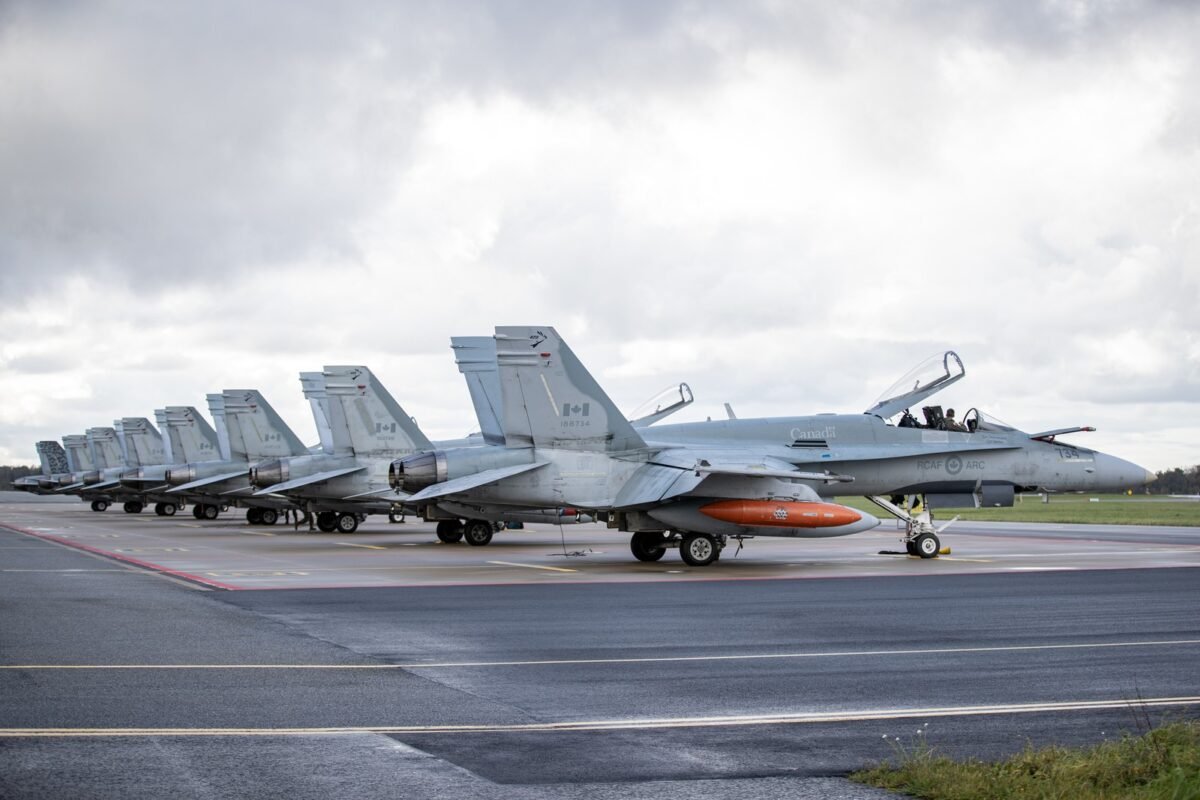
Royal Canadian Air Force CF-18 fighters at Ämari Air Base, Estonia, after their arrival for TARASSIS, a Joint Expeditionary Force exercise, October 6, 2025. Photo: kaitsevägi, pildid.mil.ee
Membership could therefore add several forms of operational value simultaneously. Canadian participation would strengthen the transatlantic dimension of JEF, deepen the connection between Arctic and Northern European defence, add military capability and provide another substantial NATO ally able to contribute to reinforcement and regional exercises. It could also help prevent the North Atlantic element of JEF’s geography from becoming conceptually European when its operational logic is inherently transatlantic.
There are nevertheless constraints that should not be dismissed simply because the strategic case is attractive. Canada already carries significant NATO responsibilities, including leadership of NATO’s multinational presence in Latvia, while its armed forces must simultaneously address continental defence, the Arctic, the Indo-Pacific and commitments elsewhere. NATO’s current eastern-flank posture identifies Canada as the framework nation for the multinational force in Latvia, illustrating that additional JEF responsibilities would have to coexist with an already substantial regional commitment rather than draw upon unused capacity.
Canadian membership would also change JEF psychologically as well as geographically. The framework would cease to be composed exclusively of European states, even though its operational geography already extends across the North Atlantic. That is not necessarily a disadvantage, but it should be acknowledged because institutional identity influences political expectations over time.
The strongest case for Canada therefore depends on defining what accession would achieve beyond current participation. If membership produces sustained Canadian engagement in Arctic and North Atlantic planning, exercises, reinforcement, infrastructure resilience and regional consultation, the additional political complexity is likely to be justified. If accession amounts primarily to another diplomatic demonstration of transatlantic solidarity, structured participation may already provide much of the practical benefit. On the evidence available today, however, Canada remains the strongest candidate for full membership because it reinforces rather than redirects JEF’s existing strategic geography.
5.2 Germany: Essential Partner, Harder Membership Question
Germany presents a more complicated case because almost every argument supporting accession simultaneously raises a question about duplication.
Its strategic relevance to Northern European defence is beyond serious dispute. Germany is a Baltic Sea littoral state, one of Europe’s largest economies and defence-industrial actors, a major continental reinforcement hub and NATO’s framework nation for the multinational force in Lithuania. Germany is also establishing a permanently stationed armoured brigade in Lithuania, further increasing its direct responsibility for the defence of the Baltic region.
Germany’s maritime role has also expanded significantly. Since October 2024, the German Navy’s DEU MARFOR headquarters in Rostock has provided the core staff for NATO’s Commander Task Force Baltic. The headquarters is designed to plan maritime operations, coordinate Alliance maritime activity and maintain a recognised maritime picture for the Baltic Sea region. Its multinational staffing and NATO certification make Germany an important contributor to the very regional situational awareness and cross-border coordination that Papers 2 and 3 identified as central to Northern European deterrence.
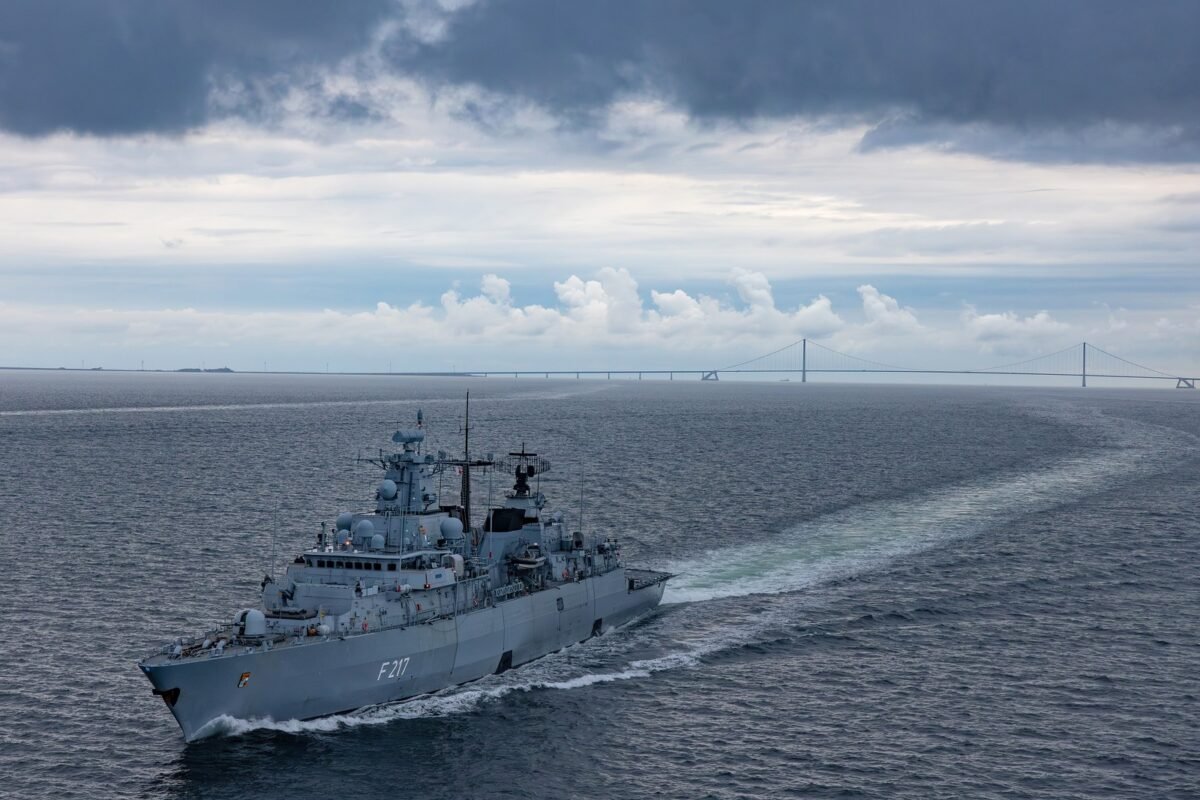
The German frigate Bayern in Danish waters near the Great Belt bridges during the Nato naval exercise BALTOPS 2025 in the Baltic Sea, June 7, 2025. Photo: Bundeswehr/Rolf Klatt
The case for membership therefore appears substantial. Germany would add military mass, ports, logistics capacity, industrial depth, Baltic geography, maritime command expertise and considerable political weight. It also sits geographically between North Sea reinforcement routes and the Baltic operating environment, making German infrastructure central to the movement of forces eastward.
Yet these same responsibilities create the harder question: what would full JEF membership add that Germany is not already increasingly required to deliver through NATO?
NATO announced in February 2026 that Germany and Poland will share command of JFC Brunssum on a rotational basis as European allies assume greater responsibility across all three operational-level Joint Force Commands. Germany therefore already occupies, or is moving towards, major formal responsibilities within NATO’s command architecture while simultaneously maintaining its Lithuania commitment and Baltic maritime role.
There is also an institutional-balance question. JEF currently combines one large framework nation with smaller and medium-sized members whose influence derives substantially from political trust and regional relevance rather than military hierarchy. Adding Germany would strengthen military and political weight but could also alter the internal balance of the framework. That need not create rivalry with the United Kingdom, but it would require careful political management because two major European military powers inevitably bring different national priorities, budgetary constraints and leadership expectations.
German capacity should also be assessed against commitments rather than theoretical inventory. Building a permanently stationed brigade in Lithuania, providing maritime command functions, modernising the Bundeswehr and assuming broader NATO responsibilities require personnel, readiness and money. Membership is meaningful only if Germany can provide additional usable capacity rather than assigning another institutional label to forces already committed elsewhere.
The sensible conclusion is therefore more nuanced than either “Germany must join” or “Germany would make JEF too complicated”. Deep German participation in the Baltic-Arctic security system is already unavoidable and should intensify regardless of membership. Full accession deserves serious consideration because Germany passes the geography, capability, infrastructure and threat-perception tests. The burden of proof, however, should remain on demonstrating what membership adds beyond NATO responsibilities and structured cooperation. Germany is too important to exclude from practical JEF interaction, but importance alone is not sufficient reason to change the framework’s political architecture.
5.3 Poland: Eastern Mass and the Baltic Question
Poland offers another powerful but structurally different case. Its Baltic coastline, direct exposure to Russia and Belarus, central role on NATO’s eastern flank and substantial military commitments make it impossible to discuss Northern European security without Poland. Polish territory is also critical to reinforcement and command arrangements affecting the Baltic states, while NATO headquarters located in Poland contribute directly to the defence of Estonia, Latvia, Lithuania and Poland. NATO’s Multinational Corps Northeast in Szczecin covers the four northeastern battlegroups, while Multinational Division Northeast in Elbląg works closely with the forces in Poland and Lithuania.
Poland is equally engaged in Baltic maritime security. Polish and Swedish defence authorities have explicitly linked their strategic cooperation to Commander Task Force Baltic, Baltic Sentry, critical-infrastructure protection and wider Baltic Sea security. This makes Poland relevant not only as a land-power anchor on the eastern flank but also as an increasingly active participant in the maritime architecture connecting the Baltic region.
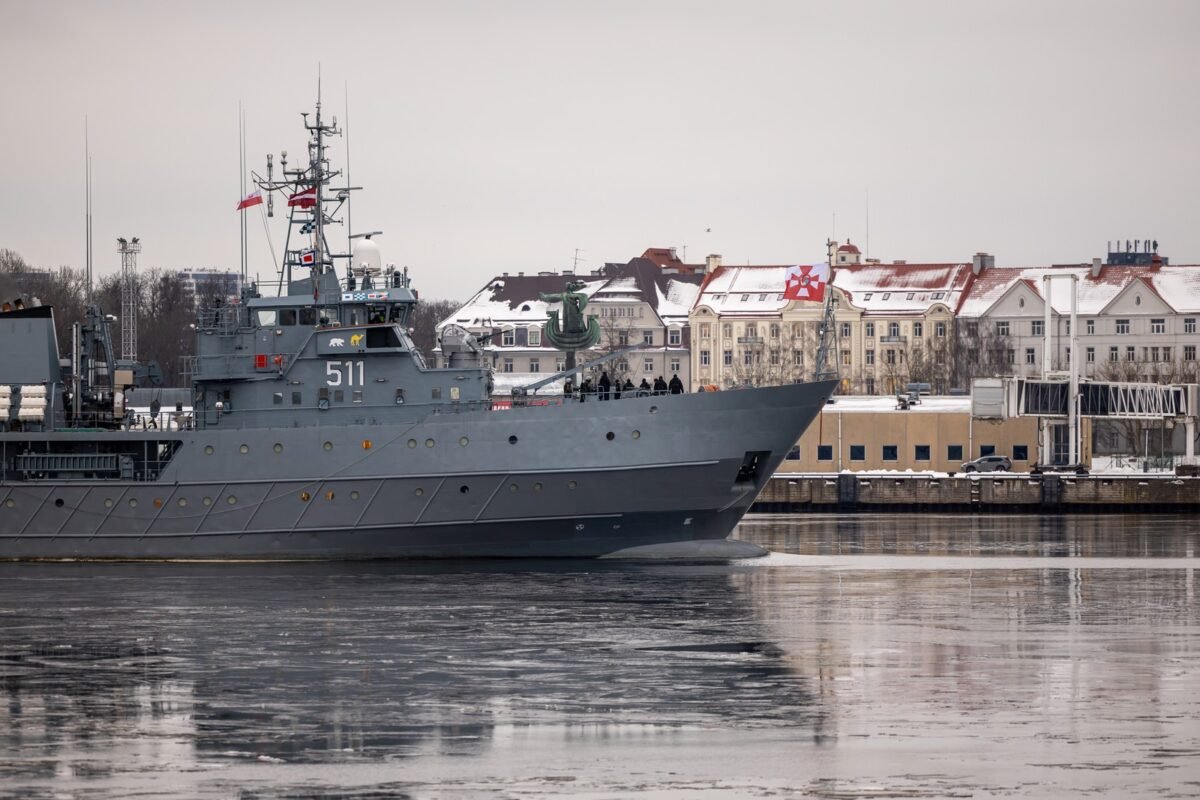
The Polish Navy ship Czernicki arrives in Riga on a planned port visit, January 5, 2026. Photo: E. Grundšteins and R.R. Putnis, Latvian National Armed Forces, via Flickr. CC BY-NC-ND 4.0 (https://creativecommons.org/licenses/by-nc-nd/4.0/).
The military argument for accession is consequently strong. Poland could add substantial land capability, logistics, geographic depth, Baltic infrastructure and political weight. It also shares JEF members’ assessment of Russia as the principal regional threat and has demonstrated sustained willingness to invest in territorial defence and NATO’s eastern posture.
The difficulty lies in what Polish membership would do to JEF’s centre of gravity. Poland’s security responsibilities extend far beyond the Baltic Sea towards Belarus, Ukraine, Slovakia and the wider Central and Eastern European theatre. Bringing Poland fully inside JEF could therefore strengthen the Baltic dimension while simultaneously pulling the framework towards a broader eastern-flank agenda.
That distinction becomes increasingly important as NATO itself strengthens its eastern architecture. Poland hosts substantial Alliance and US infrastructure, has a NATO multinational force on its territory and will share rotational leadership of JFC Brunssum with Germany. Full JEF membership would therefore need to generate additional regional responsiveness rather than create another forum covering many of the same eastern-flank responsibilities.
Poland should consequently be regarded as a strategically compelling partner whose accession cannot be assessed on military capability alone. If JEF defines itself increasingly around an integrated Baltic, North Sea, North Atlantic and High North system, Polish membership can be argued coherently through its Baltic geography and reinforcement role. If the framework begins absorbing Poland’s wider eastern-security responsibilities, however, the risk of JEF gradually becoming a second eastern-flank coalition becomes more significant.
The question is therefore not whether Poland matters, because it plainly does. The question is whether JEF’s geographic boundary can incorporate Poland without changing the strategic problem the framework exists to solve. That requires a clearer definition of JEF’s centre of gravity before accession rather than after it.
5.4 Belgium: The Underestimated North Sea Case
Belgium demonstrates why candidate assessments should not be dominated by national size. It would not bring the military mass of Germany, Poland or Canada, but its geography, maritime capabilities and logistics position produce a more credible case than headline force numbers suggest.
Belgian Defence already contributes substantially to the security environment relevant to JEF. Belgian aircraft have repeatedly participated in Baltic Air Policing and, since 2025, in Icelandic Air Policing. The Belgian Navy contributes personnel and vessels to Standing NATO Maritime Group 1 and Standing NATO Mine Countermeasures Group 1, while Belgian forces also participate in Baltic Sentry and the protection of critical underwater infrastructure. These are not hypothetical future contributions; they are existing operational links between Belgian capability and the Baltic-North Atlantic security system.
Belgium’s geographic value lies in the connection between the North Sea, Channel approaches and continental logistics network. Northern European reinforcement does not begin at the Baltic coastline. Personnel, equipment and sustainment arriving through Western European ports must move through infrastructure corridors that connect the Atlantic and North Sea to the eastern flank. Belgium therefore sits within the enabling geography described in Paper 2 even though it is not normally described as a Nordic or Baltic state.
Its specialist maritime capabilities also deserve particular attention. Mine countermeasures remain essential in the shallow and congested waters that characterise important parts of the Baltic and North Sea operating environment. A state capable of contributing meaningfully to mine warfare, maritime surveillance and infrastructure protection may provide greater marginal value to JEF than a much larger force whose principal capabilities are already heavily committed elsewhere.
The constraints are largely those of scale and prioritisation. Belgium’s armed forces cannot provide the strategic mass of the larger candidates, and any additional JEF commitment would compete with existing NATO and European responsibilities. Yet this may actually make Belgium a useful test of the admission criteria. If JEF membership is about strategic fit rather than national prestige, then useful geography, specialist capabilities and existing operational integration should count heavily.
Belgium therefore warrants serious consideration either as a full member or as a deeply structured operational partner. Its case illustrates why expansion should not become a competition between large European powers. The framework needs capability that solves regional problems, and some of those problems require minesweepers, ports, logistics and North Sea access more urgently than another large political actor.
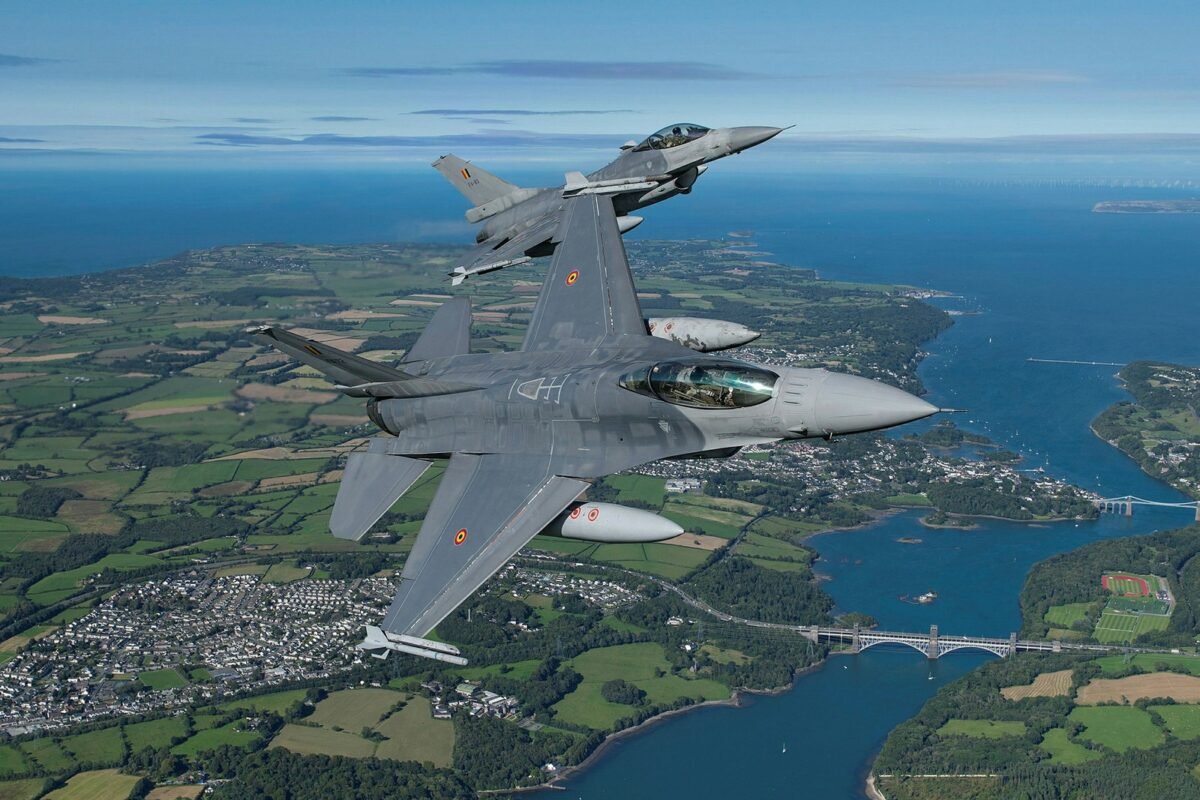
Two Belgian Air Force F-16 fighters during low-flying training in the UK after flying to RAF Valley, August 9, 2023. Image by Flt Lt Andy Donovan; © Crown copyright 2023. Open Government Licence.
5.5 Ireland: Strategic Geography, Political Misfit?
Ireland presents almost the reverse problem. Its geographic importance is considerable, but the political and military case for membership remains significantly weaker under current policy.
Ireland occupies an important position on Europe’s western Atlantic approaches. Its maritime space, telecommunications infrastructure and location adjacent to transatlantic routes make Irish security increasingly relevant to wider European resilience. The Irish government itself has recognised the growing vulnerability of critical maritime infrastructure and launched the country’s first National Maritime Security Strategy in February 2026, explicitly linking maritime security to an increasingly volatile geopolitical environment.
Geography alone, however, does not create an institutional fit. Ireland continues to define its military neutrality through non-membership of military alliances and non-participation in common or mutual defence arrangements. The Irish government reiterated that position again in 2026, while simultaneously arguing for pragmatic security cooperation and continued engagement with NATO through Partnership for Peace.
That distinction creates a fundamental question for JEF accession. Full membership in a UK-led expeditionary military framework capable of generating military response options would require a much more substantial political discussion in Ireland than participation in exercises, maritime-awareness initiatives or resilience cooperation. Irish law and policy also place specific restrictions on foreign military activity, illustrating the practical consequences of neutrality for operational cooperation rather than treating the issue as a purely symbolic national tradition.
Ireland nevertheless should not be treated as strategically irrelevant. Its government has repeatedly emphasised that neutrality does not mean isolation, while cooperation through NATO’s Partnership for Peace has improved the interoperability of Irish forces. That creates considerable space for structured cooperation involving maritime domain awareness, critical infrastructure protection, cyber resilience, search and rescue, North Atlantic surveillance and exercises compatible with Irish policy.
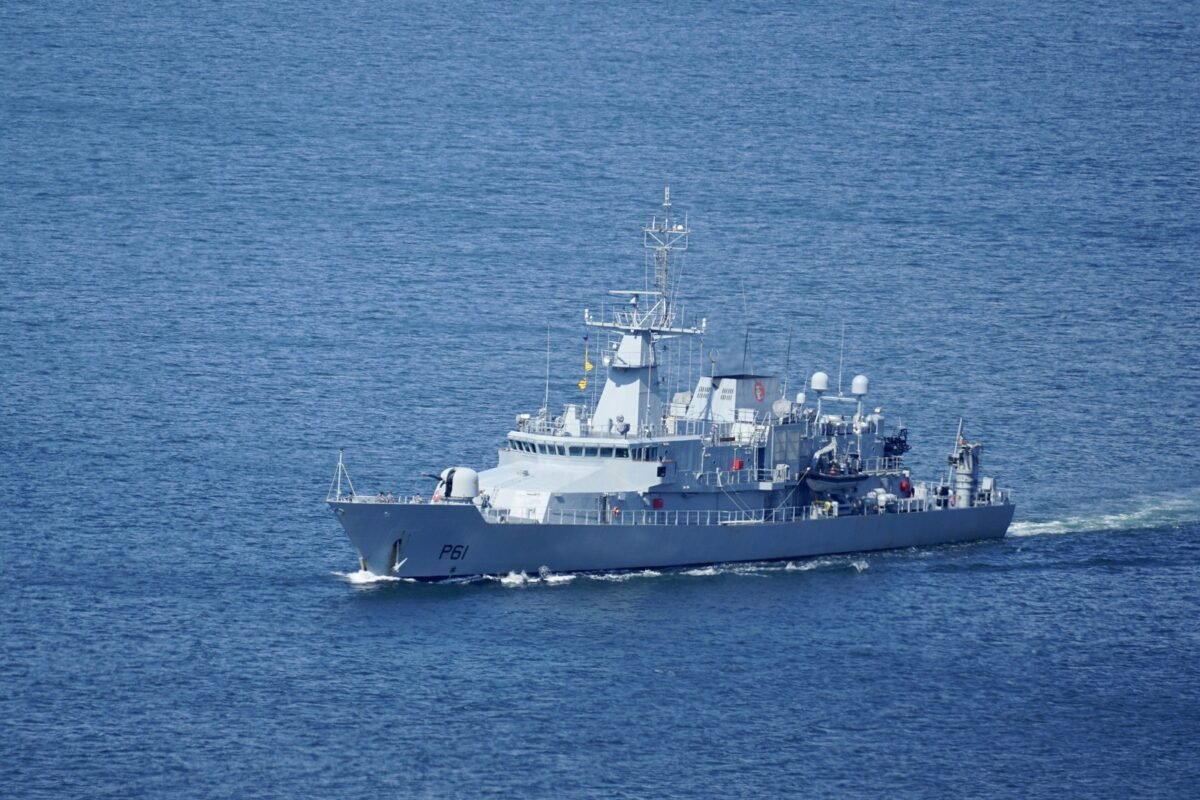
The Irish Naval Service offshore patrol vessel LÉ Samuel Beckett in the Atlantic Ocean off Portsalon, County Donegal, May 30, 2021. Photo: Mhdelaney, CC BY-SA 4.0 (https://creativecommons.org/licenses/by-sa/4.0/), via Wikimedia Commons.
The appropriate conclusion under current conditions is therefore partnership rather than membership. Ireland’s geography argues strongly for deeper integration into North Atlantic security discussions, but institutional design should respect political reality rather than pretending that geographical importance automatically overrides national defence policy. A well-designed partnership could obtain much of the practical security benefit while avoiding a membership debate that would consume political energy without necessarily producing deployable capability.
5.6 France: The Control Case
France is useful precisely because it demonstrates the limits of the argument that every powerful and strategically relevant European state should join JEF. France is a nuclear power, a major NATO ally, an Atlantic maritime state and one of Europe’s most capable expeditionary military actors. If strategic importance alone determined membership, the French case would appear obvious.
Yet the United Kingdom and France already operate a separate bilateral expeditionary framework through the Combined Joint Expeditionary Force. French Defence continues to describe the CJEF as operational since 2020 and as a mechanism for high-end Franco-British military cooperation. NATO itself recognised both structures separately from their inception, identifying the UK-led JEF under the Framework Nations Concept while also welcoming the distinct Franco-British CJEF.
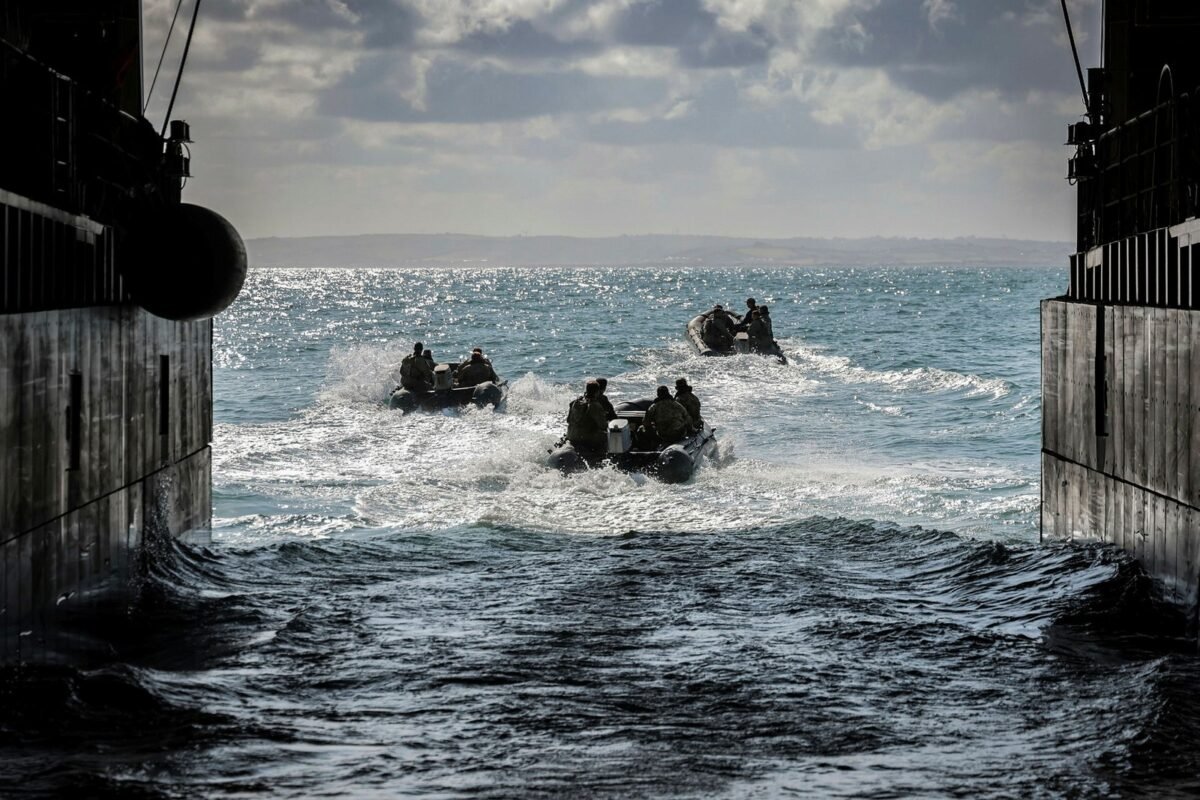
Troops of the French Navy and the Royal Marines deploy ashore from RFA Lyme Bay during Exercise Catamaran, a Franco-British exercise under the Combined Joint Expeditionary Force, June 2, 2025. Image by LPhot Matt Bradley; © Crown copyright 2025. Open Government Licence.
Adding France to JEF would undoubtedly increase military capability and political weight, but it would also change the character of the framework considerably. A structure containing the United Kingdom, France and potentially Germany or Poland would begin to resemble a broader European strategic coalition rather than the comparatively focused Northern European framework that exists today. That may be desirable under a different strategic concept, but it should not happen accidentally through a sequence of individually persuasive accession decisions.
France therefore provides the useful control case against which the entire admission test can be checked. Strategic importance, military power and political influence are not sufficient on their own. JEF membership should be reserved for states whose inclusion strengthens the particular regional function of the framework more effectively than existing NATO, bilateral or partnership mechanisms already do.
Taken together, the six cases produce a deliberately uneven picture. Canada currently offers the clearest case for accession because its geography and operational contribution extend JEF’s existing logic rather than redirect it. Germany and Poland are indispensable to Northern European defence but require a stronger demonstration of additional value because both already carry expanding NATO responsibilities. Belgium presents an underappreciated case based on specialist capability and enabling geography, while Ireland’s strategic location is better matched by partnership under its current defence policy. France demonstrates why military importance should never be confused with institutional fit.
That differentiation is precisely what an expansion policy should produce. If every strategically important state passes the admission test, the test is not demanding enough. JEF should be able to cooperate extensively with countries that do not become members, because preserving that distinction is one of the few ways expansion can strengthen the framework without eventually turning it into a smaller, less authoritative version of NATO.
6. Greenland, the Faroe Islands and the Problem of False Equivalence
Any discussion of JEF enlargement eventually encounters a category problem that is particularly visible in relation to Greenland and the Faroe Islands. Territorial sovereignty, constitutional autonomy, international membership and operational military authority are related concepts, but they are not interchangeable. Treating them as though they were produces conclusions that may sound intuitively plausible while being legally and politically inaccurate.
Greenland and the Faroe Islands are both parts of the Kingdom of Denmark, but both possess extensive self-government arrangements. The Danish Ministry of Foreign Affairs describes Greenland and the Faroe Islands as self-governing parts of the Realm and confirms that responsibility is divided between the authorities of the Kingdom and the respective autonomous governments. Under the Danish constitutional system, the authorities of the Kingdom retain responsibility for conducting foreign policy and entering into international legal obligations, while Copenhagen, Nuuk and Tórshavn cooperate on foreign, security and defence matters that are of particular relevance to Greenland and the Faroe Islands.
That constitutional arrangement immediately demonstrates why membership questions cannot be resolved through maps alone. Greenland joined the European Communities with Denmark in 1973 but withdrew in 1985, while Denmark remained a member. The Faroe Islands are likewise outside the European Union despite forming part of the Kingdom of Denmark. The constitutional relationship between a sovereign state and an autonomous territory therefore does not mean that every international institutional arrangement automatically applies identically across the Realm.
The same distinction must be maintained when discussing JEF. Official JEF material identifies the ten Participant Nations as Denmark, Estonia, Finland, Iceland, Latvia, Lithuania, the Netherlands, Norway, Sweden and the United Kingdom. Greenland and the Faroe Islands are not separately designated JEF members because they are not sovereign states participating independently in the framework. Denmark participates as the sovereign state representing the Kingdom within the intergovernmental arrangement.
That does not mean Greenland or the Faroe Islands are strategically irrelevant to JEF. Their geography is directly connected to the North Atlantic and High North operating environment that JEF identifies as part of its core area of interest. Official JEF material describes Northern Europe, the High North, North Atlantic and Baltic Sea region as its principal geographic focus, while Danish security policy similarly treats Greenland and the Faroe Islands as part of the wider Arctic and North Atlantic security complex. Strategic relevance, however, should not be confused with separate institutional membership.
Greenland, the Faroe Islands and the North Atlantic
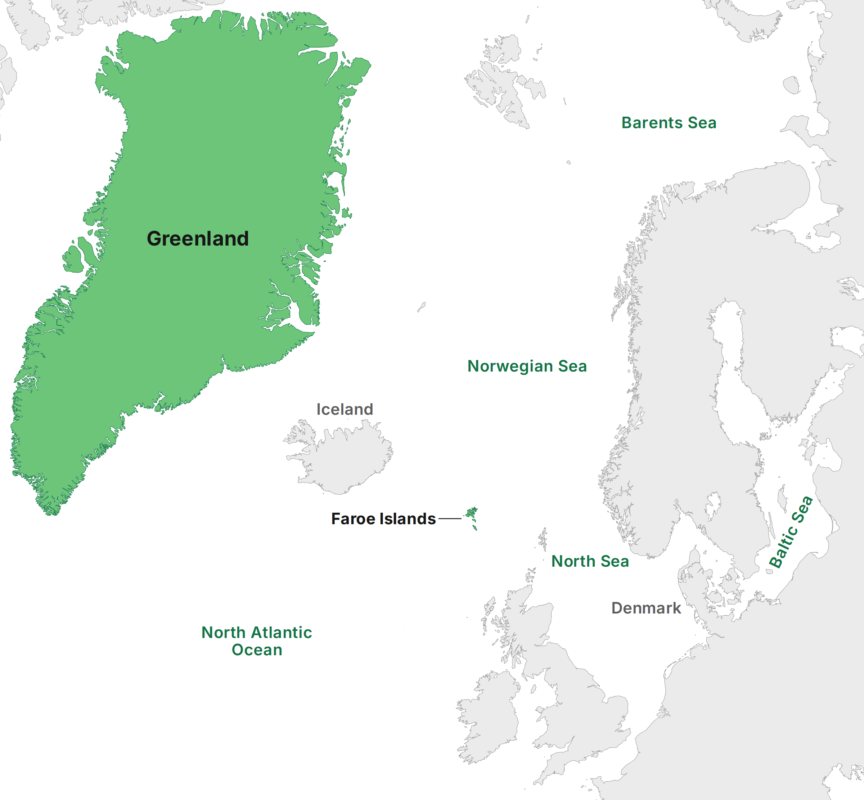
Map: BISC.
The distinction becomes even more important when considering military activity. JEF is not a supranational authority with an independent right to deploy forces wherever one of its members possesses sovereign territory. It is an intergovernmental military framework whose activities depend on political decisions by participating governments and the legal authorities applicable to the operation in question. JEF can generate military options and operate collectively, but it does not override national sovereignty, host-nation arrangements or NATO command responsibilities. Official JEF material itself describes NATO as the ultimate security guarantor for the region and emphasises JEF’s complementary role rather than an independent territorial mandate.
In the case of Greenland, political authority is additionally shaped by the Kingdom’s constitutional arrangements and by the principle that matters of particular relevance to Greenland should involve Greenlandic authorities. The Danish government retains constitutional responsibility for defence and foreign policy, but official Danish policy also emphasises close and equal cooperation with Naalakkersuisut on foreign, security and defence issues affecting Greenland. That means it would be too simplistic to argue either that Copenhagen can treat Greenland exactly like metropolitan Danish territory in every political circumstance or, at the opposite extreme, that Greenland operates as a separate sovereign defence actor. The legal and political answer depends on the specific authority being exercised and the nature of the activity involved.
Recent developments illustrate that distinction in practice. Denmark has organised security activity in Greenland under Arctic Endurance, while NATO has been developing Arctic Sentry with participation from allied forces, including JEF members. JEF planning documents describe those activities as complementary rather than as evidence of an independent JEF mandate for Greenland. The United Kingdom has likewise framed Greenland’s security through NATO and through cooperation with Denmark rather than by proposing a separate JEF security architecture.
This is why the absence of a JEF deployment to Greenland cannot, by itself, be treated as evidence that the framework has failed. Such an argument assumes that JEF was politically mandated, legally authorised and operationally intended to act there independently in the first place. Before judging non-action, the more basic questions must be answered: which authority was responsible, what political decision had been taken, under which framework would forces operate, what host-nation arrangements applied, and whether NATO or national mechanisms were already providing the relevant response.
Maps are particularly poor substitutes for answering those questions. A membership map identifies participating states; it does not define every territory of strategic interest, every constitutional arrangement within those states or every area in which military activity could occur. A NATO map, an EU map, an operational planning map and a JEF membership map answer different questions. Conflating them creates apparent contradictions that disappear once the underlying legal and political categories are separated.
Greenland and the Faroe Islands therefore provide a useful warning for the wider expansion debate. Geographic importance does not automatically create separate membership, constitutional association does not automatically determine institutional scope, and political solidarity does not itself generate military authority. JEF enlargement should be assessed through the same discipline applied elsewhere in this paper: by examining function, legal authority, strategic geography and operational added value rather than assuming that every strategically important territory requires another seat at the table.
7. Why Regional Boundaries Still Matter
JEF’s regional identity is not an arbitrary political choice. Its strategic logic comes from the fact that the Baltic Sea region, the High North and the North Atlantic are increasingly interconnected by reinforcement routes, maritime access, critical infrastructure and Russian military activity. The March 2026 JEF Leaders’ Statement explicitly reaffirmed these areas as the framework’s core interlinked geostrategic space, while also emphasising JEF’s role in strengthening NATO’s northern flank.
That geographic coherence is one of the principal reasons JEF remains useful. It allows participating states to concentrate on a connected operating environment without assuming responsibility for every European security problem. The challenge is therefore to avoid two opposite errors at the same time. Northern Europe should not be artificially fragmented into separate Nordic, Baltic, North Sea and Arctic compartments when the operational dependencies between them are obvious, but neither should the logic of interconnectedness be stretched so far that JEF becomes responsible for theatres whose principal problems are better addressed through NATO or other arrangements.
The Baltic Sea provides the clearest example. Access to the Baltic depends on the Danish Straits, making Denmark strategically important far beyond the size of its armed forces. NATO itself describes Denmark as the gatekeeper of the Baltic Straits and as a strategic bridge connecting the Baltic, Arctic and transatlantic approaches. Reinforcement of the Baltic states therefore cannot be understood solely through the territories of Estonia, Latvia and Lithuania or through land corridors farther south. Maritime access, port capacity, air routes and logistical support across Denmark, Sweden, Germany, the Netherlands and the wider North Sea region form part of the same operational problem.
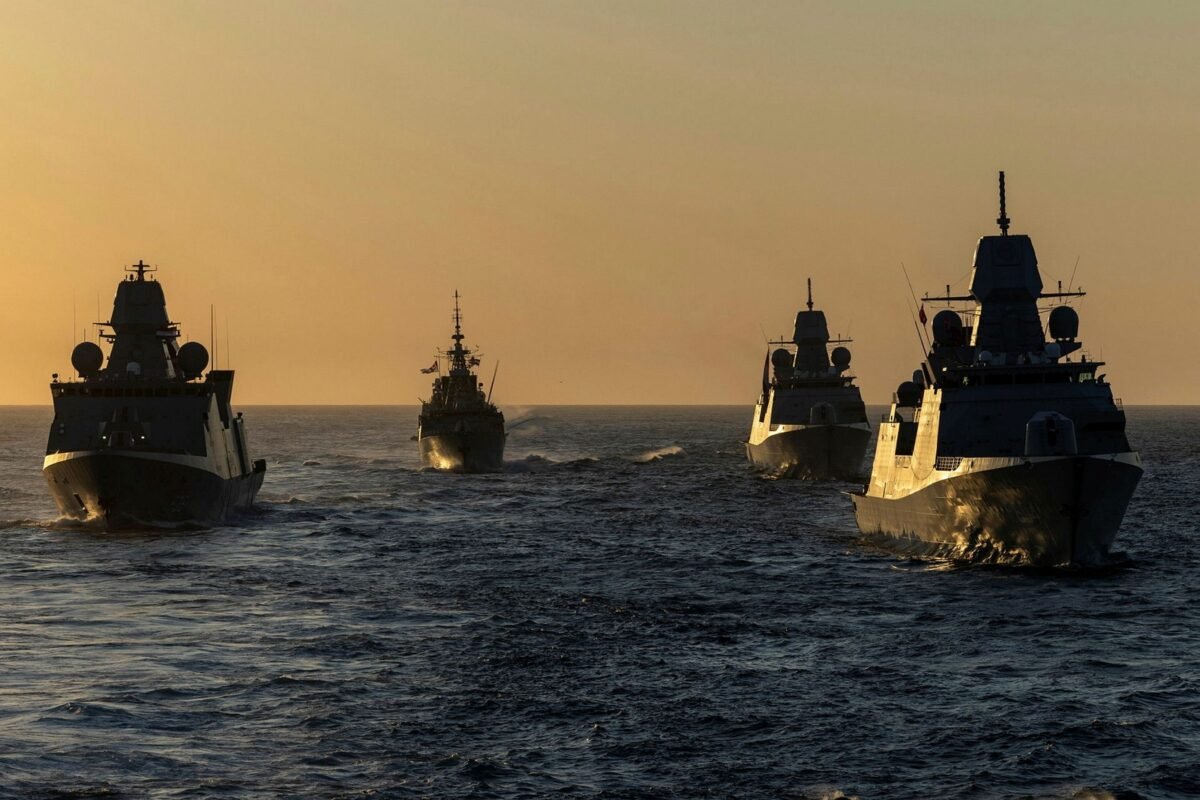
Dutch, Danish and Canadian frigates in the sail past that ended Exercise Formidable Shield, off the west coast of Scotland, May 19, 2025. Image by LPhot Oliver Leach; © Crown copyright 2025. Open Government Licence.
The Danish Straits in turn cannot be separated from the North Sea. Ships, military equipment, energy flows and commercial traffic entering or leaving the Baltic move through an operating environment that extends westward towards major European ports and Atlantic sea lines of communication. This is why treating the North Sea as somehow outside the Baltic security problem creates an artificial boundary. The infrastructure that supports reinforcement does not begin at the entrance to the Baltic, and neither do the risks associated with sabotage, mine warfare, cyber disruption or attacks against critical maritime infrastructure.
The North Sea is equally inseparable from the North Atlantic because large-scale reinforcement of Europe still depends upon secure transatlantic access. NATO’s northern posture continues to recognise the strategic importance of maintaining routes between North America and Europe, while the United Kingdom’s current national security strategy explicitly links JEF leadership to deterrence in the High North and Northern Europe, including monitoring threats to undersea infrastructure and Russia’s shadow fleet. The North Atlantic therefore forms the western operational depth of the same system rather than a separate theatre connected only during major conflict.
The GIUK Gap reinforces that relationship. The maritime passages between Greenland, Iceland and the United Kingdom connect the Norwegian Sea and Arctic approaches with the wider North Atlantic, while NATO has long treated the area as strategically significant for monitoring Russian naval activity and protecting Atlantic access. Activity around the Kola Peninsula and Russia’s Northern Fleet can consequently affect reinforcement routes well beyond the Arctic itself, just as disruption in the Baltic can generate demand for maritime and intelligence capabilities located farther west.
The same interconnectedness is visible on land. Finland’s long border with Russia, the Baltic states’ exposure to Russian and Belarusian military infrastructure, Poland’s role in eastern-flank reinforcement and Norway’s proximity to the Kola Peninsula are different strategic problems, but they are connected by the disposition of Russian forces and by NATO’s requirement to understand developments across the northern and northeastern flank as part of a wider whole. This is precisely why drawing an artificial line between “Nordic security” and “Baltic security” is increasingly unhelpful. The geography, infrastructure and adversary do not respect the conceptual separation.
Regional coherence nevertheless requires limits. The fact that Northern European security is interconnected does not mean every adjacent or strategically important European state should automatically be incorporated into JEF. Once the framework extends substantially into Central Europe, Southern Europe or the Black Sea region, its purpose begins to change. Security challenges there are equally serious, but they involve different reinforcement routes, political dynamics, military requirements and escalation considerations. NATO exists precisely because European collective defence must integrate these different theatres within a single Alliance-wide structure.
A pan-European JEF would therefore risk reproducing the problem the framework currently helps to mitigate. The more territories, theatres and national priorities it absorbs, the more consultation requirements increase and the more difficult it becomes to preserve a distinct regional focus. At some point, expansion would no longer strengthen NATO through regional concentration but begin to recreate parts of NATO’s own strategic responsibilities without NATO’s authority, command structure or scale.
The appropriate boundary should therefore be defined by operational coherence rather than by a rigid line on a map. States and partners should be included where their geography, infrastructure and capabilities materially support the Baltic Sea, North Sea, North Atlantic and High North system. Cooperation beyond that area should remain entirely possible, but it does not automatically require membership. Preserving that distinction allows JEF to remain regionally focused without becoming geographically narrow, and interconnected without becoming institutionally limitless.
8. The Risk of a “Super JEF”
The argument for a substantially stronger JEF deserves serious consideration because it begins from a real strategic problem. Julian Lindley-French, John Allen and Jim Townsend have argued that Europe needs a more capable UK-led formation able to generate meaningful military effect across NATO’s northern flank, particularly as assumptions about the scale and immediacy of future US support become less comfortable. Their “Super JEF” concept is explicitly concerned with the shortage of European military mass, the gap between political ambition and usable high-readiness forces, and the need for formations able to respond before slower multinational processes have fully developed.
Those concerns are legitimate. European allies continue to rebuild forces after decades of reduced readiness, while NATO’s own regional defence plans now require significantly more coherent national contributions, higher readiness and better integration between force posture, capabilities and command and control. The High North is also receiving greater strategic attention as Arctic access, Russian military activity, undersea infrastructure and the Greenland-Iceland-United Kingdom Gap become increasingly important to Euro-Atlantic security. The March 2026 Aurora Forum statement explicitly linked High North security to Northern Europe and the Baltic Sea while welcoming NATO’s Arctic Sentry and JEF’s Lion Protector activity as complementary contributions.
The difficulty lies in assuming that these capability problems should necessarily be solved through institutional enlargement. A stronger JEF and a larger JEF are not automatically the same thing. Expansion can increase available forces and political weight, but it can also import additional theatres, competing priorities and decision-making requirements into a framework whose principal advantage has been its relative political coherence.
Consultation provides the first constraint. JEF’s speed depends partly on a limited number of governments that broadly understand the same operating environment and have developed habits of cooperation over time. Adding several major European powers would increase military capacity, but each would also bring national strategic priorities, parliamentary processes and different assumptions about escalation and force employment. A framework intended to accelerate political-military coordination could gradually reproduce the consultation burden associated with the larger institutions it was designed to complement.
Geographic expansion presents a similar problem. The official JEF position continues to identify the Baltic Sea region, High North and North Atlantic as its interconnected core geostrategic area. Extending JEF substantially into Central Europe, Southern Europe or the Black Sea would introduce legitimate security concerns, but also different reinforcement routes, military requirements and political dynamics. Once a regional framework is expected to manage every strategically important European theatre, its regional advantage begins to disappear.
Major-power politics would also become harder to ignore. A JEF containing the United Kingdom, Germany, France and potentially Poland would possess substantially greater weight, but it would no longer have the same internal political balance. Differences over leadership, priorities and allocation of scarce military resources could become more pronounced, particularly when participating states already hold significant NATO responsibilities. The risk is not inevitable rivalry, but gradual movement from a relatively focused coalition towards a broader European power grouping with increasingly complex internal bargaining.
Institutional duplication is another concern. NATO has spent the period since 2022 strengthening regional defence plans, force posture and operational command arrangements. A significantly enlarged JEF that developed parallel planning, command or strategic responsibilities could therefore begin competing with precisely the Alliance mechanisms it is supposed to support. The problem would become particularly acute if pressure grew for JEF to compensate systematically for capabilities normally provided by the United States, because temporary European burden sharing could slowly be transformed into an expectation that JEF should become an alternative strategic architecture.
A more sustainable answer may therefore lie in strengthening the network around JEF rather than enlarging the core indefinitely. Enhanced partnerships, structured exercise participation, bilateral capability arrangements and NATO-linked functional cooperation can increase military mass and expertise without requiring every strategically relevant actor to enter the same political consultation mechanism. Ukraine’s Enhanced Partnership and Canada’s participation in JEF activities already demonstrate that deeper involvement does not require immediate accession.
The “Super JEF” debate consequently raises the right strategic concern even if institutional enlargement is not the only available answer. Europe unquestionably requires greater military mass, faster coalitions, stronger Arctic capability and a larger share of responsibility for its own defence. The question is whether JEF should absorb those requirements institutionally or help connect the forces and partnerships needed to meet them. Preserving a coherent core surrounded by increasingly capable partners may ultimately produce more operational effect than building a much larger organisation that gradually loses the agility that made JEF valuable in the first place.
9. A Three-Tier Model for Future Growth
The expansion debate becomes easier to manage once membership is treated as one option among several rather than as the inevitable end state of every deeper relationship. JEF has already moved in this direction through Ukraine’s Enhanced Partnership and through practical cooperation with non-members such as Canada and Germany. Those precedents suggest that future growth can be organised more deliberately around function and political fit rather than around a binary choice between full accession and exclusion.
A three-tier model would provide that discipline. It would allow JEF to preserve a relatively coherent political core while widening access to strategically important capabilities, geography and expertise. The objective would not be to create another bureaucracy with formal subcategories for their own sake, but to match the depth of each relationship to the operational requirement it is intended to serve.
Three tiers for JEF’s growth
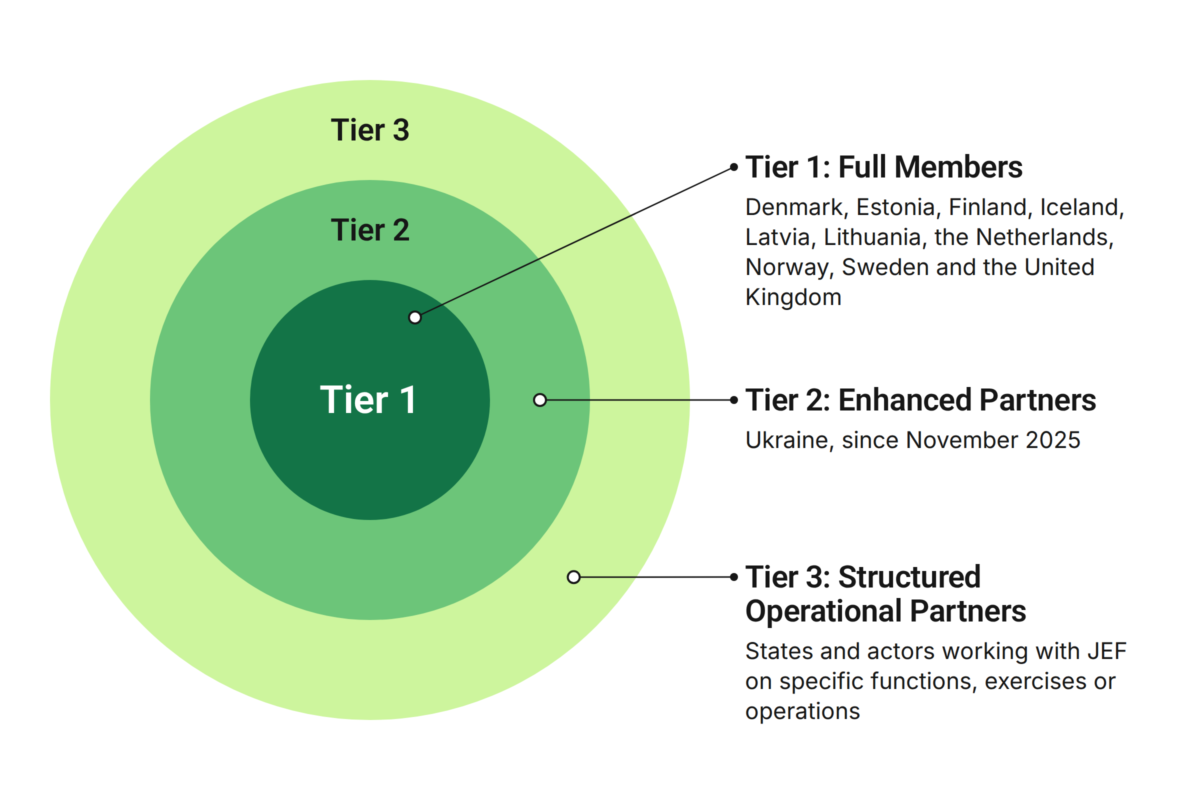
The three tiers are the author’s proposal, not an arrangement JEF has adopted. Graphic: BISC.
Tier 1: Full Members
Full membership should remain the highest threshold and should be reserved for states that meet the full combination of geographic relevance, political trust, operational contribution, interoperability and willingness to accept sustained responsibilities within the framework.
A Tier 1 member should strengthen JEF’s core operating environment rather than redirect it. It should contribute usable capability, infrastructure or strategic access and be able to participate in rapid consultation without materially reducing the framework’s political agility. Membership should also add value beyond existing NATO or bilateral arrangements rather than merely duplicating relationships that already function adequately elsewhere.
Canada currently presents the strongest potential case because its Arctic and North Atlantic geography, NATO membership, participation in JEF activity and transatlantic role all align with JEF’s existing strategic logic. Germany and Belgium could also warrant consideration depending on how JEF’s future purpose is defined, but their cases differ substantially. Germany offers mass, infrastructure and Baltic operational weight while also carrying major NATO responsibilities that complicate the added-value calculation. Belgium offers less scale but brings useful North Sea geography, maritime capability and logistics relevance that may fit JEF’s regional focus particularly well.
The important principle is that Tier 1 should remain selective. If every strategically important state qualifies for full membership, JEF gradually ceases to be a focused regional framework and begins to resemble a smaller political version of NATO.
Tier 2: Enhanced Partners
Enhanced Partnership provides a useful middle category for states whose strategic relevance is clear but whose full membership is unnecessary, premature or politically impractical.
Ukraine is the existing precedent. Its Enhanced Partnership with JEF provides a structured mechanism for operational learning, exercises and cooperation without creating the legal and political implications associated with membership. This is particularly valuable because Ukraine’s relevance to European security is indisputable, yet its relationship with NATO, ongoing war and wider security circumstances make a simple membership analogy inappropriate.
A Tier 2 relationship should therefore be substantial rather than ceremonial. Enhanced Partners could participate regularly in selected exercises, planning activity, lessons exchange, resilience work and capability development while remaining outside JEF’s core political consultation mechanism. The model would work particularly well for actors whose expertise or operational experience is indispensable but whose inclusion as full members might alter the framework’s political character or create unnecessary institutional complexity.
This category also provides flexibility over time. A state could remain an Enhanced Partner indefinitely if that relationship produces the required strategic effect, or deepen its relationship later if geography, political circumstances and capability commitments change. Partnership should not automatically be treated as a waiting room for membership.
Tier 3: Structured Operational Partners
A third tier would cover states and actors whose contribution is best organised around specific functions, exercises, operations or regional requirements rather than broad political participation.
Germany, Poland, Belgium and Ireland could all fit within this category in different circumstances without prejudging any future membership decision. Germany might participate around Baltic maritime command, reinforcement and logistics. Poland could contribute to eastern Baltic planning, land reinforcement and selected exercises. Belgium could support mine countermeasures, North Sea infrastructure protection and logistics. Ireland could cooperate on maritime domain awareness, critical infrastructure and North Atlantic resilience while remaining consistent with its current policy of military neutrality.
Structured operational participation could also extend beyond sovereign-state relationships in carefully defined areas. Autonomous territories, national agencies, infrastructure operators and specialist institutions may be relevant to particular exercises or resilience functions without any implication that they possess separate membership status. The Greenland and Faroe Islands discussion demonstrates why this distinction matters. Strategic relevance can be operationally recognised without forcing every relationship into an inappropriate membership category.
Why the Three-Tier Model Works
The principal advantage of a tiered model is flexibility without institutional inflation. It allows JEF to draw on additional capability, geography and expertise while preserving a smaller political core capable of relatively rapid consultation. Full membership remains available where it clearly strengthens the framework, but it is no longer treated as the default mechanism for every important relationship.
The model also reduces the pressure to answer complex political questions before practical cooperation can begin. States can participate in exercises, share lessons, contribute specialist capabilities and support regional operations while the longer-term membership debate remains open. That sequencing is strategically useful because it allows performance and interoperability to inform political decisions rather than asking political declarations to substitute for operational evidence.
Most importantly, the three-tier model preserves the distinction between growth and enlargement. JEF can become stronger, more connected and more capable without becoming substantially larger as a political institution. Future expansion should therefore be understood as one element of a broader growth strategy rather than as the primary measure of success.
10. The Expansion Decision
The expansion debate should not end with a ranking table that reduces complex strategic choices to a list of winners and losers. The cases examined in this paper differ too substantially in geography, military role, political fit and existing institutional commitments for that approach to be useful. A more credible conclusion is to identify where the evidence currently points and to distinguish between cases for full membership, deeper partnership and structured cooperation.
Canada currently presents the strongest case for full membership because its Arctic and North Atlantic geography, NATO role, participation in JEF activity and political engagement align closely with the framework’s existing strategic logic. Canadian accession would extend rather than redirect JEF’s core operating environment and could strengthen transatlantic reinforcement, Arctic cooperation and regional consultation. The remaining question is whether Ottawa is prepared to sustain the level of political attention and military contribution that membership would require alongside its existing continental, Arctic, NATO and Indo-Pacific commitments.
Germany is strategically indispensable to Northern European defence, but its membership case is more complicated. German geography, ports, logistics, industry, Baltic maritime command functions and commitments in Lithuania already make it central to regional deterrence. At the same time, Germany carries expanding NATO responsibilities, including future leadership responsibilities at JFC Brunssum, and much of the capability JEF would seek to access is already connected through Alliance structures. Full membership is therefore plausible, but the additional operational value must clearly exceed the political complexity and institutional duplication it would introduce. Deep structured cooperation should continue regardless of whether accession ultimately follows.
Belgium offers a different and frequently underestimated proposition. It would not transform JEF through military mass, but it could add useful North Sea geography, mine countermeasures, maritime capability, logistics infrastructure and existing experience in Baltic and North Atlantic operations. Its case is important because it tests whether JEF expansion is genuinely being judged according to regional utility rather than national size. If specialist capability and enabling geography are valued appropriately, Belgium deserves considerably more attention than it typically receives in enlargement debates.
Poland is equally difficult to ignore and harder to classify. Its military growth, Baltic coastline, infrastructure and direct exposure to Russia and Belarus make it essential to the defence of NATO’s northeastern flank. The concern is not Polish relevance but institutional direction. Full accession could strengthen JEF’s Baltic dimension while also pulling the framework further towards the wider eastern-flank agenda, where NATO already carries extensive command and planning responsibilities. Poland therefore remains a strategically compelling partner, but membership should depend on a clearer definition of where JEF’s geographic centre of gravity ends.
Ireland presents almost the opposite case. Its North Atlantic geography is strategically valuable, particularly in relation to maritime awareness, undersea infrastructure and transatlantic connectivity, but its current policy of military neutrality makes full membership a poor fit. Structured partnership around maritime security, resilience and infrastructure would likely deliver greater practical value without forcing an institutional arrangement that sits awkwardly with Irish defence policy.
France demonstrates why strategic importance alone cannot determine accession. Its military capability, Atlantic geography, nuclear status and political weight are unquestionable, but the United Kingdom and France already possess a mature bilateral expeditionary framework through the CJEF. French membership would therefore risk changing JEF from a focused Northern European coalition into a broader European strategic grouping. That may be an argument worth having in another context, but it is not automatically an argument for accession.
Ukraine should remain in a separate category. Its Enhanced Partnership is currently the appropriate model because it allows JEF to deepen access to operational lessons, exercises and battlefield adaptation without forcing a membership decision that does not fit the present political and security circumstances. The partnership should deepen precisely because Ukrainian relevance is so substantial, not because full membership is the only way to recognise that relevance.
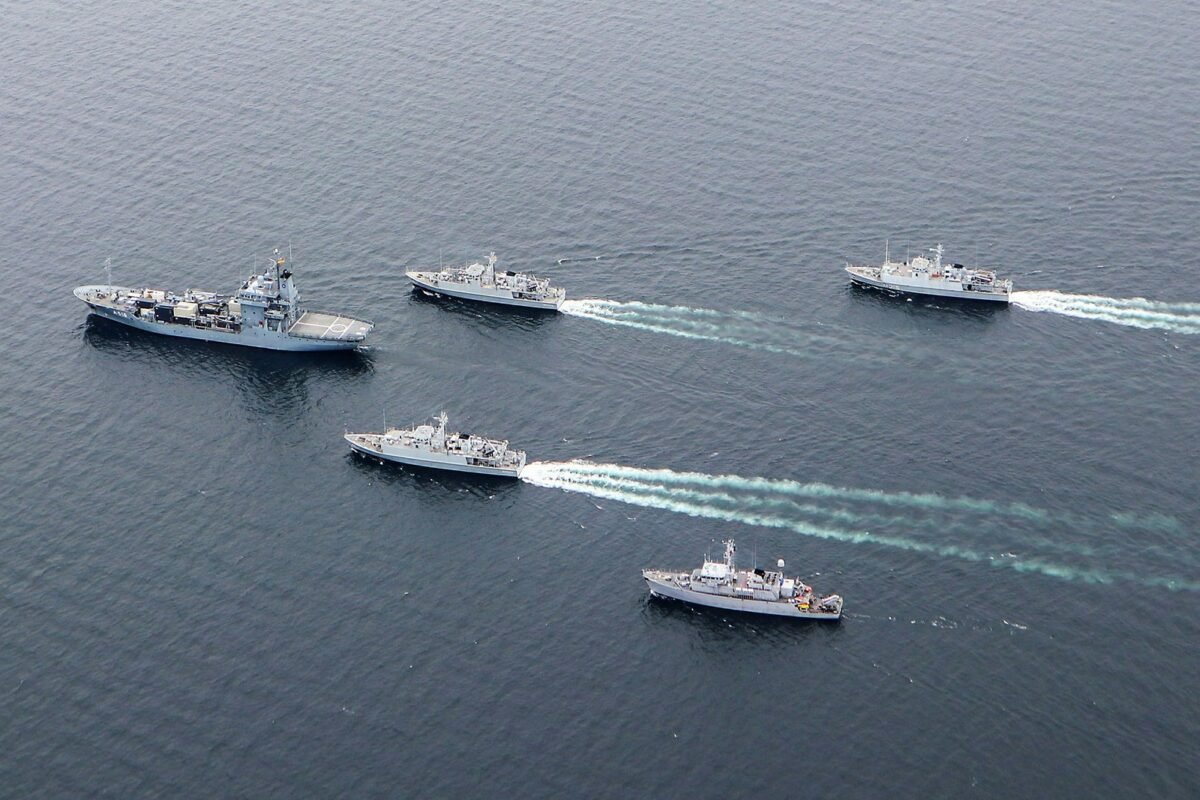
Ships of several Nato partners in formation south of the Isle of Arran, Scotland, for Exercise Sea Breeze 24, June 24, 2024. Image by Lt Ian Miller; © Crown copyright 2024. Open Government Licence.
Taken together, these cases point towards a selective rather than expansive model of growth. Canada currently offers the clearest argument for full membership. Germany and Belgium merit serious consideration, but for very different reasons. Poland requires greater caution over geographic and institutional fit, Ireland is better suited to partnership, France is better treated through existing strategic arrangements, and Ukraine’s Enhanced Partnership should continue to mature.
The final test remains consistent across all cases. Accession should strengthen JEF’s speed, political trust, geographic coherence and operational output at the same time. If a candidate adds forces but slows decision-making, adds political weight but blurs regional focus, or adds another institutional layer without improving readiness, the case for membership weakens considerably. Expansion is justified only when the framework becomes more useful as a result, not merely larger.
11. Conclusion: Grow Only Where Growth Makes JEF Better
Paper 1 began with a relatively simple question: why does JEF work? The answer was not that the framework possessed the greatest military mass, the largest bureaucracy or the widest membership. Its value came from a different combination of qualities: geographic coherence, political trust, operational familiarity and an institutional design light enough to support rapid consultation without attempting to replicate the organisations around it. Any serious discussion of expansion should therefore return to those same characteristics rather than assume that enlargement is inherently evidence of progress.
Paper 4 has argued that future growth should be judged according to whether it preserves and strengthens those qualities. Additional members can contribute forces, infrastructure, political influence, industrial capacity and strategically important geography, but they also introduce new priorities, national decision-making processes and institutional demands. A larger JEF that becomes slower to consult, harder to coordinate or less clear about the region it exists to serve would not necessarily be a stronger JEF. Military mass matters, but so does the ability to turn political alignment into timely operational effect.
The candidate cases demonstrate why a single model of enlargement is insufficient. Canada currently presents the strongest case for full membership because its North Atlantic and Arctic position reinforces JEF’s existing strategic geography. Germany, Poland and Belgium bring substantial but very different forms of value, while their cases also expose questions concerning NATO duplication, internal political balance and geographic scope. Ireland illustrates the limits imposed by national defence policy even where geography is strategically relevant, while France demonstrates that military importance alone does not create an institutional requirement for membership. Ukraine, meanwhile, shows that strategically indispensable cooperation can be deepened through Enhanced Partnership without forcing every relationship into the same organisational category.
That distinction should shape the next phase of JEF’s development. Full membership, enhanced partnership and structured operational participation can coexist within a wider network of regional cooperation. Such an approach would allow JEF to access additional military capability, operational experience and strategic geography while protecting the relatively small political core that enables it to move quickly. A carefully structured network around JEF may therefore generate greater strategic effect than a substantially enlarged formal membership whose internal complexity begins to resemble the institutions JEF is intended to complement.
The central question should remain operational rather than institutional. Expansion should proceed where accession demonstrably improves deterrence, preparedness, regional coherence and the ability to support NATO. Where those benefits can be achieved more effectively through partnership, exercises, bilateral arrangements or functional cooperation, membership should not be treated as the more prestigious or desirable outcome. Institutional restraint was part of what made JEF useful in the first place, and there is little reason to abandon that discipline simply because expansion has become politically interesting.
The progression of The JEF Papers now moves naturally from membership to capability. Paper 1 examined why JEF works, Paper 2 established the strategic geography it serves, Paper 3 considered how it complements NATO, and Paper 4 has asked who should participate and at what level. Paper 5 will turn to the practical question that follows from all four: what capabilities should these nations actually integrate and deliver together if JEF is to remain operationally relevant rather than merely politically coherent?
The distinction is important because the future of JEF will ultimately be determined less by how many flags appear around the table than by what those states can understand, decide, integrate and deliver together. Growth should therefore remain a means of improving the framework, not a measure of its success.
Published Papers
Paper 1: Why JEF Works
LinkedIn Article https://www.linkedin.com/pulse/jef-papers-paper-1-why-works-eva-sula-bya6f/
LinkedIn Post https://www.linkedin.com/feed/update/urn:li:ugcPost:7466369611756814336/
Paper 2: The Baltic-Arctic Security Bridge
LinkedIn Article https://www.linkedin.com/pulse/jef-papers-paper-2-baltic-arctic-security-bridge-eva-sula-dzf1f/
LinkedIn Post https://www.linkedin.com/feed/update/urn:li:ugcPost:7474339985178144768/
Paper 3: NATO’s Complement, Not Competitor
LinkedIn Article https://www.linkedin.com/pulse/jef-papers-paper-3-nato-complement-competitor-eva-sula-ozrrf/
LinkedIn Post https://www.linkedin.com/posts/eva-sula-02b9a73_jef-nato-northerneurope-activity-7484082112497778689-asbD
Upcoming Papers
Paper 4
The Expansion Question
Should JEF expand beyond its current membership, and if so, what strategic, political and operational principles should determine future membership?
Paper 5
Capability Integration Across JEF
How should JEF integrate command and control, ISR, logistics, autonomy, electronic warfare, cyber resilience, AI and the digital backbone to strengthen regional deterrence and complement NATO?
Paper 6
The Future of Regional Defence Cooperation
What does JEF reveal about the future of European defence cooperation, regional coalitions and Alliance adaptation in an increasingly contested security environment?
The JEF Command & Control Papers
Published
Paper 1
Why Command and Control Must Be Commanded
LinkedIn Article https://www.linkedin.com/pulse/jef-c2-commanding-northern-flank-paper-1-why-must-commanded-eva-sula-vrmbf/
LinkedIn Post https://www.linkedin.com/posts/eva-sula-02b9a73_jef-nato-commandandcontrol-activity-7475382205628977152-TYFU
Published
Paper 2
Commanding the Northern Flank
LinkedIn Article https://www.linkedin.com/pulse/jef-c2-commanding-northern-flank-paper-2-nato-decision-eva-sula-m840f/
LinkedIn Post https://www.linkedin.com/posts/eva-sula-02b9a73_nato-jef-c2-activity-7484507266642137088-kHey
Upcoming
Paper 3
Regional C2 for NATO’s Northern Flank
Paper 4
Decision Advantage Under Multi-Domain Pressure
Paper 5
Building a Resilient Northern C2 Architecture
Primary Sources Used
Joint Expeditionary Force
- Joint Expeditionary Force – About JEF https://jefnations.org/about-the-jef/
- Joint Expeditionary Force Newsroom https://jefnations.org/jef-activities/newsroom/
- JEF 2024 Information Booklet https://jefnations.org/wp-content/uploads/2024/02/JEF-2024-Info-Booklet.pdf
- TARASSIS activities and lessons https://jefnations.org/2025/
Official Government Material
- Joint Statement of JEF Leaders 26 March 2026 https://www.gov.uk/government/news/joint-statement-from-the-leaders-of-the-joint-expeditionary-force-26-march-2026
- Government Offices of Sweden Joint Statement https://www.government.se/contentassets/995055042dc84c84984e7d6fbf273bf2/joint-statement-the-joint-expeditionary-force-leaders-summit/
- Prime Minister of Canada Participation in the JEF Leaders’ Summit https://www.pm.gc.ca/en/news/readouts/2026/03/26/prime-minister-carney-participates-virtual-meeting-joint-expeditionary
UK Ministry of Defence
- JEF Enhanced Partnership with Ukraine https://www.gov.uk/government/news/joint-expeditionary-force-launches-enhanced-partnership-with-ukraine-as-allies-step-up-further
- Written Parliamentary Questions on JEF https://questions-statements.parliament.uk/written-questions/detail/2025-12-08/97997/
NATO and National Defence
- Netherlands Ministry of Defence Joint Expeditionary Force https://english.defensie.nl/topics/i/international-cooperation/other-countries/joint-expeditionary-force
- NATO Command and Control Centre of Excellence https://www.c2coe.org
- NATO Cooperative Cyber Defence Centre of Excellence https://ccdcoe.org
- NATO Centre of Excellence for Operations in Confined and Shallow Waters https://www.coecsw.org
- NATO Allied Joint Force Command Norfolk https://jfcnorfolk.nato.int
- NATO Allied Joint Force Command Brunssum https://jfcbs.nato.int
- NATO MARCOM https://mc.nato.int
- SHAPE https://shape.nato.int
Parliamentary and Research Material
- UK House of Commons Library - What is the Joint Expeditionary Force? https://researchbriefings.files.parliament.uk/documents/CBP-10074/CBP-10074.pdf
- House of Commons Research Briefing - European Security and Defence https://researchbriefings.files.parliament.uk/documents/CBP-10262/CBP-10262.pdf
- UK Defence Committee Oral Evidence 15 July 2026 https://committees.parliament.uk/oralevidence/17972/pdf/
Additional Reference Material
- NATO Strategic Concept (2022) https://www.nato.int/strategic-concept/
- NATO Vilnius Summit Communiqué https://www.nato.int/cps/en/natohq/official_texts_217320.htm
- NATO Washington Summit Declaration https://www.nato.int/cps/en/natohq/official_texts_227678.htm
- NATO Integrated Deterrence and Defence publications https://www.nato.int
- EU Strategic Compass https://www.eeas.europa.eu/eeas/strategic-compass-security-and-defence_en
Suggested Reading
For readers wishing to explore the broader strategic context beyond this paper, the following publications provide useful and complementary perspectives.
NATO
- NATO Strategic Concept (2022)
- NATO Washington Summit Declaration
- NATO Vilnius Summit Declaration
- Allied Joint Doctrine publications relevant to regional operations, deterrence and command and control.
JEF
- JEF Vision Statement (2023)
- JEF Leaders’ Statements (2023–2026)
- JEF Information Booklet
- TARASSIS lessons and activity reports
- Nordic Warden public material
Arctic and Northern Europe
- NATO High North publications
- UK Ministry of Defence: The UK’s Defence Contribution in the High North
- Finnish Government publications on comprehensive security and total defence
- Swedish Government publications on Total Defence
- Norwegian Government High North strategies
Maritime Security
- NATO MARCOM publications
- NATO Centre of Excellence for Operations in Confined and Shallow Waters
- Critical Undersea Infrastructure initiatives
- Baltic Sentry public material
- North Sea and Baltic critical infrastructure protection reports
Command and Control
- NATO C2COE publications
- NATO Federated Mission Networking (FMN)
- NATO Digital Transformation Strategy
- NATO Multi-Domain Operations publications
Cyber and Resilience
- NATO CCDCOE publications
- Tallinn Manual project
- NATO Resilience Baseline Requirements
- EU Critical Entities Resilience Directive
- NIS2 Directive
Eva Sula is an independent defence and security strategic advisor specialising in NATO and European defence cooperation, regional security, emerging technologies and operational capability development. She is a NATO DIANA Defence Mentor, a Senior Fellow for Estonia at the Council on Strategic and Foreign Intelligence (CSFI), and a member of The Alphen Group.
© Eva Sula
First published on LinkedIn on August 20, 2026. Read the original article.
All opinions expressed are those of the author alone and may not represent those of the institutions they represent or the Baltic International Security Centre (BISC). BISC maintains a strict intellectual independence policy across all its projects and publications.