
Crises in Kaliningrad, Baltic Barometer, and BISC at Vinted’s Policy Breakfast
Sign up to get Be More Baltic by email.
Behind Russia’s nuclear sabre-rattling over Kaliningrad is another story: the Kremlin worries about the unsustainability of its westernmost exclave. Moscow’s rule there is rigid but brittle. As economic, social and other strains grow, crises are inevitable. But how will outsiders react?
That is exactly what BISC explored in its crisis simulations last week. Assuming the roles of key local and regional decision-makers, experts gathered at the ISM University in Vilnius to work through three hypothetical crisis scenarios. They assessed diplomatic, military, economic and other responses and their implications for the Baltics and the rest of Europe. Participants included Russia expert Keir Giles, former Nato spokesperson Oana Lungescu, former ambassadors and retired military officers.
More on that in a moment.
BUT FIRST: NO LONGER AN ENERGY ISLAND
Today we publish the second edition of our regular Baltic Barometer. The June edition contrasted the B3’s foreign borrowing costs (surprisingly cheap) with the local capital markets (dire). The latest Barometer challenges another lazy misconception: of the B3 as a vulnerable energy island. This picture is years out of date. Sustained investment and effort have transformed Baltic energy systems and eliminated dependencies on Russia.
Download the Barometer to discover how Lithuania, Latvia and Estonia have achieved this remarkable transformation and are weathering the current energy crisis and the closure of the Strait of Hormuz, and what needs to be done next.
Keep an eye out too, for our third Baltic Barometer on defence technology, which will round out 2026. It will challenge another cliché: the idea of the B3 as defence minnows. It will show how Baltic innovators are drawing on their priceless, unique connections with Ukraine to develop world-class solutions to pressing military problems. That’s vital not only for themselves, but for their allies too.
BACK TO KALININGRAD
“The Kremlin likes to depict Kaliningrad as a geopolitical trophy and military bastion,” says BISC’s Edward Lucas, who convened the simulations and wrote about them in his Times and EUobserver columns last week. “And outside commentators tend to see it as an east-west hotspot. But we want to show another story: Kaliningrad is fragile, and that fragility is a problem for its neighbours.”
The exercise, he says, “examines Kaliningrad as a potential problem for Russia itself, and gives regional decision-makers the agency they are too often denied in Western commentary.”
BISC’s initiative hit the headlines, with coverage in all main Lithuanian outlets (LRT, Delfi, TV3, Alfa.lt, Bernardinai and LRT Radio) and a 45-minute podcast (in English). More to come when the embedded journalists are released from their embargo.
Sky News (which produced the “War Game” series featuring a Russian attack on Britain) filmed the event for their news channel, with extended coverage upcoming on the Defence Insider app.
BISC’s Kaliningrad 2050 programme has other elements too. Our book-length report Fragile Fortress will be available for download (with the link in future newsletters). And our regular review of the Kaliningrad media highlights the authorities’ furious response to an intriguing rumour about conscription plans (A Nato psy-op? In your dreams).
GOOD GERMAN JOURNALISM
This week we have two bouquets. The first is to Daniel Sagradov of Die Zeit for his interview with Lithuanian foreign-policy guru, Professor Margarita Šešelgytė (briefly: we need deeds not words to deter Putin). The other is to Carolina Drüten of Die Welt. She took brickbats for her much-criticised “Ernstfall” podcast, in which German leaders hesitated while (voiceless) Lithuania was reduced to a bystander. But hats off for her well-researched piece on air defence in the Baltics, datelined from Šiauliai, the Lithuanian air base that hosts Nato’s Baltic Air Policing mission. Both in German.
Our weekly German-language press review comes with an English summary and the full German version. Both of our weekly media reviews are made possible by the Friedrich Naumann Foundation for Freedom in Vilnius.
BISC IN THE WILD
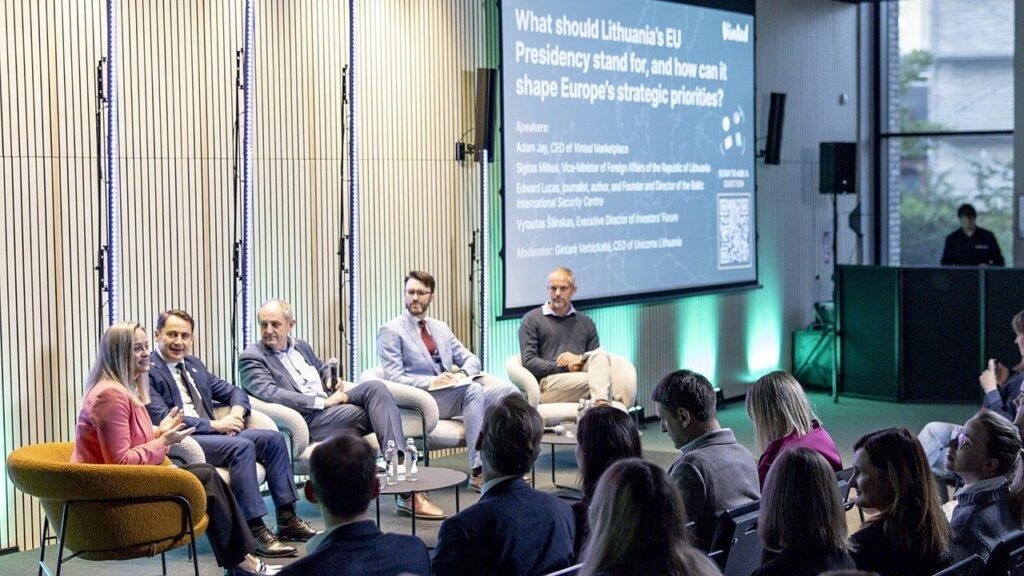
Policy Breakfast by Vinted in Vilnius, September 29. Photo: Vinted
- Kyiv Independent: Russian sabotage has outgrown the word “hybrid”. Europe should hit back across borders, so the risk of escalation is shared.
- EUobserver: what the new de Gaulle film leaves out about how the second world war ended for the other half of Europe.
- ISM University: “Be More Baltic”, a conversation with ISM president Dalius Misiūnas on what the West should learn from the B3, and how to strengthen their voice.
- Echo24 [in Czech]: Russia has been testing the West’s will for 30 years, and the Balts, supposedly the most exposed, are the ones calling for calm.
- El País [in Spanish]: Russia’s influence campaign aims to sow fear in and around the Baltic states. The Balts will not be caught by surprise. Nato is not built for the ambiguous war Russia is fighting.
- Vinted [in Lithuanian]: a Policy Breakfast panel on Lithuania’s priorities for its coming European Union presidency. Our take: Lithuania has never been so prosperous, so free and so safe, and should say so.
WHAT WE ARE READING
- Deep Baltic: “The land of what if”. The pseudonymous Incognitov goes offline in the Suwałki corridor during Russian jamming and reports from the ground. Excellent.
- Our friends at Baltic Sentinel: Colonel Ants Kiviselg, Estonia’s military intelligence chief, sees no sign of a new Russian mobilisation wave or a Crimea-style operation in the Baltic states. Sabotage attacks, he says, “will probably continue.”
- The Financial Times on Estonia’s “active defence”: the main brigade’s headquarters moves from Tapa to Jõhvi, 50 km from the Russian border, with rockets that reach 300 km on order. The plan is to fight from the border, not fall back and wait.
OVER TO YOU
As always, send us spots and tips, rants and raves. Follow us on Facebook, LinkedIn and X.
If you would like to support our work, write to us at donate@securebaltics.org.
Best regards, Edward Lucas and the BISC team
Next dispatch: October 26.
BISC’s motto is “Be more Baltic!” Estonia, Latvia and Lithuania see what the rest of Nato doesn’t see. And they do what others don’t do.
EARLIER DISPATCHES
- Dispatch two: Narva is not next, September 28
- Dispatch one: We asked Budanov to change his tune, September 16