
Featured image: Aircraft from Germany, Finland, Sweden and the United States fly in formation during BALTOPS 22, June 6, 2022. Photo: Mass Communication Specialist 3rd Class Jesse Schwab, U.S. Navy, public domain, via Wikimedia Commons.

The Baltic Reality | Part 3 of 5
By Eva Sula
Editor’s note: This is Part 3 of Eva Sula’s five-part series The Baltic Reality: Beyond the Red Arrows. BISC added the maps and the visuals. They are not part of her original article, which appears here as she wrote it.
All opinions expressed are those of the author alone and may not represent those of the institutions they represent or the Baltic International Security Centre (BISC). BISC maintains a strict intellectual independence policy across all its projects and publications.
© Eva Sula
First published on LinkedIn on July 27, 2026. Read the original article or the LinkedIn post.
Introduction
The first part of this series examined why military geography must be understood before credible conclusions can be drawn about Baltic security. The second showed that this geography creates dependencies extending far beyond Estonia, Latvia and Lithuania, across the Baltic Sea, the Nordic region and the infrastructure linking northern Europe to the wider alliance.
The next question is what military action within that geography actually requires. Public discussion often reduces operations to arrows crossing political borders, as though movement from one point to another were the operation itself. Every operational arrow drawn across a map represents thousands of assumptions that are rarely made visible: assumptions about intelligence, command, air and maritime access, engineering, logistics, communications, civilian infrastructure, weather, reinforcement, sustainment and the ability to recover when one or several of those conditions fail.
Military reality begins where the arrow stops being a graphic and becomes a sequence of interdependent actions.
Maps Are Not Operations
Political maps are indispensable for understanding sovereignty, borders and administrative responsibility. They show where one state ends and another begins, identify major settlements and transport routes, and provide a common geographical reference for governments, planners and the public. They were never intended to describe how military operations unfold.
Operational planning begins where the political map reaches its limits. A planner looking at the same area immediately sees a different set of questions. Which routes can sustain heavy military traffic over time? Which bridges impose weight restrictions? Which ports and airfields can receive, support and protect follow-on forces? Which transport corridors become bottlenecks? Which infrastructure is essential for sustaining operations, and which assets represent single points of failure? The political map remains useful, but it becomes only one layer within a much broader operational picture.
This distinction is particularly important in the Baltic region because relatively short geographical distances conceal considerable operational complexity. Terrain, infrastructure and the natural environment influence movement and sustainment in ways that are not immediately visible on conventional maps. Seasonal variation further changes those conditions. Frozen ground may improve mobility in one area while sea ice restricts maritime access elsewhere. Prolonged rainfall can reduce ground bearing capacity, spring thaw alters mobility, storms affect maritime activity and flooding may disrupt both civilian and military movement. None of these conditions is exceptional in isolation, yet each changes the assumptions on which operations depend.
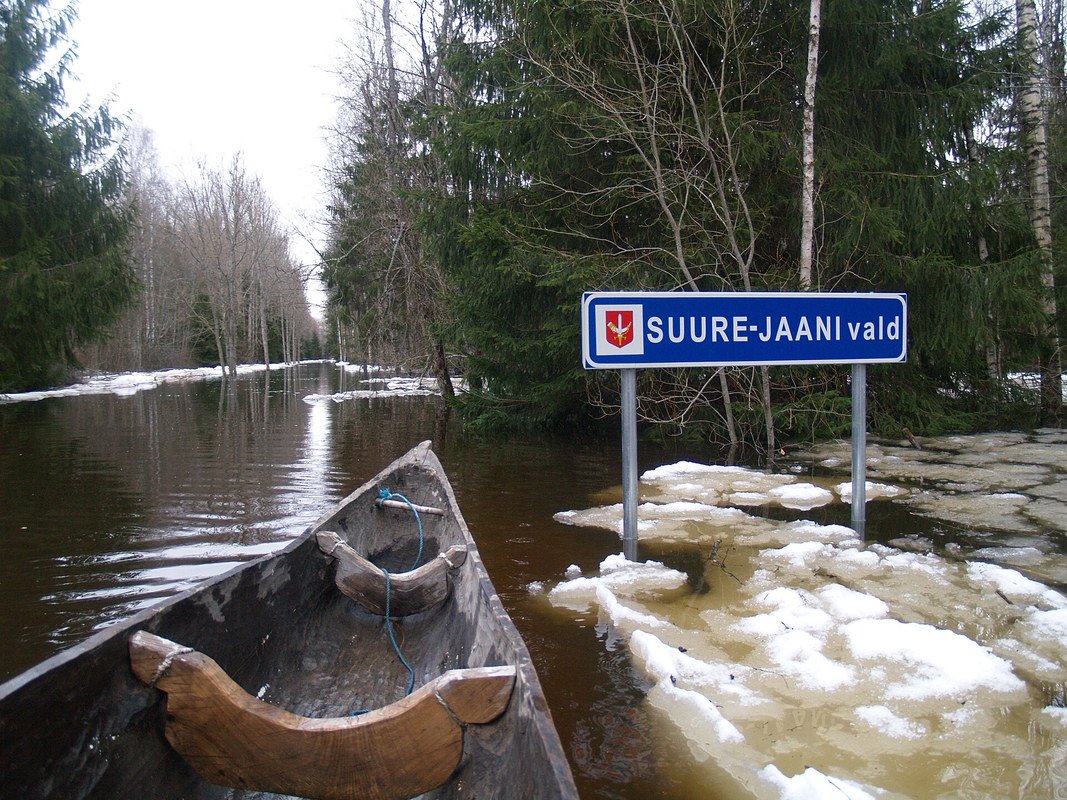
A flooded road in Soomaa National Park, Estonia, photographed between 2005 and 2014. Photo: Ruukel, CC BY-SA 4.0, via Wikimedia Commons.

Movement Is Only the Beginning
Military movement is often described as though it were a self-contained task: forces depart, travel along an identified route and arrive where they are required. In operational terms, arrival solves only the first part of the problem. A force that reaches its destination without sufficient fuel, ammunition, maintenance capacity, engineering support, medical provision or a functioning resupply system may have completed its movement while losing much of its ability to act.
This distinction is central to operational momentum. Mobility creates the opportunity to place forces where they are needed, but logistics sustains their ability to operate. Engineering opens, maintains or restores routes. Maintenance preserves equipment availability. Recovery returns damaged or immobilised platforms to service or removes them from routes where they obstruct further movement. Medical support preserves personnel and fighting strength. Fuel and ammunition determine how long particular capabilities can continue operating at the required tempo. These functions are often presented separately because they require different expertise, organisations and planning processes, yet operationally they form one system. A constraint in any one of them can reduce the effectiveness of all the others.
A road may be open, for example, while still being unsuitable for the intended movement. Its bridges may not support the required loads, its tunnels may lack sufficient clearance, its junctions may not accommodate abnormal vehicles and its shoulders may be incapable of supporting recovery operations. The route may also have to carry civilian traffic, emergency services, commercial freight and several military formations moving in different directions. The existence of a road on a map provides very little information about its usable capacity once those demands are combined.
Weather adds another layer because it alters the usable characteristics of terrain and infrastructure rather than merely making movement uncomfortable. Frozen ground may temporarily increase bearing capacity and permit movement through areas that are difficult to cross in warmer conditions. Thaw, persistent rainfall and flooding can reverse that advantage, reduce cross-country mobility, damage roads and increase the number of vehicles requiring recovery. Snow and ice affect braking distances, loading operations, switching equipment, port activity and railway availability. Wind, sea state and icing influence maritime movement, while poor visibility and storms can delay air operations and complicate the handling of cargo at exposed terminals.
Transport capacity is only useful when it connects to a functioning supply system. Fuel provides a particularly clear example because it is consumed continuously by ground vehicles, aircraft, ships, generators and the logistics fleet carrying other supplies. It must be received, stored, protected, tested, transported and distributed in the correct form to the units that need it. A disruption at any point can affect several capabilities at once, and increased movement itself creates additional demand because the vehicles delivering fuel also consume fuel.
Maintenance and recovery further complicate the assumption that a force which has moved successfully will remain available. Equipment becomes unserviceable through mechanical failure, collision, environmental exposure and ordinary wear, even without hostile action. Heavy vehicles place substantial demands on engines, tracks, tyres, suspensions and drivetrains, particularly when travelling long distances on surfaces or at speeds for which they were not optimised. Maintenance requires trained personnel, diagnostic equipment, tools, spare parts, suitable facilities and enough time to complete the work. Recovery requires specialised vehicles capable of reaching immobilised equipment, operating under the same terrain and weather constraints and moving damaged platforms without blocking the route for everyone else.
Medical support follows the same logic of interdependence. Casualty evacuation depends on access, transport, communications, protected treatment capacity and the ability to move patients through successive levels of care. Roads and aircraft required for evacuation may also be needed for reinforcement or resupply. Civilian hospitals may contribute essential specialist capacity while already dealing with ordinary demand or the effects of the same emergency. Medical planning therefore affects route allocation, force protection, personnel policy and operational tempo rather than existing as a separate humanitarian arrangement behind the manoeuvre.
Movement is only the beginning because every force that advances also lengthens, changes or increases its dependence on that supporting system. Maintaining momentum becomes a continuous process of managing friction, uncertainty and finite capacity across military, civilian and commercial networks. The ability to reach an objective remains important, but the ability to continue operating after arrival determines whether movement produces a lasting operational effect.
Multi-Domain Means Everything Happens Simultaneously
Multi-domain operations are often presented through diagrams in which land, air, maritime, cyber and space sit in separate boxes connected by arrows. The diagram is useful because it shows that the domains interact, but it also conceals the difficulty. In practice, the domains do not wait for one another, operate at the same speed or produce effects on the same timescale. A land formation may require hours or days to reposition, an aircraft may cross the same distance in minutes, a maritime asset may need to remain deployed for weeks, a cyber intrusion may persist undetected for months, and disruption in the electromagnetic spectrum may alter communications or sensing immediately. Commanders do not receive these effects in a convenient sequence. They must understand and coordinate them while conditions continue to change.
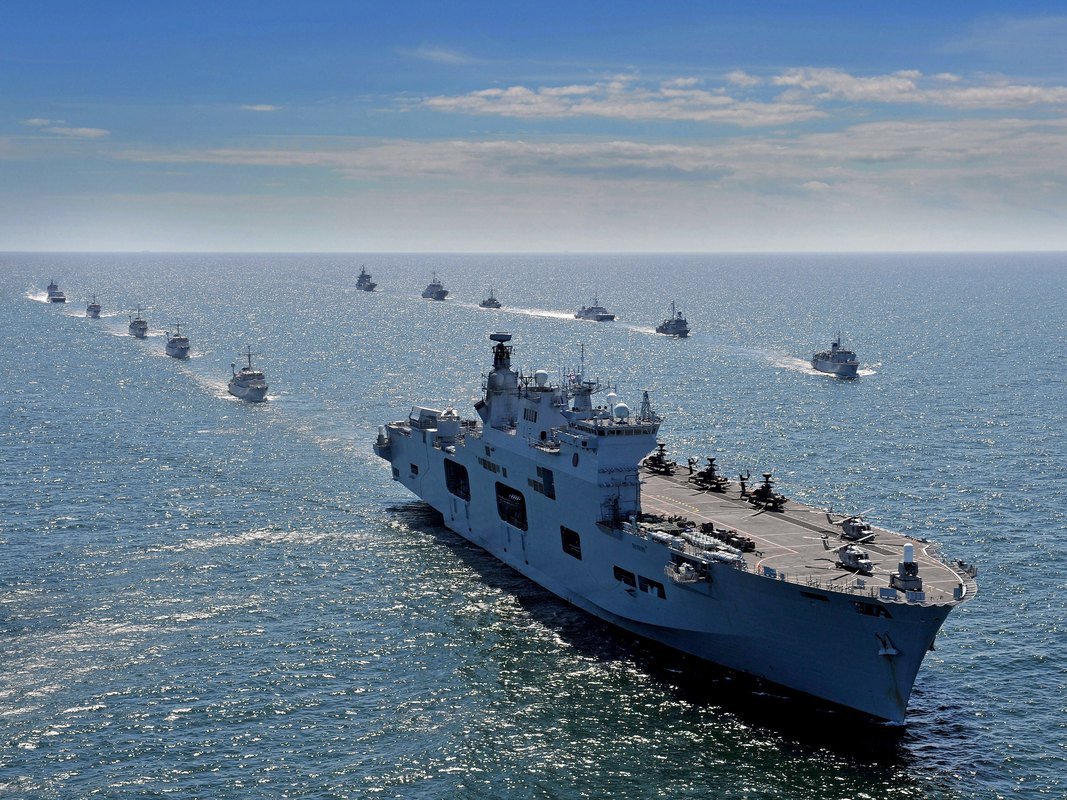
The helicopter carrier HMS Ocean, with Apache and Wildcat helicopters on deck and the ships of the 17 nations taking part behind her, during BALTOPS 2015, June 8, 2015. Photo: LA(Phot) Luron Wright, UK Ministry of Defence, Crown copyright, Open Government Licence v1.0, via Wikimedia Commons.

The same decision may depend on information from several domains and organisations. A land movement can be affected by the recognised air picture, maritime activity, satellite-enabled positioning and communications, cyber security, spectrum availability, civilian traffic and the condition of energy or telecommunications networks. An air operation may depend on targeting information generated by land, maritime, space-based or national intelligence sources. Maritime activity may rely on shore-based sensors, civilian port infrastructure, undersea communications, air protection and information held by several states. None of these relationships is unusual. They are the normal operating environment in which modern military action has to be planned.
NATO describes multi-domain operations as the orchestration of military activities across all operational domains and environments, coordinated with non-military instruments and actors to produce converging effects. That definition is important because it places the burden on orchestration rather than on the mere presence of capabilities from several services. Deploying land, naval and air forces in the same theatre does not by itself create a multi-domain operation. The operational advantage arises only when information, authorities, timing and effects can be aligned well enough for one activity to support, protect or create an opportunity for another. NATO’s own work on data centricity states directly that operating across domains while coordinating with civilian instruments depends on the ability to share and exploit data securely and reliably.
Speed creates a further complication because the domains do not only operate differently; they generate decision requirements at different rates. A commander may have minutes to respond to an air or missile threat while simultaneously managing land manoeuvre planned over days, maritime protection arranged over a wider area and cyber activity whose full significance remains uncertain. Faster data does not remove this problem. It can increase the volume of information reaching headquarters without resolving whether the information is accurate, relevant, shareable or understood in the same way by every participant.
This is where the data problem becomes operational rather than technical. Multi-domain operations depend on the ability to discover, access, understand, trust and exchange information across systems that were often developed by different nations, services, agencies and suppliers for different purposes. The problem is not merely that one system cannot send a message to another. Data may use different formats, definitions, classifications, coordinates, identifiers, levels of precision or rules for release. Two organisations may receive information about the same object and still be unable to combine it because they describe it differently, assign different confidence levels or lack permission to share the underlying source.
NATO’s current data strategy acknowledges that multi-domain operations, situational awareness and political decision-making require a secure data-sharing ecosystem in which Allies retain control of their data while enabling collaborative access. Its Digital Backbone is intended to provide connectivity and data transport across maritime, land, air, space and cyberspace, linking operational users, decision-makers and effectors. These initiatives address a genuine operational constraint rather than a general ambition to become more digital. NATO’s Allied Command Transformation has noted that fragmented and siloed data, together with legacy systems that cannot communicate easily, limit collaboration and slow decisions.
Classification is part of this constraint but not its complete explanation. Sensitive information must be protected because sources, methods, capabilities and operational intentions can be compromised through inappropriate disclosure. The difficulty begins when protection measures are applied without sufficiently clear arrangements for what can be shared, with whom, at what level of detail and under whose authority. A highly classified assessment that cannot reach the unit, agency or civilian operator required to act may protect the source while failing to produce the necessary operational effect. Conversely, lowering classification without understanding the risk can expose capabilities and future access. The leadership task is therefore not to choose between secrecy and sharing, but to establish information requirements, releasability rules and technical mechanisms early enough that essential information can move to the people who need it without dismantling legitimate security controls.
This becomes harder in multinational operations because national classification systems and disclosure rules do not always align. Access may depend on nationality, role, network connection, mission status or bilateral arrangements. A coalition headquarters can therefore contain personnel working on the same operational problem while seeing different portions of the information required to solve it. Federated Mission Networking and NATO’s interoperability testing seek to reduce these obstacles by establishing agreed standards and mission networks that allow participating nations to connect and exchange information from the beginning of an operation. The need for repeated testing also shows why interoperability cannot be declared on a slide and assumed to exist. Systems, procedures and data exchanges have to work under realistic conditions before operational pressure exposes the differences.
Exercises remain essential because they reveal technical incompatibilities, unclear procedures and gaps in authorities before they are encountered in a crisis. They also have limits. Exercise scenarios are bounded by time, safety rules, available forces, training objectives and assumptions about which systems will function. Participants generally know that the event has been planned, that the scenario will end and that evaluators are present. Real emergencies introduce competing national priorities, incomplete information, political pressure, public scrutiny, exhaustion, damaged infrastructure and consequences that cannot be reset after the final briefing.
Cross-border civil protection provides a useful example because it requires many of the same practical capabilities without reproducing military operations. Under the Union Civil Protection Mechanism, a state facing an emergency can request assistance, after which the Emergency Response Coordination Centre coordinates offers of personnel, aircraft, vehicles, equipment and expertise from participating countries. For the 2026 wildfire season, the European response included 22 firefighting aircraft, five helicopters and 777 firefighters from 14 countries, with teams pre-positioned in higher-risk areas to reduce response time. France, Portugal, the Netherlands and the Czech Republic had activated the mechanism for wildfire assistance by early July, receiving combinations of aircraft, helicopters, firefighters and vehicles from other European states.
This experience is directly relevant to wider preparedness, although military and civil protection missions should not be treated as interchangeable. Both depend on reception arrangements, common terminology, communications, situational awareness, logistics, host-nation support and the ability to integrate people who have not previously worked together. Both also reveal that a capability existing on a national inventory does not guarantee that it can be deployed, supported and used effectively in another country. The difference between an available resource and an operational contribution lies in the arrangements that connect it to the receiving system.
The difficulty is that these organisations do not share one command structure, one legal basis or one information system. They may also define urgency differently. A military commander may prioritise the movement of forces through a transport corridor, while a municipality needs the same route for evacuation, emergency repair or food distribution. A telecommunications operator may require access to a damaged site that military force-protection measures have restricted. A hospital may need fuel and personnel at the same time that logistics planners are allocating transport capacity elsewhere. These are not failures of commitment. They are competing operational requirements that need a mechanism for prioritisation and a clearly identified authority capable of making decisions across organisational boundaries.
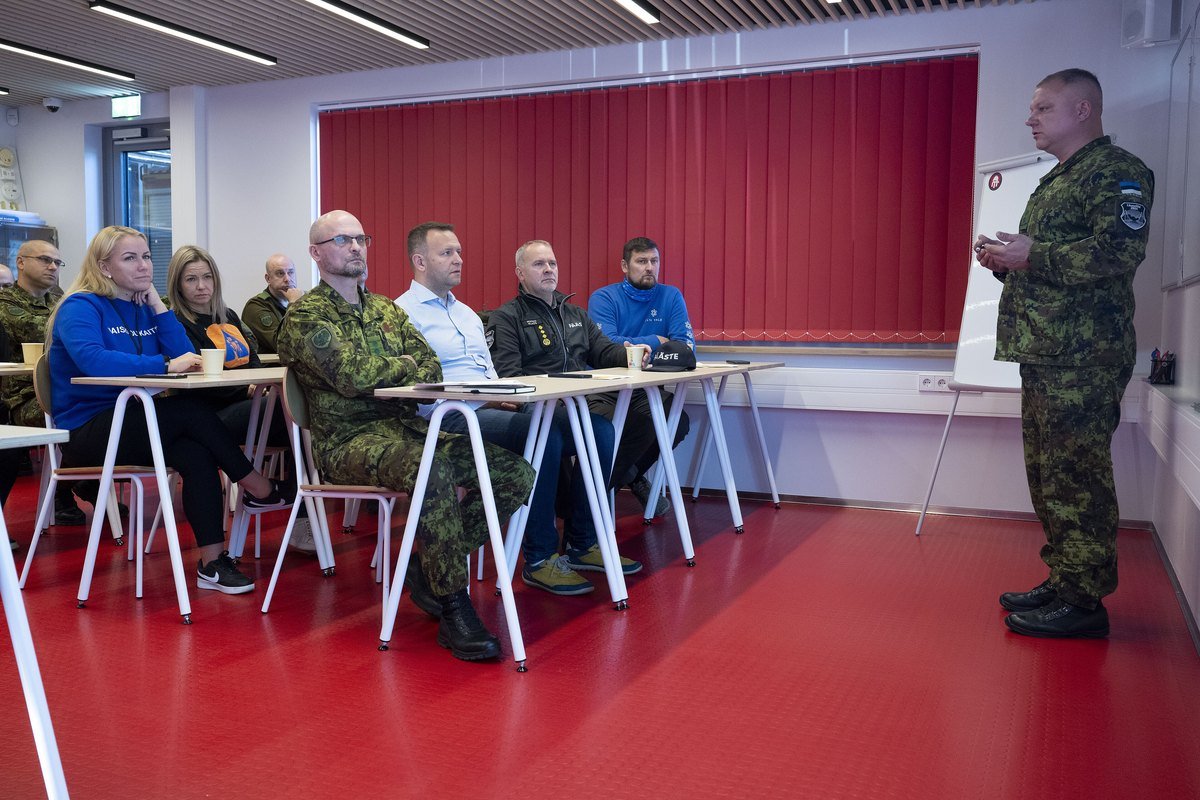
A briefing during Lõuna Sild 2024, the evacuation exercise run by the Estonian Defence League and the Rescue Board, October 6, 2024. Photo: Gunnar Teas, Estonian Defence League, CC BY 2.0, via Wikimedia Commons.

Responsibility is often easiest to describe at the policy level and hardest to locate when several systems fail together. National plans may assign responsibility for cyber incidents, energy disruption, public order, emergency response and military defence to different authorities. Each arrangement can appear coherent within its own sector. The uncertainty emerges at the boundaries: who leads when a cyber incident disrupts a civilian network carrying military communications, when a port required for reinforcement also supports national fuel supply, or when emergency services are responding to natural hazards while military demand is increasing? The existence of plans in each organisation does not guarantee that dependencies between those plans have been mapped, exercised and resourced.
Cyber operations expose these boundary problems particularly clearly. Cyber is often discussed as a separate domain, yet its effects are usually experienced through another activity. A compromised identity system may prevent staff from accessing operational applications. An attack on a telecommunications provider may reduce military and civilian communications. Manipulation of logistics data may cause supplies to be misdirected without physically damaging the transport network. Disruption to industrial control systems may affect electricity, water, heating or port operations. The cyber incident becomes operationally important because it changes what people and organisations can do in the physical world.
The European Union’s July 2026 statement on Russia’s malicious cyber activity described an ecosystem involving intelligence services, cybercriminal groups, hacktivists and private companies, with activity including the infiltration of government networks and sabotage of critical infrastructure. The statement identified targets across several EU member states, while the Council imposed restrictive measures on individuals and entities involved in attacks against critical infrastructure and essential services. The relevance to multi-domain planning lies not only in attribution or sanctions, but in the range of actors and systems involved. Cyber pressure may be persistent, distributed and deniable, and it may affect public services or private infrastructure long before it resembles a conventional military action.
Electronic warfare adds both opportunity and risk. It can detect, deceive, disrupt or deny adversary use of the spectrum, but the same activity can interfere with friendly or civilian systems if it is poorly coordinated. A force seeking to reduce its own electronic signature may limit communications at the moment when other organisations require more information. Jamming intended to protect a local area may affect navigation, aviation or emergency communications beyond it. Multi-domain coordination must therefore account for electromagnetic effects as part of the operational plan, including who has authority to employ them, who may be affected and how essential services will continue.
ISR presents the central information challenge across these domains. Intelligence, surveillance and reconnaissance are frequently discussed as though collecting more data automatically creates better understanding. Collection is only the first stage. Information must be processed, correlated, assessed, distributed and presented in time to support a decision. Different sensors may produce contradictory results, while the most precise source may be unavailable to the partner best placed to act. A headquarters can therefore possess large quantities of information without having a coherent or sufficiently shared picture.
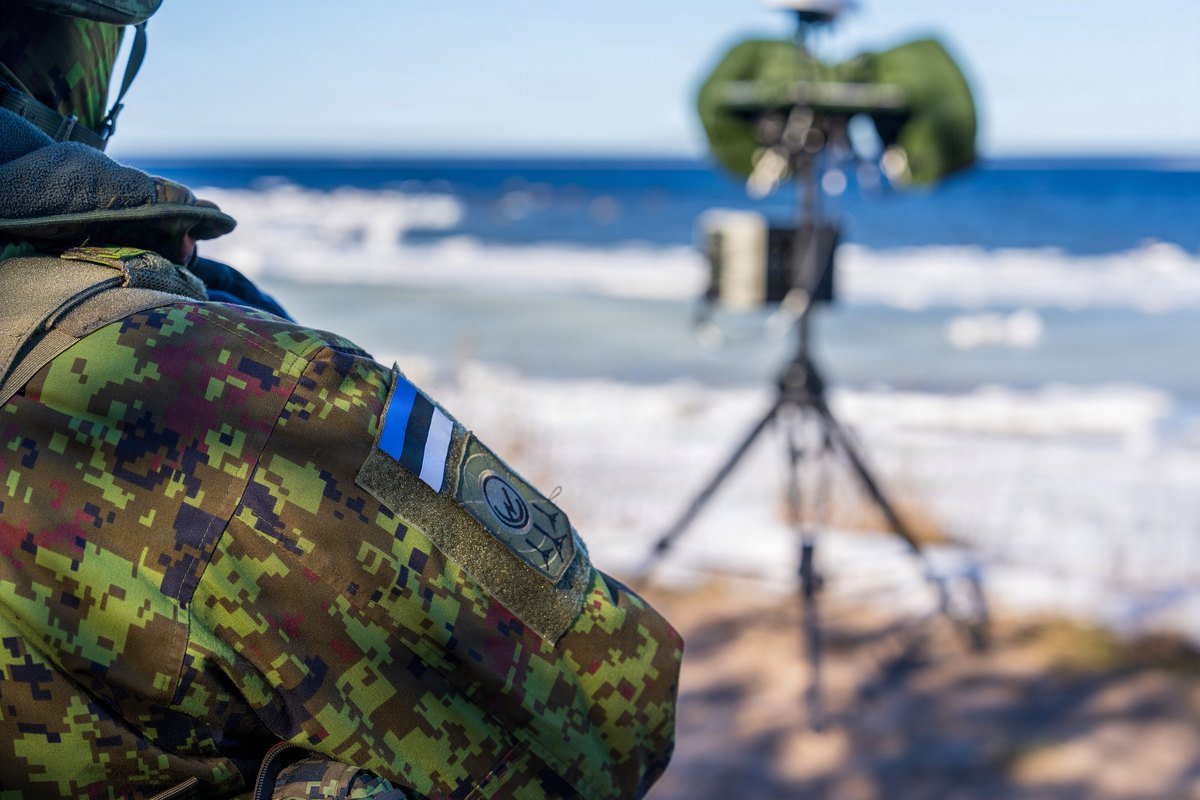
An Estonian soldier puts a radar into operation during the air surveillance exercise Digital Shield 2.0 in Estonia, March 2026. Photo: Maj. Alexander Watkins, U.S. Army, public domain, via Wikimedia Commons.

Data ownership is often where otherwise ambitious interoperability programmes encounter ordinary institutional resistance. Organisations may be willing to receive information while remaining cautious about exposing their own data, particularly when quality is uneven, legal responsibility is unclear or sharing may reveal operational limitations. A system owner may control the application but not the underlying information. A national authority may be accountable for security while another organisation is responsible for operational use. Without clear governance, every exchange becomes a separate negotiation, and the delay is experienced by the operational user rather than by the organisations that created it.
Exercises should test those decisions rather than merely demonstrate that participating systems can exchange selected messages. A useful exercise introduces degraded communications, conflicting reports, unavailable specialists, national restrictions, civilian demand and failures in infrastructure outside the immediate military area. It tests who recognises the change, who is authorised to respond, whether the common picture remains credible and how priorities are adjusted when several organisations require the same limited capability. Cross-border deployments during real disasters provide an additional source of evidence because they expose personnel and systems to unfamiliar conditions, real consequences and the practical friction of multinational coordination.
Multi-domain operations are difficult because they require separate institutions to produce a combined effect without becoming one institution. Nations retain sovereignty, services retain specialist responsibilities, civilian organisations retain legal duties and private operators retain ownership of much of the infrastructure involved. Successful coordination does not remove these distinctions. It creates sufficient shared understanding, authority and interoperability for them to act coherently despite those distinctions.
Operations therefore become systems rather than collections of individual actions. A land movement depends on air, maritime, cyber, space, information, spectrum and civilian support, while each of those elements has its own constraints and dependencies. The operational result is determined not only by the strength of the individual capabilities but by the quality of the connections between them. When those connections are weak, additional technology can increase complexity without improving effect. When they are understood, tested and governed, different capabilities can reinforce one another across domains, borders and institutions while operating at different speeds and under different forms of pressure.
Reinforcement Is More Than Moving Forces
Reinforcement is often described as a problem of strategic movement: forces and equipment are assembled, transported across national borders and delivered to the theatre where they are required. That description captures the visible journey but not the system that makes the journey operationally useful. Reinforcement succeeds only when arriving forces can be received, organised, supplied, protected, maintained, medically supported and integrated into an existing command and operational structure. Moving a formation into a country without establishing those conditions transfers a capability geographically; it does not necessarily make that capability available for employment.
Strategic movement begins before departure
The first constraint on reinforcement may emerge long before a force reaches a border. Personnel and equipment need to be assembled from several locations, inspected, documented, loaded and matched with suitable transport. Vehicles may require rail wagons or heavy equipment transporters that are scarce and must be booked in advance. Ammunition and other dangerous goods require specific routes, permissions and handling arrangements. Aircraft, ships, trains and commercial carriers operate to their own technical, regulatory and scheduling limits. A unit may be ready in military terms while the transport assets needed to move it remain unavailable, committed elsewhere or incompatible with the cargo.
Large-scale movement is therefore an allocation problem as much as a transport problem. The same roll-on, roll-off vessel, railway wagon, cargo aircraft or loading terminal may be required by several formations, national authorities and civilian operators. Prioritising one movement can delay another, while an early delay may affect every subsequent stage because reception capacity has been reserved for a particular sequence. When several countries are involved, differences in documentation, customs procedures, hazardous-goods rules and movement permissions add further points at which the plan can slow or fragment.
The ability to transport a force also depends on whether the load can move as a coherent package. Personnel arriving separately from their vehicles, communications systems, ammunition or maintainers may create congestion without producing useful capability. Equipment delivered to a port without drivers, documentation, security or onward transport remains cargo. Reinforcement planning must therefore preserve relationships between people, equipment and support elements while allowing enough flexibility to reroute them when transport capacity changes. The operational requirement is not simply to maximise the volume moved, but to deliver usable combinations of capability in the sequence required by the receiving commander.
Ports are systems, not empty quays
Ports are frequently treated as points of entry on a map, yet their military value depends on far more than the presence of a berth. A port must have sufficient depth, quay strength, ramp access, cargo-handling equipment, storage space, security, workforce capacity and connections to roads and railways. It must also be able to manage the particular vessels and cargo involved. A container port, a bulk terminal and a roll-on, roll-off facility may sit within the same harbour while offering very different options for unloading military equipment.
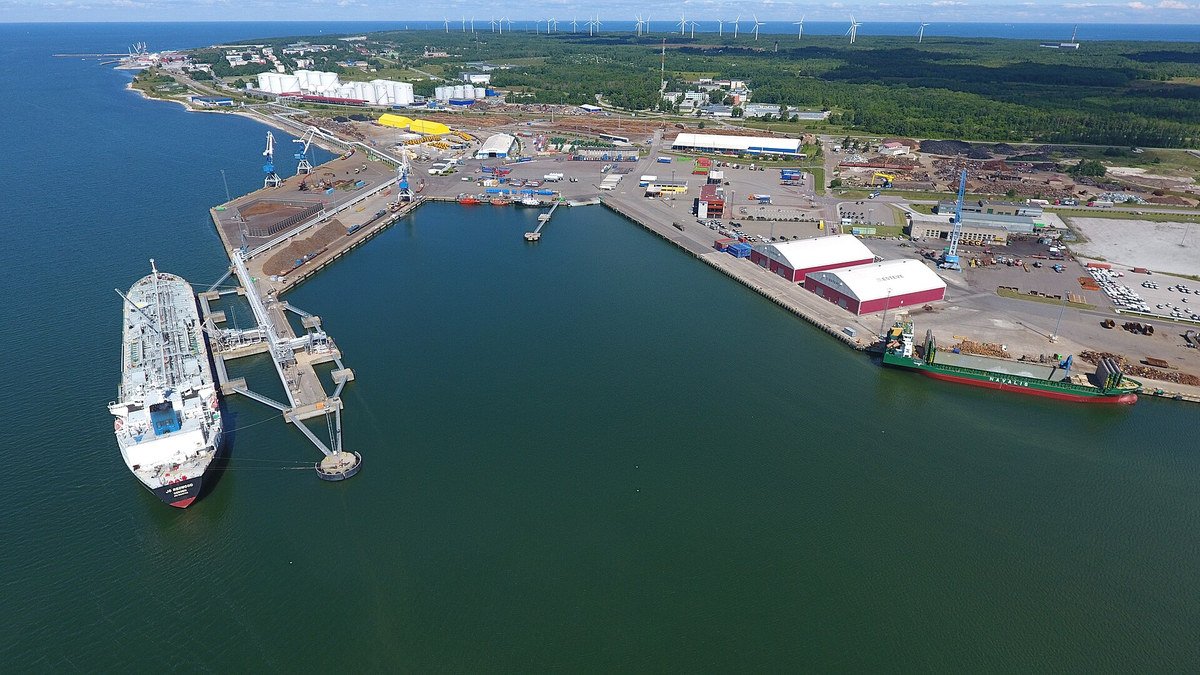
Paldiski South Harbour in Estonia from the air, July 21, 2017. Photo: Fantom100, CC BY-SA 4.0, via Wikimedia Commons.

Redundancy is equally important. A single large port may offer substantial throughput in normal conditions, but dependence on one entry point concentrates risk. Smaller alternatives may provide less capacity while giving planners options if the principal port is damaged, congested or inaccessible. Those alternatives are useful only if they have been assessed, connected to onward transport and included in agreements with operators. A nominal alternative that lacks suitable ramps, rail access, handling equipment or nearby staging space does not become operational merely because it appears on a contingency map.
Airfields deliver speed but not unlimited capacity
Air transport can move personnel, specialised equipment and urgent supplies faster than surface transport, but speed is purchased through limited payload, high demand and dependence on suitable airfield infrastructure. Airfields require adequate runway length and strength, parking areas, cargo-handling equipment, fuel, firefighting services, air traffic control, maintenance support, security and access to onward transport. A runway capable of accepting an aircraft does not automatically mean that the airfield can receive several aircraft in quick succession, unload them safely and move their cargo before the next arrivals.
Dispersal creates options but increases support requirements. Using several airfields can reduce congestion and concentration risk, yet each location requires security, communications, logistics, liaison staff and onward movement. Smaller airfields may accept particular aircraft but lack the equipment needed to handle their cargo. The choice between concentration and dispersal therefore involves the same balance seen elsewhere in reinforcement planning: efficiency must be weighed against survivability, resilience and the ability to support operations across several sites.
Railways provide scale through a tightly coupled network
Rail is particularly valuable for moving large quantities of heavy equipment over long distances, but its capacity depends on an interconnected system that is difficult to improvise. Suitable wagons, locomotives, drivers, loading ramps, train paths and compatible infrastructure must all be available. Differences in loading gauge, axle load, signalling, electrification and national operating rules can constrain cross-border movement. Congestion or failure at one junction may affect trains far beyond the immediate location because rail networks offer less freedom to bypass disruption than road systems.
Rail movements also have to be inserted into networks used by passenger and commercial freight services. Allocating priority to military trains may disrupt civilian schedules and industrial supply chains, while failing to allocate priority may make reinforcement timelines unreliable. Infrastructure managers, railway undertakings, ministries, armed forces and terminal operators must therefore coordinate capacity in advance and retain procedures for changing priorities during an emergency. The network cannot be controlled effectively through military command alone because much of the relevant infrastructure, rolling stock and expertise belongs to civilian organisations.
The Baltic region contains an additional structural challenge because the connection between the Baltic States and the wider European standard-gauge network remains incomplete. Rail Baltica is intended to integrate Estonia, Latvia and Lithuania more directly into the European railway system, with the European Commission describing the project as important for both civilian connectivity and common security. Until the full connection and its supporting terminals are operational, reinforcement planning must account for changes of gauge, transhipment requirements and dependence on other transport modes.
Two rail gauges and Rail Baltica
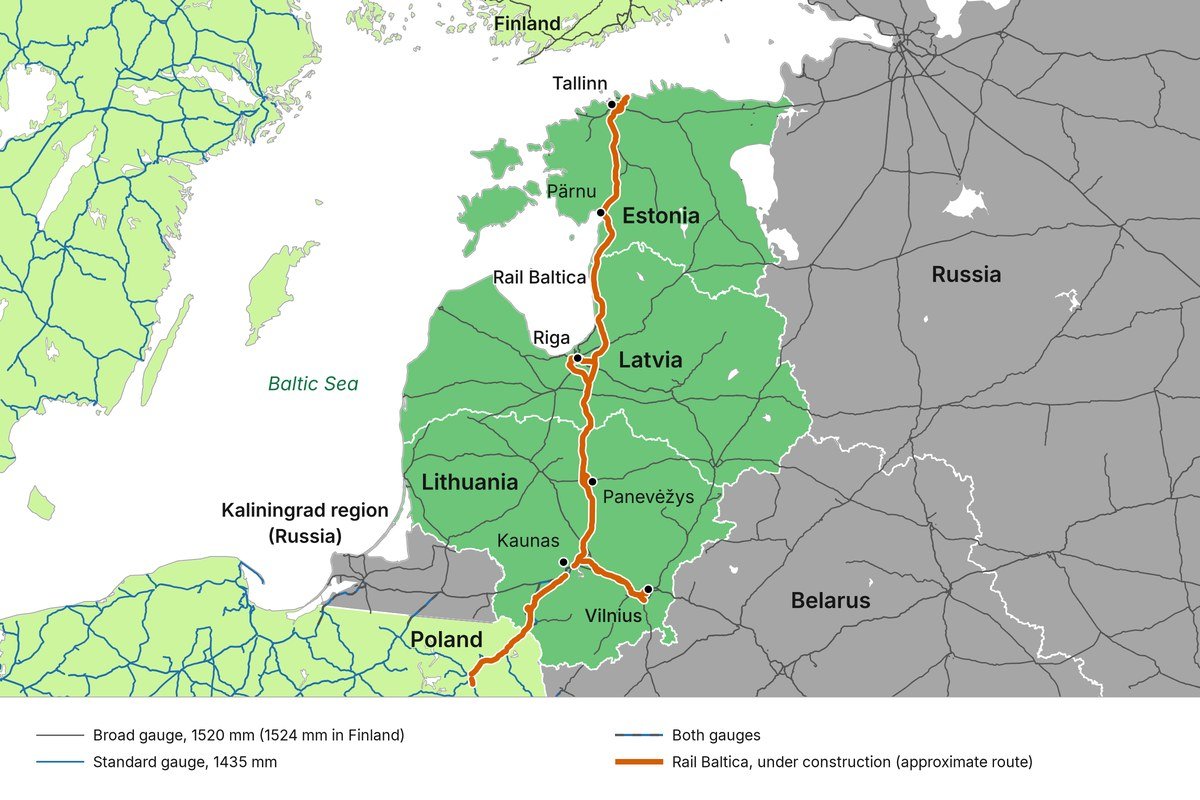
Map: BISC. Railways and borders: OpenStreetMap contributors.
This does not make rail unusable. It means that rail capacity must be understood as a chain rather than as a collection of tracks. The chain includes departure sidings, loading equipment, border procedures, compatible rolling stock, network capacity, destination terminals and the road or rail links needed after unloading. A failure at any stage can leave forces waiting in the wrong location while creating congestion for everything scheduled behind them.
Roads provide flexibility but absorb friction
Road movement offers greater flexibility than rail because vehicles can use alternative routes and often travel closer to their final destination. That flexibility is constrained by bridge capacity, tunnel clearance, road width, pavement strength, traffic conditions, weather, driver availability and the need for rest, maintenance and refuelling. Heavy convoys also move differently from ordinary traffic. They require spacing, traffic control, secure halts, recovery support and coordination across jurisdictions.
Long road movements impose wear on both vehicles and infrastructure. Tracked and heavy wheeled platforms may be unsuitable for sustained self-deployment over civilian roads, creating demand for specialised transporters that are themselves limited in number. Convoys consume fuel, require trained drivers and can block routes needed by civilian traffic or emergency services. A road corridor that appears available under routine conditions may therefore become saturated when several military formations, commercial freight operators and civilian authorities use it simultaneously.
European assessments have identified approximately 500 infrastructure hotspots along priority military mobility corridors, including bridges requiring reinforcement, tunnels requiring enlargement and ports and airports needing additional capacity. The EU has supported 95 dual-use transport projects in 21 Member States through approximately €1.7 billion under the 2021 to 2027 Connecting Europe Facility, while the Commission has proposed substantially greater investment for the following budget period. These figures demonstrate both progress and the scale of the remaining gap. Reinforcement depends on continuous corridors, and improving individual nodes does not solve the problem when the connecting route still contains weight, height or capacity restrictions.
Military mobility in numbers
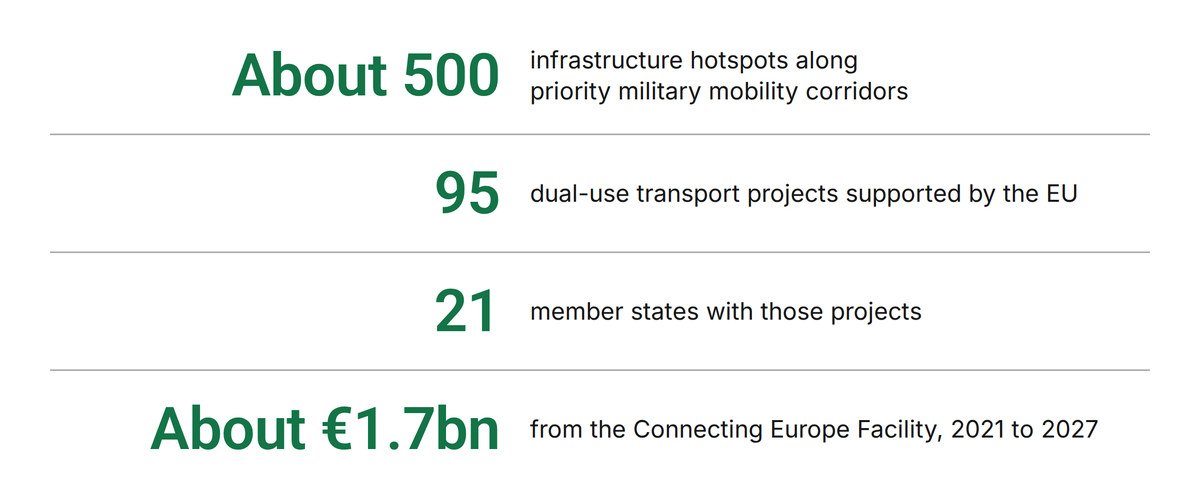
Graphic: BISC.
Road planning must also consider the use of the network after the initial movement. The same routes may be needed for resupply, maintenance recovery, casualty evacuation, civilian evacuation and emergency repair. A corridor filled to maximum capacity during deployment may leave insufficient space for the support traffic required once forces begin operating. Reinforcement plans therefore need to reserve capacity for follow-on movement rather than treating the first arrival as the completion of the task.
Host nation support converts geography into usable capacity
A receiving country contributes much more than permission to cross its territory. It provides access to infrastructure, local knowledge, services, labour, facilities, supplies and authorities that an incoming force cannot efficiently reproduce for itself. Host nation support may include reception areas, transport coordination, fuel, accommodation, food, water, maintenance, medical services, security, communications, construction support and access to civilian contractors. Its exact form varies between operations, but its purpose is consistent: to connect the arriving force to the physical and institutional systems of the receiving state.
Host nation support must be planned before forces arrive because many of the required resources are already assigned to civilian purposes. Hotel beds may accommodate displaced people or essential workers. Warehouses may hold commercial stocks. Fuel contracts may not include priority access during an emergency. Heavy recovery equipment may belong to private companies with other obligations. Hospitals may have little spare capacity, while municipal utilities may be operating close to normal limits. The host nation cannot provide resources that have not been identified, contracted, protected or prioritised.
The sending organisation understands its force requirements; the receiving state understands its infrastructure, law and service capacity. Operationally useful host-nation support requires detailed arrangements between them covering access, quantities, standards, responsibility and decision-making.
Local knowledge is particularly important when the formal plan meets practical reality. National and municipal authorities understand road works, seasonal constraints, utility networks, emergency routes, local contractors and the locations where military activity will collide with civilian demand. Police and transport authorities can manage traffic and security, while infrastructure operators know which systems have limited redundancy. Their participation is not an act of courtesy to the arriving force. It is part of the operational design.
The burden on the host nation also extends beyond the principal reinforcement corridors. Forces need staging areas, training space, waste management, sanitation, communications and access to everyday services. Increased population and traffic can affect small communities far from the final operating area. If these effects are ignored, friction appears through local congestion, environmental restrictions, workforce shortages and competition for supplies. A reinforcement plan that depends on society must account for the capacity and consent of that society to continue supporting it.
Pre-positioning trades flexibility for time
Pre-positioned equipment, ammunition, fuel and supplies can reduce the volume that must be transported during a crisis. Personnel may move more quickly than heavy equipment, allowing a force to assemble around stocks already held in or near the intended theatre. Pre-positioning can therefore shorten reinforcement timelines and reduce pressure on strategic transport during the period when demand is highest.
The apparent simplicity conceals several continuing obligations. Stored equipment must be inspected, maintained, updated and exercised. Batteries degrade, seals deteriorate, software changes, fuels and lubricants require management, and vehicles that have not moved for long periods may not be immediately serviceable. Ammunition and medical supplies have storage-life requirements, while communications and protection systems must remain compatible with the units expected to use them. A warehouse full of nominal capability can produce limited operational value if the equipment has not been maintained to a defined readiness standard.
Pre-positioned stocks also require protection and distribution plans. Concentrating equipment simplifies maintenance and inventory control but creates a valuable target and a potential bottleneck. Dispersal reduces concentration risk while increasing demands for security, transport, personnel and infrastructure across several locations. Sites must be accessible to the intended users, connected to onward routes and supported by fuel, ammunition, tools and trained technicians. The decision is therefore not merely how much to pre-position, but what to place where, at what readiness level and with which arrangements for release and movement.
Ownership and authority need equal attention. Equipment may belong to a sending nation, the receiving state, a multinational organisation or a contractor. Access may depend on political decisions, national release procedures and verification of which unit is authorised to receive it. These issues must be resolved before an urgent deployment because a physical stock that cannot be released promptly remains unavailable in operational terms.
Pre-positioning also reduces some dependencies while creating others. It lowers demand for long-distance transport but increases reliance on local maintenance, energy, security and infrastructure. It may reduce the time needed to deliver vehicles while leaving personnel, specialist tools and spare parts to arrive separately. The value of the arrangement therefore depends on whether the entire capability package has been considered rather than only its most visible equipment.
Maintenance determines how much reinforcement remains usable
Arriving equipment begins consuming maintenance capacity as soon as it moves. Long strategic journeys create wear before the force reaches its operating area, while loading, unloading and exposure to unfamiliar conditions can reveal faults not apparent at departure. Different nations and units may use equipment requiring distinct tools, diagnostic systems, spare parts, software and technical expertise. A receiving area capable of repairing ordinary civilian vehicles may have little ability to support specialised military platforms.
Maintenance facilities need suitable space, power, lifting equipment, security, environmental controls and access for recovery vehicles. They also require a supply chain for parts and consumables. A workshop with trained technicians but no components cannot restore capability, while a stock of parts without reliable inventory data may conceal shortages until the first failures occur. Maintenance planning must therefore connect technical support, warehousing, transport, data and procurement rather than treating the workshop as an isolated service.
The distribution of maintenance resources creates another trade-off. Centralised facilities may offer greater expertise and equipment but require damaged platforms to travel further and can accumulate queues. Forward repair capability reduces evacuation distance but is smaller, more exposed and harder to supply. Recovery and repair planning must therefore distinguish between faults that can be resolved close to the operating unit, equipment that needs evacuation to a larger facility and platforms whose repair would consume more resources than their return to service justifies.
Reinforcement numbers should consequently be interpreted with care. The quantity of equipment delivered does not equal the quantity available for operations. Serviceability, maintenance backlog, spare parts, trained crews and recovery capacity determine how much of the nominal force can be employed at any given time. Follow-on reinforcement may include technicians, tools and components precisely because maintaining the first arrival can be more important than adding another layer of equipment that the support system cannot absorb.
Medical support shapes operational freedom
Medical support is sometimes described as a service provided after casualties occur. In reinforcement planning, it is part of the force’s ability to operate at all. The medical system must collect, stabilise, treat and evacuate patients through several levels of care, while maintaining blood supplies, pharmaceuticals, specialist personnel, communications and protected transport. Its capacity influences how much risk commanders can accept and how long forces can operate at distance from definitive treatment.
Arrival at a theatre does not guarantee access to an adequate medical pathway. Treatment facilities need to be matched with ground and air evacuation, while patients may have to cross national borders or enter civilian hospitals. Different countries use different medical standards, records, pharmaceuticals and administrative procedures. Agreements are needed for patient transfer, reimbursement, clinical responsibility and the handling of protected medical information. A bed may be physically available while the legal, transport or specialist arrangements required to use it are not.
Medical evacuation also competes with other movement priorities. Aircraft, roads and secure corridors required for casualties may be needed simultaneously for reinforcement and resupply. Weather can limit aviation, while congestion or damaged infrastructure extends ground evacuation times. Medical planners therefore require current information about routes, transport availability and treatment capacity rather than a static list of hospitals. Established operational medical principles require medical planning to be integrated into contingency and operational planning, based on expected risk, evacuation requirements, climatic conditions and available resources.
Civilian healthcare provides essential depth but cannot be treated as unused reserve capacity. Hospitals continue caring for ordinary emergencies, chronic conditions, childbirth, infectious disease and other civilian needs during a security crisis. They may also face staff shortages, cyber disruption, power failures or increased casualties from attacks and accidents. Assigning a military role to civilian hospitals requires an understanding of what capacity can realistically be made available and which services must remain protected for the population.
Medical supply chains introduce further dependencies. Blood products, oxygen, medicines and specialised equipment have storage, transport and quality requirements. Some cannot be stockpiled indefinitely, while others depend on international manufacturing and distribution. A reinforcement plan that increases the number of personnel in a theatre without expanding the medical supply and evacuation system increases demand without increasing the means to manage it.
Multinational medical exercises help expose these problems because clinical interoperability cannot be assumed from professional competence alone. NATO’s Vigorous Warrior 2026 exercise in Estonia brought together 38 Allied and partner nations to train large-scale medical support and civil-military cooperation. Although conducted in an Alliance setting, the requirement it addresses is universal: medical teams from different systems must be able to exchange patients, information and responsibility under pressure without allowing procedural differences to interrupt care.
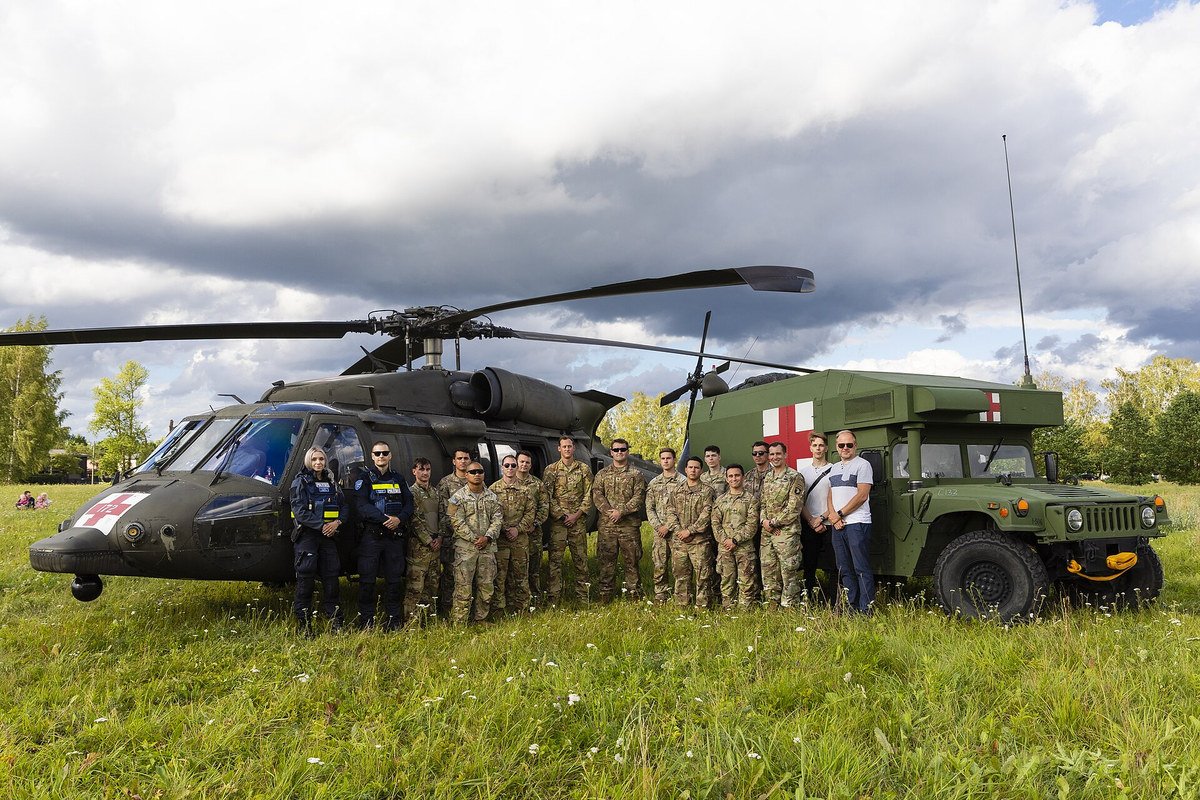
Estonian police, U.S. Army soldiers and Tartu University Hospital staff during a medical evacuation exercise in Tartu, Estonia, August 4, 2023. Photo: Staff Sgt. Oscar Gollaz, U.S. Army, public domain, via Wikimedia Commons.

Civilian infrastructure is part of the reinforcement system
Most reinforcement routes and support services are dual-use. Ports handle commercial trade, railways carry passengers and freight, roads support everyday mobility, airports connect economies, telecommunications networks carry civilian and military data, and energy infrastructure supplies both public services and deployed forces. The military can obtain priority in defined circumstances, but priority does not create additional physical capacity. It reallocates existing capacity and transfers the resulting constraints elsewhere.
This means that reinforcement decisions have societal consequences that must be anticipated rather than discovered during execution. Prioritising military rail movements may delay passenger services and commercial freight. Reserving port capacity may affect fuel or food imports. Closing roads for convoys can interfere with commuting, emergency response and civilian evacuation. Using public buildings for accommodation may displace local services. Drawing heavily on electricity, water and fuel can strain systems already operating under emergency conditions.
The correct conclusion is not that civilian disruption makes reinforcement impossible. It is that civilian continuity and military movement must be planned together. The receiving state needs to identify which services are indispensable, where temporary reductions are tolerable and which infrastructure requires additional protection or redundancy. Operators need clarity about priority rules, compensation, security and access to their own sites. Local authorities need enough information to manage consequences without receiving operational details they do not require.
The European Union’s current military mobility framework increasingly reflects this dual-use reality. It covers transport nodes alongside energy and communications infrastructure, proposes the systematic identification and protection of strategic assets and recognises that military movement can temporarily affect civilian traffic. The framework also seeks pre-planned routes and coordinated emergency measures because resilience depends on keeping the wider system functioning while military demand increases.
Private ownership complicates responsibility. A strategically important terminal, telecommunications link, fuel depot or repair facility may be operated by a company whose contractual duties and investment decisions were developed for peacetime markets. Governments may expect the asset to support national security while lacking detailed arrangements for priority access, workforce continuity, cybersecurity, physical protection or recovery after damage. Designating infrastructure as critical does not by itself resolve who pays for additional resilience, who directs operations during a crisis or what level of disruption the operator must be prepared to absorb.
Workforce availability is another frequently hidden dependency. Infrastructure does not operate without harbour pilots, crane drivers, railway signallers, engineers, technicians, air traffic controllers, medical personnel and many other specialists. Some skills exist in small numbers and cannot be replaced quickly. Personnel may be unable to reach work because transport is disrupted, may be caring for family members or may themselves be reservists called to other duties. Reinforcement planning needs to consider which civilian roles are essential to the military task and how those people will be protected, supported and retained.
Digital services connect much of this infrastructure. Ports, railways, warehouses, fuel systems and hospitals depend on scheduling, identity, communications and industrial-control systems. A cyber incident may therefore reduce reinforcement capacity without damaging a bridge, runway or rail line. Manual alternatives are useful only when organisations retain the people, data and procedures required to use them. The physical corridor and the digital systems controlling it must consequently be treated as one operational dependency.
Reception, staging and onward movement require deliberate sequencing
The point at which forces enter the receiving area is not the point at which they become operationally available. They must be received, accounted for, inspected and reorganised before moving onward. Personnel may need to join equipment arriving through another route. Vehicles require fuel and communications checks. Ammunition and supplies must be distributed. Units need updated information, local coordination and confirmation of their command relationships.
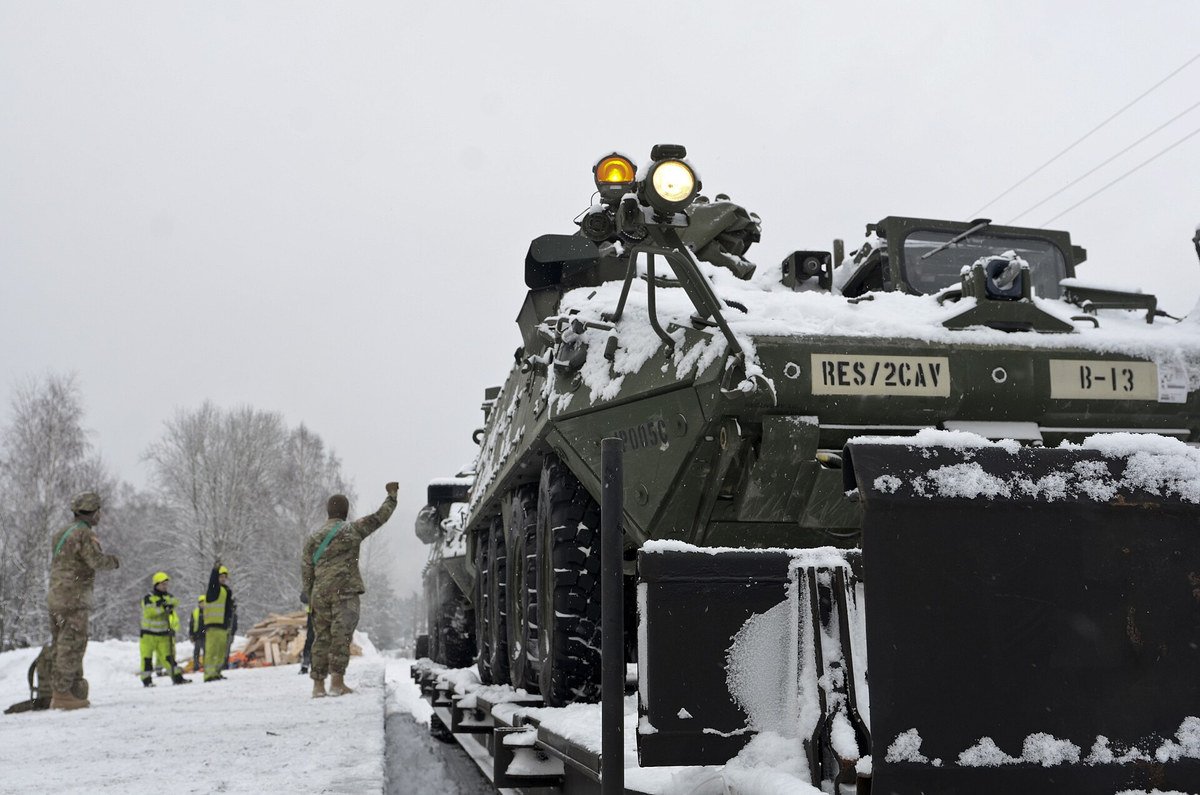
Latvian rail workers and U.S. Army soldiers offload vehicles from a train near Ādaži, Latvia, January 14, 2016. Photo: Staff Sgt. Steven M. Colvin, U.S. Army, public domain, via Wikimedia Commons.

Staging areas provide the space and time for this work, but they create their own requirements. They need road access, security, communications, sanitation, power, shelter, food, water and waste management. Large concentrations of personnel and equipment can attract observation and increase demand on nearby communities. Locations chosen for convenience may become congested or vulnerable, while more dispersed arrangements require additional liaison and transport.
Onward movement must be coordinated with the receiving formation and the wider traffic plan. Sending units forward as soon as they arrive may reduce congestion at the staging area but deliver them without complete support. Holding them until every element is ready may delay urgently needed capability. The correct sequence depends on the operational requirement, but the decision must be deliberate. Reinforcement should deliver usable increments of capability rather than an accumulation of disconnected assets.
This is also where command relationships become practical. Arriving forces need to know who controls their movement, who provides support, what information systems they will use and when authority transfers from the sending organisation to the receiving command. Ambiguity may be manageable during routine deployment but becomes dangerous when several formations are moving through the same area and drawing on the same resources.
Follow-on operations depend on the same system remaining functional after the first force has passed through it. Ports and terminals must continue receiving supplies. Routes must remain available for resupply and evacuation. Maintenance and medical services must absorb increasing demand. Host nation resources must be replenished rather than consumed once. Reinforcement capacity is therefore not measured only by how many forces can enter during the first days, but by whether the network can sustain repeated movement over the duration required.
Reinforcement is a continuing operational function
Its performance depends on throughput rather than the success of one convoy, ship or airlift. Throughput measures whether the complete network can receive, process and move the required volume over time. A highly capable port connected to a constrained railway does not provide high theatre throughput. Neither does an airfield with sufficient runway capacity but inadequate cargo handling, nor a road network with strong bridges but no secure staging areas. The limiting element governs the effective capacity of the wider system.
Resilience requires alternatives, but alternatives impose costs. Maintaining several ports, airfields, routes, storage sites and support arrangements is less efficient than relying on the most capable option during peacetime. It requires investment, exercises, contracts and personnel for infrastructure that may rarely be used at full capacity. The operational value appears when the principal route is unavailable or demand exceeds its design assumptions. Leaders therefore need to decide which redundancy is essential and fund it before the disruption that justifies it occurs.
Exercises must test the complete reinforcement process rather than only the visible movement. A successful arrival ceremony does not demonstrate that forces can be sustained, repaired, medically supported and integrated under degraded conditions. Testing should include unavailable routes, disrupted communications, port congestion, civilian demand, hazardous cargo restrictions, maintenance failures, reduced medical capacity and delays in national permissions. It should also test whether organisations can revise priorities when the original sequence no longer works.
The questions that determine reinforcement are practical. Planners need to know which transport assets exist, who controls them, how quickly they can be made available and what infrastructure they require. They need to understand where forces will be received, how long processing will take, what host nation resources are committed and which civilian services will be affected. They must establish how pre-positioned equipment will be released, maintained and connected with arriving personnel. They need sufficient medical, maintenance and recovery capacity to preserve the force after it enters the theatre. These questions require answers across ministries, armed forces, municipalities, infrastructure operators and private companies because none controls the complete system.
Reinforcement is therefore more than moving forces because movement creates operational effect only when the receiving system can absorb and support what arrives. Ports, airfields, railways and roads provide access, while host nation support, pre-positioning, maintenance, medical care and civilian infrastructure convert access into usable capability. Follow-on operations depend on those arrangements continuing under pressure, after the initial movement has consumed capacity and exposed weaknesses that routine conditions concealed.
A force has not been reinforced merely because additional personnel and equipment have crossed a border. Reinforcement has occurred when those resources are integrated, supplied, protected and capable of contributing to the operation for the required duration. The decisive measure is not how much can be moved once, but how much capability the wider system can receive, generate and sustain over time.
The Civilian System Never Stops Existing
Military operations do not replace civilian society. They take place inside it, depend upon it and compete with it for many of the same people, networks, facilities and supplies. Electricity must still reach homes, hospitals, water systems and communications networks. Municipalities must continue collecting waste, clearing roads and supporting vulnerable residents. Food must be transported, pharmacies supplied, children cared for and emergency calls answered. The military requirement may become urgent, but the civilian requirement does not disappear merely because another priority has been added.
This is one of the most persistent weaknesses in simplified security analysis. Military forces are often shown moving across an otherwise empty map, supported by infrastructure that appears to exist solely for their use. Ports receive equipment, railways carry it onward, fuel arrives where required and hospitals absorb casualties. The population is acknowledged mainly through estimates of evacuation or displacement, while the institutions that keep society functioning remain outside the operational picture.
In reality, most of the systems on which military operations depend are civilian, dual-use or privately operated. They were designed around normal public and commercial demand rather than the simultaneous requirements of defence, emergency response and societal continuity. Their capacity is finite, their workforces are specialised and their dependencies are often shared. The same electricity network may support an airfield, a railway signalling system, a telecommunications exchange, a water-treatment plant and thousands of homes. The same road may be required for reinforcement, ambulance traffic, emergency repair and civilian movement. The same fuel stocks may serve military vehicles, rescue services, hospitals, farms, generators and the commercial transport network that carries food.
The operational question is therefore not whether civilian systems matter to military operations. It is how long those systems can continue supporting several competing missions when infrastructure is damaged, information is incomplete and ordinary demand is already increasing.
Energy is an operational dependency before it becomes a military target
Modern military capability is heavily dependent on energy, but the energy system is not military in design or ownership. Electricity generation, transmission, distribution, fuel terminals, pipelines, storage facilities and commercial supply chains support society as a whole. Military bases and deployed forces are only some of the users connected to that system, and often not the largest.
Loss of electricity has effects well beyond lighting and heating. It can interrupt communications, railway signalling, water pumping, wastewater treatment, electronic payments, refrigeration, fuel distribution, medical equipment and the digital services used to coordinate emergency response. Backup generators can preserve selected functions, but they introduce further requirements for fuel, maintenance, testing and physical access. A generator that has not been exercised under load, cannot be refuelled or depends on a failed control system offers less resilience than its appearance on an inventory suggests.
Ukraine has demonstrated the operational significance of these relationships at national scale. The joint 2026 Rapid Damage and Needs Assessment by the Government of Ukraine, the World Bank Group, the European Commission and the United Nations found that housing, transport and energy remained the most heavily affected sectors after four years of war. Damage to energy assets increased by approximately 21 per cent during 2025, including damage to generation, transmission, distribution and district-heating infrastructure, while attacks on railways and ports also increased transport-sector needs. The consequence is not limited to restoring damaged assets. Energy, transport, housing, industry, healthcare and local government must recover together because each depends on the others.
The effect on military freedom of action is direct. Forces require energy for communications, maintenance, command posts, sensors, air defence, accommodation, medical facilities and logistics. They also require the civilian system to continue producing and transporting supplies. When electricity is scarce, leaders must determine which loads receive priority, which services can tolerate interruption and who has authority to make that allocation. These decisions cannot be improvised solely within the defence sector because the consequences extend across the population and economy.
Energy resilience therefore involves more than adding backup generation at military sites. It requires an understanding of upstream dependencies, including fuel availability, grid stability, maintenance staff, replacement components, telecommunications, cyber security and access to damaged infrastructure. A hospital generator and a military generator may depend on the same fuel distributor. A substation may be physically repaired while remaining unavailable because control systems or communications links are still compromised. A port may have intact berths but no power for cranes, pumps, security systems or railway interfaces.
The strategic value of redundancy also needs to be understood carefully. Additional interconnectors, storage sites and generation sources can reduce dependence on any single asset, but they create networks that require monitoring, maintenance and protection. Resilience comes from having alternatives that can carry the required load and be activated in time, not simply from having a greater number of connections on paper.
Balticconnector showed how one incident crosses several systems
The damage to the Balticconnector gas pipeline between Estonia and Finland in October 2023 is useful because it demonstrates how an infrastructure incident immediately becomes a cross-border, cross-sector and security problem. Finnish authorities identified the leak in Finland’s exclusive economic zone and opened a criminal investigation, while Estonia investigated damage to a telecommunications cable detected during the same period. The Finnish National Bureau of Investigation later concluded that Balticconnector had been damaged by the anchor of the vessel Newnew Polar Bear, although the wider legal and investigative process continued with Estonian, Chinese and Hong Kong authorities.
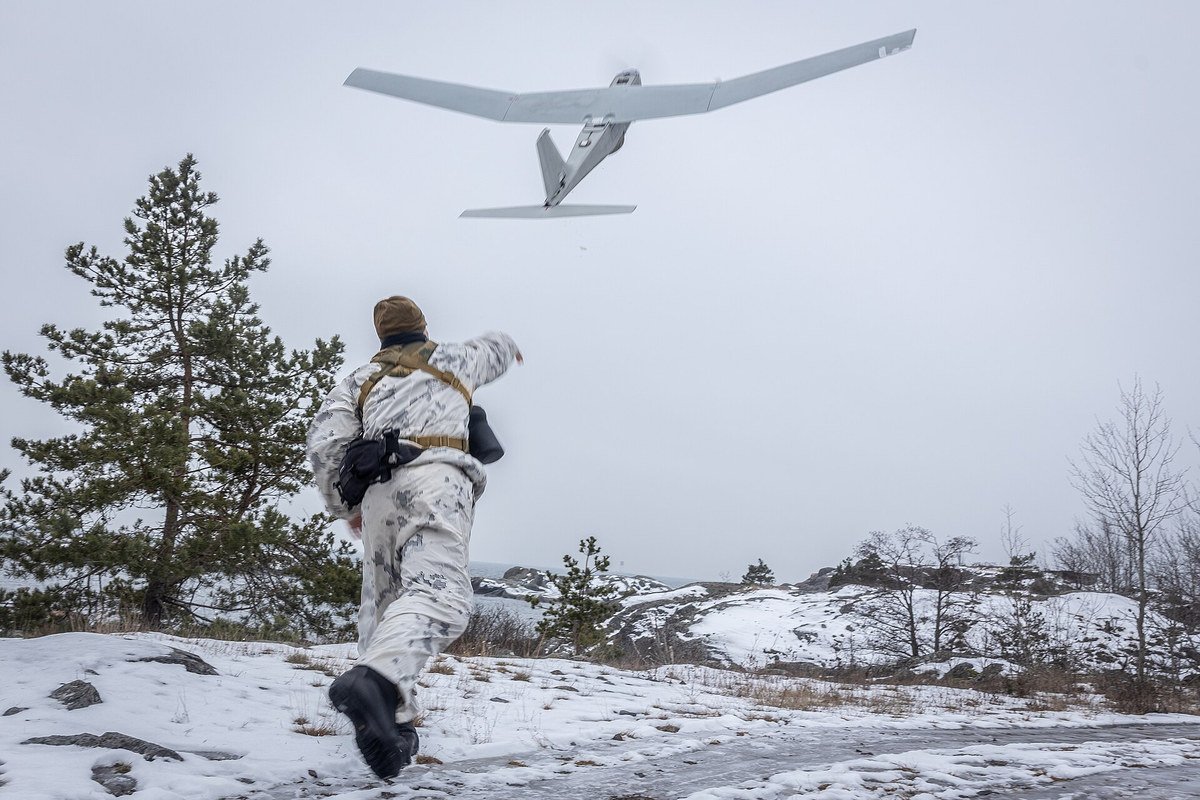
A U.S. Navy corpsman with the U.S. Marines launches an RQ-20 Puma drone in southern Finland during Nato’s Baltic Sentry, February 24, 2025. Photo: Lance Cpl. Brian Bolin Jr., U.S. Marine Corps, public domain, via Wikimedia Commons.

The immediate security-of-supply position remained stable, which was itself evidence of the value of alternative arrangements. That outcome did not make the incident operationally minor. Authorities had to identify the damage, isolate the pipeline, assess energy implications, investigate a cross-border maritime event, coordinate with infrastructure operators and examine damage to associated communications links. Repair required specialist maritime capability and time, while political and military organisations reassessed the protection of critical undersea infrastructure across the region.
The incident also exposed the limits of assigning responsibility to one sector. A pipeline is an energy asset, but it lies in a maritime environment, is operated commercially, regulated nationally and connected to regional security of supply. Damage may involve police, border guards, navies, intelligence services, ministries, private companies, environmental authorities and international partners. Telecommunications cables in the same area create additional dependencies, while attribution and legal responsibility require different evidence from that needed to restore the service.
Protecting such infrastructure is consequently not a simple matter of placing a vessel above every pipeline and cable. The Baltic Sea contains dense commercial traffic, fishing activity, ports, offshore infrastructure and numerous seabed connections. Surveillance must distinguish normal activity from suspicious behaviour, while intervention must remain legally justified and operationally feasible. Repair capability, spare components, specialist vessels and contractual arrangements are as important to continuity as detection. A system that can identify damage but cannot restore the service quickly remains vulnerable to prolonged disruption.
NATO and national authorities have increased attention to critical undersea infrastructure following repeated damage in the Baltic and North Seas. NATO established a Maritime Centre for the Security of Critical Undersea Infrastructure and increased patrols and surveillance after several incidents, while its official policy continues to recognise that national responsibility, collective security, private ownership and information sharing all intersect in this area. These measures reflect the practical difficulty of protecting infrastructure that is distributed across national jurisdictions and operated largely by civilian entities.
Balticconnector therefore matters not because one damaged pipeline created a regional collapse. It matters because the incident required several systems to work together and showed how quickly an apparently technical failure becomes an energy, maritime, policing, diplomatic and national-security issue. It also showed that resilience is partly measured by how much disruption can be absorbed without forcing leaders into immediate operational compromises.
Telecommunications connect almost every other dependency
Telecommunications are sometimes treated as supporting infrastructure rather than as an operational system in their own right. That distinction has become increasingly difficult to sustain. Military command, emergency services, public administration, hospitals, transport operators, energy networks, banking, media and private companies all depend on communications and digital services. The physical and digital layers are inseparable because damaged cables, failed power supplies, compromised identities and corrupted data can all produce the same practical outcome: people cannot obtain, trust or transmit the information required to act.
The capacity of telecommunications networks is not unlimited. A crisis can increase demand sharply as authorities, emergency services, military users, companies and the public seek information at the same time. Network congestion may coincide with physical damage, power loss or cyber disruption. Priority services may help essential users, but they require advance identification, technical configuration and agreements with operators. Granting priority to one category of traffic can also reduce service elsewhere, particularly where alternative routes are limited.
Private ownership adds an important operational dimension. Telecommunications companies make commercial decisions about network architecture, staffing, maintenance and redundancy. Governments may designate their services as critical while possessing limited direct control over daily operations. The companies may rely on foreign equipment suppliers, cloud services, subcontractors and international cable networks. A national plan can therefore depend on decisions and assets outside the country without making those dependencies visible to the organisations expected to respond.
Continuity planning must account for more than the survival of the network core. Engineers need physical access to repair sites, fuel for vehicles and generators, spare parts, security and reliable information about the condition of connected systems. A telecommunications node can remain technically functional while users cannot reach it because roads are flooded, police restrictions prevent entry or staff have been reassigned to other duties. Conversely, a damaged local link may be bypassed if alternative routes have sufficient capacity and the operator has authority to reconfigure them.
Military planners need to understand these constraints without assuming operational control over the civilian network. The requirement is to identify which services are essential, establish minimum levels of performance, agree priorities and test how communications will degrade. It is not enough to list commercial networks as redundant alternatives if they share the same power supply, fibre route, data centre or upstream provider.
Cyber incidents produce physical operational consequences
Cyber activity makes civilian and military dependencies particularly difficult to separate because the effect is usually experienced through another service. A cyber incident may prevent railway staff from scheduling trains, disrupt a hospital’s access to patient information, interfere with a municipality’s payment systems or compromise credentials used by infrastructure operators. The incident becomes operationally relevant because it changes physical activity, delays decisions or undermines trust in the information used to coordinate them.
The European Union’s July 2026 statement on Russia’s malicious cyber ecosystem described activity involving intelligence services, cybercriminal groups, hacktivists and private companies. The EU identified operations affecting governmental networks, public services and critical infrastructure across several member states, including disruptive activity against combined heat and power infrastructure in Poland. The breadth of actors and targets illustrates why cyber pressure cannot be treated as an isolated military campaign with a clearly defined beginning. It may be persistent, distributed and directed at the institutions on which both security operations and daily life depend.
The operational weakness is often not the absence of cyber policy. It is the gap between sectoral responsibility and combined consequences. A ministry may be responsible for public administration, another authority for energy, a regulator for telecommunications and law enforcement for criminal investigation. Each can have a credible plan within its own remit. The difficulty appears when one incident affects all of them, when information cannot be shared quickly or when no authority has a sufficiently complete picture to prioritise recovery.
Technical response is only one part of the problem. Organisations must determine whether data can be trusted, which services can continue, what manual alternatives exist and how users will be authenticated if central systems are unavailable. They must also communicate uncertainty without paralysing operations. A system that is available but suspected of manipulation can be harder to use safely than one that has failed completely.
Cyber resilience also depends on ordinary institutional capacity. Smaller municipalities, hospitals and public bodies may struggle to recruit and retain specialists. Legacy systems cannot always be replaced quickly, while upgrades can interrupt essential services and create new dependencies on suppliers. Security budgets compete with visible public needs, and technical work is often difficult to explain until failure makes the consequences obvious. Treating cyber security as compliance may produce policies and reports without ensuring that essential services can continue when preventive measures fail.
For military operations, the practical concern is whether civilian digital systems can support increased demand under pressure. Transport bookings, customs documentation, fuel distribution, medical records, identity systems and infrastructure control may all be involved in reinforcement and sustainment. A force can be physically ready while digital permissions, cargo information or commercial systems prevent movement. The same vulnerability affects civilian emergency response, which means recovery priorities must be agreed before military and public authorities both require the same technical specialists.
Transport continues serving society while supporting operations
Roads, railways, ports and airports remain civilian systems during military operations. They continue carrying workers, patients, food, energy supplies, industrial goods and emergency services. Military priority may alter how capacity is allocated, but it does not remove these other requirements or create new physical capacity.

An Elron commuter train at Balti jaam station in Tallinn, May 5, 2024. Photo: Mike Peel, CC BY-SA 4.0, via Wikimedia Commons.

This creates difficult choices because transport disruption propagates. Closing a road for military movement can delay ambulances, repair teams and civilian deliveries. Prioritising military rail traffic can affect passenger services and commercial freight. Reserving a port terminal for reinforcement may delay fuel, food or industrial cargo required by the same economy supporting the deployment. The operational benefit of one decision can therefore create a later constraint elsewhere.
Civilian mobility is particularly difficult to model because behaviour changes rapidly under uncertainty. Some people will leave an area before formal instructions, while others will remain because of family, work, animals, disability or distrust of official information. Roads may become congested in directions that planners did not expect. Public transport may lose staff at the same time demand increases. Fuel stations can experience shortages created partly by precautionary purchasing rather than by an immediate absence of supply.
Evacuation planning cannot therefore be reduced to estimating the number of residents and dividing them by road capacity. It requires decisions about destinations, transport for people without cars, medical support, care facilities, traffic control, communications, fuel, accommodation and the continued operation of services in areas that are not evacuated. It must also account for people moving into the area, including emergency personnel, military forces, repair teams and volunteers.
Ukraine has demonstrated that civilian transport networks continue operating under direct pressure because the population, economy and military all depend upon them. Railways have moved civilians, military supplies, humanitarian assistance and commercial goods while infrastructure has been repeatedly attacked. Ports, roads and railway nodes have remained operationally significant far beyond the front line, which is reflected in the increasing transport-sector recovery needs identified in the 2026 assessment.
The lesson is not that every European transport operator should reproduce Ukrainian wartime practice. It is that transport resilience depends on operators, maintenance crews, dispatchers, police, municipalities and commercial partners continuing to make thousands of practical decisions under pressure. Infrastructure alone does not create mobility. People, procedures, information and authority determine whether the network can adapt when normal schedules and priorities no longer apply.
Healthcare cannot be reserved in advance as empty capacity
Military medical planning often identifies civilian hospitals as part of the available depth. That may be necessary, particularly for specialist treatment and large casualty numbers, but civilian healthcare does not remain idle while waiting for military demand. Hospitals continue treating emergencies, cancer, chronic illness, childbirth, infectious disease and the effects of the crisis on the general population.
Their operating capacity depends on electricity, water, oxygen, pharmaceuticals, food, communications, waste management, blood products and staff. Disruption to any one of those inputs can reduce the number of patients a facility can safely accept. A hospital may have beds while lacking nurses, surgeons, sterile supplies or functioning diagnostic equipment. Capacity expressed as a building or bed count can therefore conceal the operational limits of the complete care system.
Healthcare staff may also be affected personally by the crisis. They may be unable to travel, responsible for children or relatives, displaced from their homes or called into reserve service. The same applies to ambulance crews, pharmacists, laboratory staff and technicians maintaining specialised equipment. Plans that count facilities without accounting for workforce continuity risk assigning medical tasks to capacity that will not exist when needed.
Military and civilian casualty flows may require different security, documentation and clinical arrangements, but they converge on many of the same specialist resources. Intensive care, trauma surgery, burns treatment, rehabilitation and mental-health services are not easily expanded at short notice. Transferring patients to another region or country requires transport, clinical information, receiving capacity and agreements on responsibility. Weather, damaged infrastructure and airspace restrictions may further reduce evacuation options.
The leadership challenge is to protect essential civilian care while creating sufficient flexibility for additional demand. This requires realistic thresholds for when military patients enter civilian facilities, how beds are released, which elective procedures are postponed and how displaced civilian patients are supported elsewhere. It also requires protected communications and data-sharing arrangements that allow medical decisions without exposing sensitive information unnecessarily.
Healthcare resilience is a military concern because medical capacity influences operational risk, personnel confidence and the ability to sustain a prolonged effort. It remains a societal responsibility because the legitimacy and endurance of that effort depend on the population continuing to receive care. Treating one side as secondary eventually weakens both.
Municipalities carry responsibilities that national plans often compress
National security documents tend to assign broad responsibilities to ministries and central agencies. Many of the practical tasks, however, reach the population through municipalities. Local authorities manage or coordinate water, waste, social care, schools, shelters, local roads, public information and support for vulnerable residents. They also know which buildings have backup power, where isolated residents live and which local contractors possess useful machinery.
This local knowledge is difficult to replace from a national headquarters. A central plan may identify a municipality as responsible for opening shelters, while the municipality must determine who holds the keys, whether the ventilation works, how sanitation will be managed and which staff can reach the site. It may be expected to support evacuation while also maintaining care homes, distributing water and responding to storm damage. The policy responsibility can appear clear while the operational capacity remains limited.
Municipalities vary greatly in size, wealth and professional capability. A capital city can maintain specialist departments and formal contracts that a small rural authority cannot. Smaller municipalities may compensate through personal relationships and local knowledge, but those networks are vulnerable when a few key people are unavailable. National requirements that do not account for this variation can create nominal preparedness without consistent delivery.
The relationship between local and national authority also becomes important when priorities conflict. A national body may require a road, building or fuel supply for military use while the municipality needs it for emergency response. Local officials may possess information about the consequences but lack access to the operational reasoning behind the request. Effective coordination requires a mechanism through which that information can influence decisions without delaying urgent action.
Municipal resilience should therefore be treated as part of operational design rather than as a community programme running alongside defence. The condition of local services affects movement, public confidence, workforce availability and the ability of national authorities to concentrate resources elsewhere. A municipality capable of maintaining basic services reduces the number of problems that must be managed at higher levels.
Water systems are essential, fragile and difficult to substitute
Water supply illustrates how an ordinary public service becomes an operational constraint when several dependencies fail together. Treatment plants and pumping stations require electricity, chemicals, control systems, maintenance and trained operators. Distribution networks can be damaged physically or lose pressure when power fails. Wastewater systems face similar requirements, and their failure can create health risks that increase demand on already strained medical services.
Emergency water distribution is labour-intensive and transport-heavy. Bottled water or tankers may support selected users temporarily, but they require vehicles, loading points, storage, security and a continuing source. Hospitals, food production, firefighting and military facilities may need quantities that cannot be met through household-level emergency supplies. Water planning must therefore prioritise the restoration of networked systems while maintaining minimum service during interruption.
Cybersecurity is relevant here because water systems increasingly use digital monitoring and control. Manual operation may be possible for some functions, but it requires staff who understand older procedures and can remain on site. Spare pumps or generators provide limited value if the chemical supply, communications or access road has failed. The water system must be considered as a chain of dependencies rather than a single plant.
Flooding creates a further complication because too much water can damage the infrastructure needed to supply safe water. Floodwater may contaminate sources, overwhelm wastewater treatment and restrict access to pumping stations. Drought can produce the opposite pressure by reducing available supply while increasing demand from agriculture, firefighting and the population. Weather therefore affects water both as a resource and as a hazard.
Fuel connects nearly every civilian and military function
Fuel is often discussed as a military logistics problem, but the same supply chain supports emergency services, agriculture, public transport, freight, heating and backup power. Interruptions affect not only the movement of forces but also the ability of society to continue producing and distributing essential goods.
Priority allocation becomes difficult because many claims are legitimate. Ambulances, police vehicles and fire engines require fuel. Hospitals and telecommunications sites may need generator supplies. Farmers may need diesel to produce or harvest food. Commercial trucks move medicines, spare parts and groceries. Military forces may require large quantities over sustained periods. Reserving fuel for one category can create operational consequences in another.
The distribution system depends on electricity, information systems, drivers, terminals, storage sites and road access. Fuel can exist nationally while remaining unavailable at the point of need because pumps have no power, terminals cannot load tankers or drivers cannot reach work. Strategic stockpiles provide time, but they do not remove the need for distribution. The release process, transportation contracts and priority rules determine whether those stocks become useful.
Public behaviour also influences availability. Visible disruption or uncertain communication can lead households and businesses to increase purchases, placing additional pressure on retail networks. Authorities may need to limit sales, prioritise essential users or explain why supply remains secure despite temporary shortages. These decisions have political consequences because fuel availability is immediately visible and affects personal mobility.
Military planning must therefore understand how fuel demand interacts with the wider economy. Drawing heavily from civilian networks without coordination can reduce the transport and industrial capacity needed to sustain the operation. Building completely separate military arrangements may be inefficient and still leave dependencies on common terminals, pipelines and suppliers. The practical requirement is a coordinated system with protected minimums, alternative routes and clear authority for allocation.
Industry provides depth, but not on demand
Military operations depend on industry for ammunition, spare parts, vehicles, electronics, communications equipment, construction materials and repair. Civilian industry also supplies food, medicines, energy equipment and infrastructure components. The assumption that production can simply increase during a crisis often overlooks the dependencies and lead times involved.
Factories require electricity, skilled labour, raw materials, machine tools, software, logistics and regulatory approvals. Components may come from several countries, while specialised suppliers can be difficult to replace. Expanding production may require new facilities, additional shifts and long-term contracts before output increases. A government may possess the legal authority to prioritise orders while lacking the spare industrial capacity or workforce needed to fulfil them.
Commercial efficiency can also conflict with resilience. Concentrating production in a small number of specialised facilities reduces cost but increases dependence on individual sites. Just-in-time supply chains limit inventory and make disruption visible quickly. Maintaining additional capacity, alternative suppliers or strategic stocks costs money during periods when they appear unnecessary. The choice is not between efficiency and resilience in absolute terms, but between different levels of risk and the time available to recover from interruption.
Industry also competes for workers with the armed forces and public services. Engineers, drivers, cyber specialists and technicians may be reservists or otherwise reassigned during a crisis. Calling up personnel can strengthen military units while weakening the factories, networks and transport systems required to sustain them. Personnel policy therefore needs to identify occupations whose civilian contribution may be more operationally valuable than their military assignment.
The relationship with private companies must be established before demand becomes urgent. Contracts should address priority access, security, liability, data sharing and workforce continuity. Companies need enough information to invest in resilience, while governments need visibility into supply chains and realistic production capacity. Broad declarations of partnership are insufficient when no mechanism exists to allocate scarce inputs among competing national requirements.
Food security is a logistics and continuity problem
European states generally do not face food security as a question of whether enough calories exist nationally on a normal day. The more immediate vulnerability lies in processing, distribution, refrigeration, payment systems, packaging, transport and workforce availability. Supermarkets depend on frequent deliveries, while hospitals, care homes, schools and military facilities require organised catering and specialised diets.
Food production itself depends on fuel, fertiliser, energy, water, machinery, veterinary services and seasonal labour. Agriculture cannot be paused without consequences, and some losses cannot be recovered by working harder the following week. Livestock require continuing care, while crops must be harvested within limited windows. Military movement restrictions, fuel shortages or damaged transport infrastructure can therefore affect future supply even where immediate stocks remain adequate.
Urban populations are particularly dependent on distribution. Few households maintain large reserves, and retail systems are designed around predictable purchasing patterns. Disruption, rumours or visible shortages can change consumer behaviour rapidly. Authorities need reliable information about stocks and transport capacity, but commercial data may be fragmented across companies and protected for legitimate competitive reasons.
Food distribution also places demands on roads, warehouses, cold storage and electricity that may be required for other missions. Prioritising military transport without preserving essential commercial freight can create shortages that reduce public confidence and workforce availability. Conversely, allowing all commercial movement to continue unchanged may limit reinforcement or emergency access. The problem requires active coordination rather than an assumption that markets or military priority alone will resolve it.
Humanitarian support adds another layer when people are displaced. Reception centres need food, water, sanitation, medical support and staffing, while the municipalities receiving displaced populations may have limited capacity. Supply estimates must account for duration and dietary needs rather than only the first emergency delivery. A functioning food system is therefore part of both civil resilience and operational endurance.
Wildfires demonstrate how civilian capacity can be consumed before a security crisis
Natural hazards matter to military planning because they draw on many of the same capabilities required for other emergencies. Wildfires can demand aircraft, helicopters, firefighters, police, medical services, road closures, public information, accommodation and cross-border coordination. Floods and storms place different but overlapping demands on engineers, transport, telecommunications and local government.
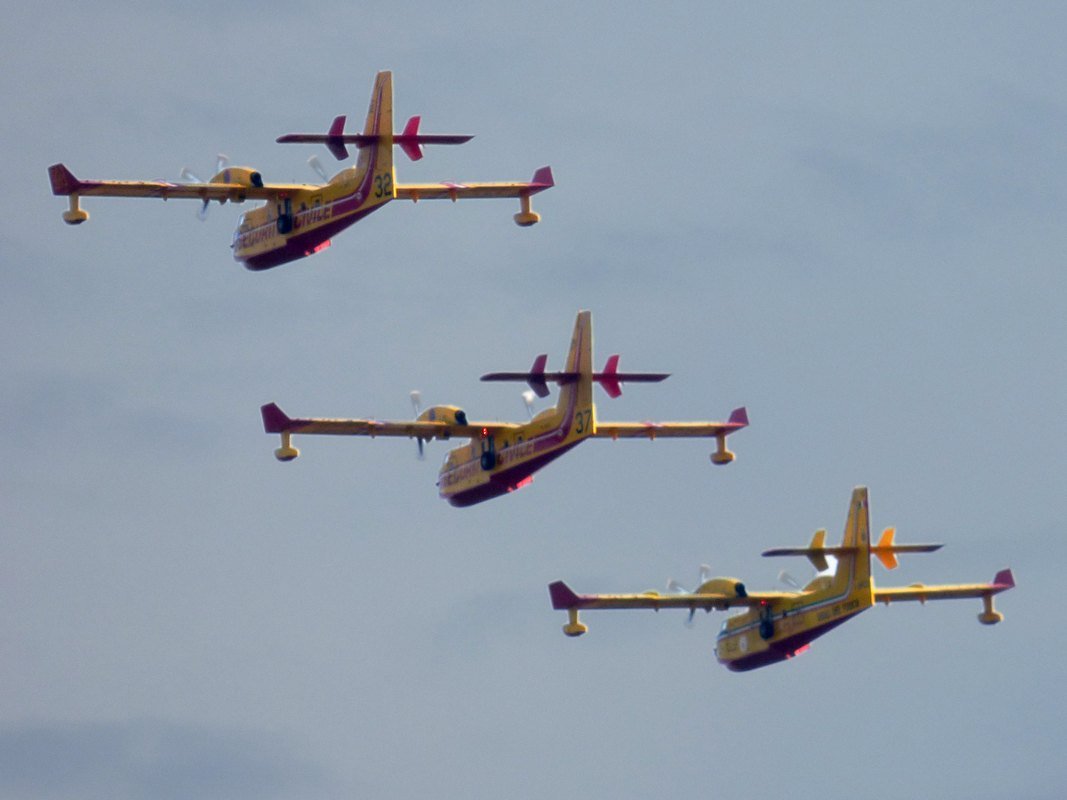
Three French Canadair CL-415 water bombers over Tillberga after a mission against the Västmanland forest fire in Sweden, August 8, 2014. Photo: Jimneilberg69, CC0, via Wikimedia Commons.

The Union Civil Protection Mechanism provides a practical example of multinational civilian capacity operating across borders. A country facing a disaster can request assistance through the Emergency Response Coordination Centre, after which personnel, aircraft, vehicles and specialist equipment are offered by participating states or mobilised from common European reserves. For the 2026 wildfire season, the system included 22 firefighting aircraft, five helicopters and 777 firefighters from 14 countries, with teams pre-positioned in higher-risk areas. France and Portugal activated the mechanism in July 2026 and received aircraft, helicopters, firefighters and vehicles from several European countries.
The mechanism shows the value of shared capacity but also its limits. The same aircraft cannot fight fires in two countries simultaneously. When heat, drought and wind create several major incidents at once, demand rises across the system. Pre-positioning improves response time but requires forecasts and political decisions about where assets are most likely to be needed. Moving equipment across borders requires crews, maintenance, fuel, liaison and host-nation arrangements, while the receiving authority must integrate foreign teams into its own command structure.
These operations provide experience that exercises cannot fully reproduce. Firefighters encounter unfamiliar terrain, vegetation, procedures and communications arrangements while working under real time pressure. They learn techniques from other services and test whether their equipment and command practices function in multinational conditions. The knowledge returns with them, improving domestic preparedness and revealing where interoperability remains dependent on personal improvisation.
The military relevance lies in competition and transferability rather than in treating firefighting as a military mission. Rescue helicopters, transport aircraft, engineers, medical teams and communications specialists may be useful in several types of emergency. A severe natural disaster can consume those resources while security demands are also increasing. Personnel deployed abroad may be unavailable at home, although the experience they gain can strengthen longer-term capability. Leaders need visibility into these overlaps because national inventories can count the same asset several times under different plans.
Weather also affects infrastructure outside the area of immediate concern. Heat can reduce railway and power-system performance, drought can increase wildfire risk and constrain water, while storms and floods can damage roads, ports, communications and energy networks. Conditions may differ sharply across Europe at the same time, leaving one region managing wildfire and heat while another faces flooding or saturated ground. Reinforcement and civil-protection networks extend across both, which means disruption in one area can affect operations elsewhere without any direct hostile action.
Civilian continuity and military freedom of action are inseparable
Military freedom of action is usually discussed in terms of terrain, enemy capability, command and sustainment. Civilian continuity belongs within the same analysis because the military depends on infrastructure, labour and services that remain responsible for the population. When those systems weaken, commanders face additional constraints even if their own units remain intact.
A shortage of electricity can limit communications and maintenance. Hospital pressure can reduce the tolerance for casualties. Road congestion can delay movement. Telecommunications failure can fragment command and public information. A fuel shortage can affect military logistics and the civilian trucks delivering food. Municipal failure can turn local problems into national emergencies requiring military support. These effects accumulate and interact rather than remaining within their administrative sectors.
Civilian resilience is therefore not simply a programme intended to keep the public calm while military organisations conduct the serious work. It determines how much capacity the state can continue generating under pressure. A society that maintains energy, healthcare, food distribution, water, communications and local government gives national leaders more options. A society in which those systems fail forces military resources into substitution tasks and narrows political choices.
This does not mean that every civilian service must function normally. Continuity planning is about identifying acceptable degradation, protecting minimum services and restoring the most consequential dependencies first. Some transport may be reduced, public facilities repurposed and commercial demand postponed. The difficult work lies in deciding which reductions remain tolerable, for how long and for whom.
Those decisions require legitimate authority because they distribute risk across society. A commander may identify an operational need, but elected leaders and civilian authorities must weigh it against public safety, economic continuity and longer-term endurance. Private operators hold technical knowledge and control many of the assets, while municipalities understand local effects. None can make the complete decision alone.
Resilience is an operational function, not a separate policy field
Resilience is often discussed through strategies, indicators and institutional responsibilities. These are necessary, but the operational measure is whether essential functions continue when several assumptions fail together. A power outage combined with cyber disruption, extreme weather and transport congestion creates a different problem from any one event in isolation. Plans organised by sector may not reveal how quickly failure in one area changes the others.
Dependency mapping is therefore more valuable than simply listing critical assets. Authorities need to know what each service requires, how long it can operate without those inputs and which organisations can provide alternatives. They need to identify shared single points of failure, including data centres, substations, fuel terminals, specialist staff and telecommunications routes. The map must include contractual and legal dependencies as well as physical ones.
Accountability has to remain clear at the boundaries. It may be obvious who owns a pipeline, operates a hospital or manages a road. It is often less obvious who decides when military demand takes priority, who compensates the operator, who informs the public and who coordinates recovery when several sectors are affected. Exercises should force these decisions rather than allowing participants to defer them to policy.
The same principle applies to data. Civilian and military organisations need enough shared information to coordinate priorities, but commercial sensitivity, privacy, national security and technical incompatibility limit what can be exchanged. A common operating picture cannot be created by instructing every participant to share everything. It requires agreed information needs, trusted channels and a clear understanding of which decisions the data is intended to support.
The civilian system never stops existing because people continue to need security, care, water, food, energy and movement regardless of the operational situation. Military operations draw strength from that system, but they can also place it under additional pressure. The relevant question is not whether society supports defence in an abstract sense. It is whether civilian and military requirements have been designed to coexist when infrastructure, personnel and time are limited.
A credible operational plan must therefore account for what society must continue doing while forces move, fight, reinforce and recover. It must identify which civilian systems provide military capacity, which military decisions create civilian consequences and where failure would force a change in operational priorities. Resilience becomes a military concern at precisely the point where the ability of society to continue functioning determines what the armed forces remain able to do.
Operational Depth Exists Far Beyond the Front Line
The front line remains physically real. It is where forces contest terrain, where direct fire is concentrated and where the immediate consequences of military action are most visible. It is not, however, a reliable boundary between the area in which operations occur and the area from which they are supported. Modern forces depend on command networks, sensors, airfields, ports, energy systems, industrial production, maintenance facilities, communications links and transport corridors distributed across a much wider geography. Those systems can be observed, disrupted or struck without an adversary first having to defeat every formation positioned between them and the immediate area of contact.
Operational depth describes more than the distance behind a forward position. It includes the physical, organisational and informational space required to generate, deploy, command, sustain and regenerate military capability. A port in the Netherlands, a railway junction in Germany, an air base in the United Kingdom, a satellite ground station in the Nordic region and a telecommunications cable crossing the North Sea may all support activity in the Baltic theatre. Their distance from Estonia, Latvia or Lithuania does not place them outside the operational system. It determines the time, routes and dependencies through which their contribution reaches it.
This changes the way the Baltic region should be analysed. The relevant theatre cannot be contained within the political borders of the three Baltic States or represented by a narrow strip of territory immediately adjacent to Russia and Belarus. It extends westwards through Germany, Belgium and the Netherlands, northwards through Finland, Sweden, Norway and the North Atlantic, and across the United Kingdom’s military, industrial and command commitments to the region. The exact boundary shifts with the capability being considered. Air defence, maritime surveillance, cyber activity, reinforcement, industrial production and deep precision strike each create a different operational geography, and those geographies overlap without becoming identical.
The rear area has become a contested operating environment
The distinction between a front line and a rear area developed partly from the expectation that distance offered some protection. Forces closest to the enemy faced direct attack, while command, logistics, industry and national infrastructure operated with progressively greater security further behind them. Distance still matters because it affects weapon range, warning time, access and the effort required to produce an effect. It no longer guarantees that supporting systems can operate without interference.
Long-range missiles, uncrewed systems, cyber operations, electronic warfare, sabotage, covert action and information activity allow an adversary to apply pressure across several layers of the operational system. These tools do not produce identical effects and should not be treated as interchangeable. A missile may physically destroy a facility, a cyber intrusion may make its systems unreliable, electronic interference may reduce access to positioning or communications, and sabotage may interrupt a service while complicating attribution. The common operational consequence is that planners cannot assume that capability located away from the immediate fighting will remain continuously available.
The growth of long-range strike capability has made this problem more explicit. NATO’s 2026 capability initiatives describe deep precision strike as an integral part of defence planning and link it with the ability to deny an adversary military advantage. European states have consequently begun several multinational programmes covering ground-launched systems and long-range uncrewed capabilities, while a July 2026 initiative brought together twelve countries, including Estonia, Finland, Germany, the Netherlands, Sweden and the United Kingdom, around substantial investment in deep precision strike over the following decade. These developments reflect a broader operational requirement rather than a fascination with range for its own sake: forces need the ability to affect command, logistics, air defence, launch systems and other high-value military capabilities located well beyond the immediate area of contact.
The same logic applies in the opposite direction. Once long-range systems become part of European defence planning, the bases, launchers, munitions storage, sensor networks and command arrangements supporting them also become part of the operational problem. A capability may be physically located hundreds of kilometres from the Baltic States while contributing directly to the defence of the region. Its protection, dispersal, maintenance and connection to intelligence are therefore relevant to Baltic security even when the asset itself never enters the Baltic theatre.
Calling these locations rear areas can create false reassurance if the term is understood to mean protected areas. A more accurate distinction is between different functions and levels of exposure. Some locations will remain less vulnerable to particular threats because of distance, geography or defensive capacity. They may still be essential to the operation and vulnerable through another route. Operational depth must therefore be designed and protected as a system rather than assumed to exist because Europe possesses geographical space.
Deep effects depend on a chain of information and authority
Long-range weapons do not create useful operational effects simply because they can reach a distant location. Their employment depends on identifying a relevant objective, establishing its position and significance, determining whether the information remains current, assigning an appropriate capability, obtaining authority and assessing the result. Each stage relies on data, communications, trained personnel and agreed processes that may cross several national and organisational boundaries.
Intelligence, surveillance and reconnaissance are central to this chain. Space-based sensors, aircraft, maritime platforms, land-based systems, uncrewed vehicles, electronic support measures and national intelligence organisations may each contribute part of the picture. Their observations differ in timeliness, precision, confidence and classification. A sensor may identify activity without establishing intent, while a detailed intelligence assessment may arrive too late to support a time-sensitive decision. The operational challenge is not only collecting more information but connecting the right information to the authority and capability able to act upon it.
This requirement links the Baltic region to assets positioned across northern and western Europe. Maritime patrol aircraft may operate from one country while monitoring activity over the Baltic or North Atlantic. Satellite information may be processed elsewhere. National intelligence can inform multinational commands, while operational units require sufficiently releasable information to use the resulting assessment. The United Kingdom, for example, continues to operate surveillance aircraft over the Baltic Sea while maintaining forces and command commitments from the UK. In July 2026, the British government described RAF P-8 Poseidon and Rivet Joint aircraft patrolling the Baltic Sea alongside an approximately 800-person UK-led battlegroup in Estonia and a brigade held at high readiness in Britain to reinforce it.
That arrangement demonstrates why operational depth is not merely a logistics corridor. British capability relevant to Estonia is distributed between personnel already present in the country, forces held in the United Kingdom, aviation operating across the wider region, national command structures and maritime activity linking the Baltic, the North Atlantic and the High North. The operational contribution depends on those elements remaining connected and on decisions being coordinated across distance.
The chain also depends on authority. Intelligence may be held nationally while an operational effect requires multinational coordination. A sensor operator may detect a potential target without possessing authority to assign a weapon. A commander may have a capable system but insufficiently reliable information. Different states may apply different legal restrictions, risk thresholds or release conditions. The speed of the weapon does not remove these institutional requirements, and faster strike systems can expose their weaknesses more sharply because the decision window becomes shorter.
The practical question is therefore not only how far a capability can reach. Leaders need to know how quickly the complete system can detect, understand, decide, act and reassess under degraded conditions. A long-range weapon connected to a slow or fragmented decision process may create less operational value than a shorter-range capability integrated into a reliable chain. Operational depth is generated by the quality of those connections as much as by physical distance.
Command networks create depth and dependence at the same time
Modern command structures allow military activity to be coordinated across countries and domains without placing every decision-maker near the immediate operation. Distributed headquarters can provide resilience, specialist expertise and access to national authorities. They also depend on communications, identity management, data services, common procedures and a sufficiently shared understanding of the situation.
A command network may span national headquarters, multinational commands, component commands, operational units and civilian authorities. Each level requires a different picture and possesses different powers. Information must move upwards for assessment and decision, sideways for coordination and downwards in a form that can be acted upon. Excessive centralisation can delay action and overload senior headquarters, while excessive decentralisation can produce conflicting decisions or uncoordinated use of scarce capabilities.
Physical separation does not remove the command network from the contested environment. Headquarters can be affected through cyber intrusion, communications disruption, electronic attack, deception, pressure on personnel or loss of the civilian infrastructure on which the site depends. Moving command functions further west may reduce exposure to some forms of physical attack while increasing reliance on long-distance networks and cross-border data exchange. Distributing functions across several sites can improve survivability but creates additional requirements for synchronisation and clear succession arrangements.
This is particularly important when the theatre includes forces from many states. National governments retain authority over their contributions, while operational commands need enough delegated authority to respond at the speed of events. Communications must support both military coordination and political consultation. A technical network can remain available while the command system becomes slow because responsibilities are unclear, information is classified unevenly or national approval is required at several stages.
Command resilience therefore cannot be reduced to hardened buildings or backup communications. It requires an agreed distribution of decisions, alternative command locations, trained personnel, trusted data and procedures that remain usable when parts of the network are unavailable. Exercises need to test not only whether a headquarters can exchange messages but whether the wider organisation continues making coherent decisions when one headquarters, data source or national link is degraded.
Air bases far from the Baltic Sea remain part of Baltic air operations
Air power makes the geographical breadth of the theatre particularly visible. Aircraft can move rapidly between regions, but their operations depend on bases, maintenance, fuel, munitions, air traffic management, secure communications and trained ground crews. A sortie over the Baltic may begin at an airfield outside the Baltic States and draw on information or support from several other countries.
Air bases in the United Kingdom, Germany, the Netherlands, Belgium and the Nordic countries therefore form part of the wider capacity available to northern European operations. Their exact role varies. Some host combat aircraft, maritime patrol platforms, airlift, tankers or surveillance assets, while others provide staging, diversion, maintenance or dispersal. The operational value lies partly in the number and distribution of options. A force dependent on a small number of highly capable bases may be efficient during routine activity but vulnerable to disruption, congestion or political constraint.
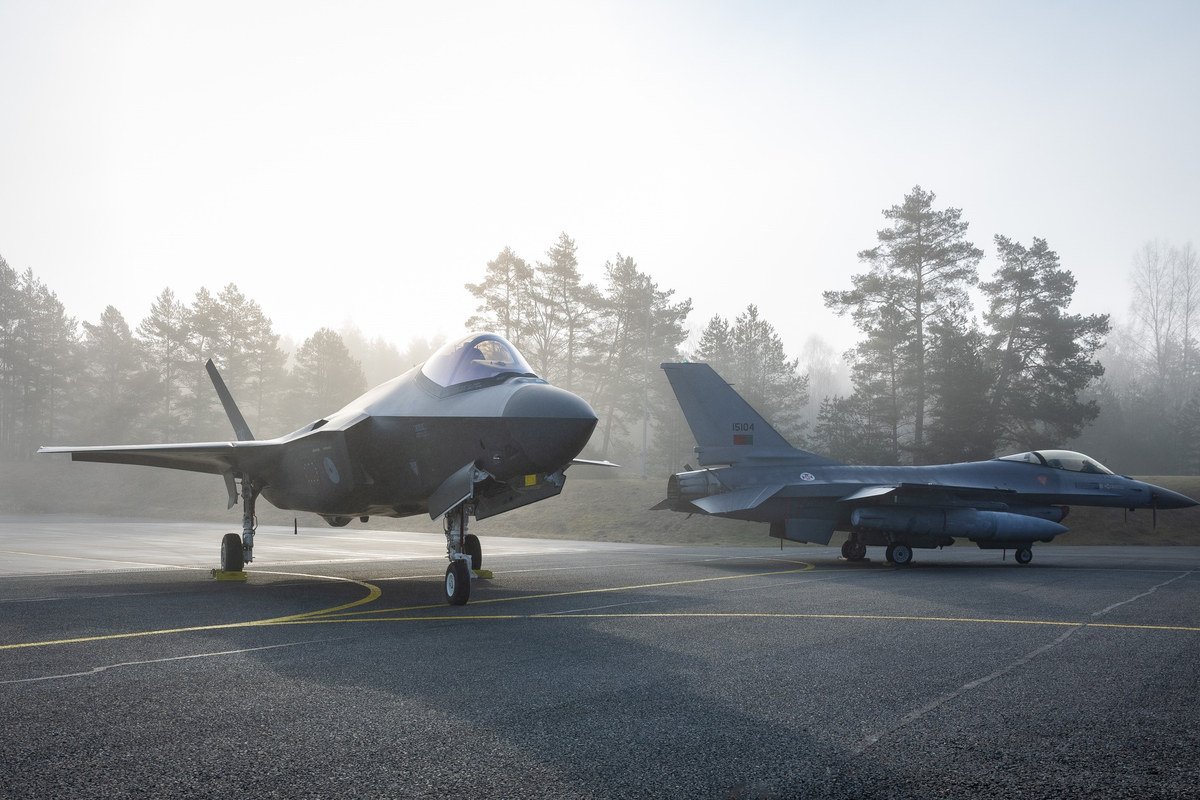
A Dutch F-35, with a Portuguese F-16 beside it, at Ämari Air Base in Estonia during the Baltic air-policing mission, April 1, 2025. Photo: Netherlands Ministry of Defence, CC BY-SA 4.0, via Wikimedia Commons.

Airfield resilience involves more than protecting runways. Fuel systems, munitions handling, maintenance facilities, communications, navigation aids, electricity and access roads all influence sortie generation. Runway repair can restore the ability to land while leaving the base unable to refuel or rearm aircraft. Dispersal to a smaller airfield may reduce concentration risk but place greater demands on logistics and technical support. Air forces therefore need to balance the efficiency of established bases against the operational flexibility gained from alternatives.
Electronic interference adds another layer across both military and civilian aviation. EASA has documented a significant rise in global navigation satellite system jamming and spoofing since 2022, including in the Baltic Sea and Arctic regions. Its 2026 guidance identifies effects including false position information, time shifts, navigation anomalies, diversions and reduced airspace capacity, while EASA and EUROCONTROL have established a coordinated action plan involving flight crews, air traffic controllers, regulators, manufacturers and national authorities. This is an example of an operational effect extending beyond a traditional front line: interference associated with security activity can alter civilian flight management, military navigation, airspace availability and the workload of controllers across a much wider region.
The consequence is not that aviation becomes impossible whenever satellite signals are degraded. Aircraft and air traffic systems retain other methods and procedures, although their availability and effectiveness vary. The operational concern is that degradation increases workload, reduces efficiency and may constrain capacity precisely when military and civilian demand are both rising. Resilience depends on crews being trained for degraded navigation, alternative systems remaining available and civil-military authorities sharing information quickly enough to manage the effect.
An air base in Britain or western Germany can therefore be operationally relevant to Baltic defence while also depending on European airspace, fuel distribution, civilian air traffic management and digital services stretching across several jurisdictions. The aircraft’s speed conceals the amount of infrastructure required to produce and sustain each mission.
Ports in Belgium and the Netherlands are not distant from Baltic security
Belgium and the Netherlands appear far removed from the Baltic front line when viewed on a political map. In operational terms, their North Sea ports are gateways into the continental transport system connecting western Europe with Germany, Poland, the Baltic States and the Nordic region. The European Commission’s North Sea-Baltic corridor extends for approximately 9,030 kilometres across nine countries, linking ports in the Netherlands and Belgium with Germany, Poland, Lithuania, Latvia, Estonia, Finland and Sweden.
Rotterdam, Antwerp-Bruges and other ports in the North Sea region matter because strategic movement from the United Kingdom and across the Atlantic requires places where personnel, vehicles, containers, fuel and other materiel can enter the European network. Their relevance does not depend on whether every reinforcement plan uses the same terminal. It arises from the volume, specialist handling capacity, commercial connections and onward rail, road and inland-waterway networks concentrated in the region.
Germany’s own defence planning describes this relationship directly. The Bundeswehr identifies Germany as a central hub through which reinforcements from the United States, Canada and the United Kingdom may arrive via major seaports in Germany, the Netherlands or Belgium before continuing eastwards. The same network must carry supplies towards deployed forces and return personnel and equipment in the opposite direction. Germany’s role therefore combines transit, host-nation support, sustainment and protection of the corridors connecting western entry points with northern and eastern Europe.
This turns infrastructure in Belgium and the Netherlands into part of the operational depth of the Baltic theatre. A disruption at a port, rail terminal, bridge, data system or energy connection can affect reinforcement timelines far from the place where the disruption occurs. The effect may be temporary and manageable if alternatives exist. It becomes operationally significant when several constraints coincide, when rerouting requires more capacity than the alternative network can provide or when the disruption changes the sequence in which capabilities arrive.
Ports also remain commercial and societal infrastructure. Rotterdam and Antwerp-Bruges support energy, industrial supply chains and large volumes of European trade. Military prioritisation cannot be separated from the need to maintain civilian fuel supply, food distribution and industrial production. Protecting a port’s military function while allowing its civilian role to collapse would eventually weaken the wider system required to sustain operations.
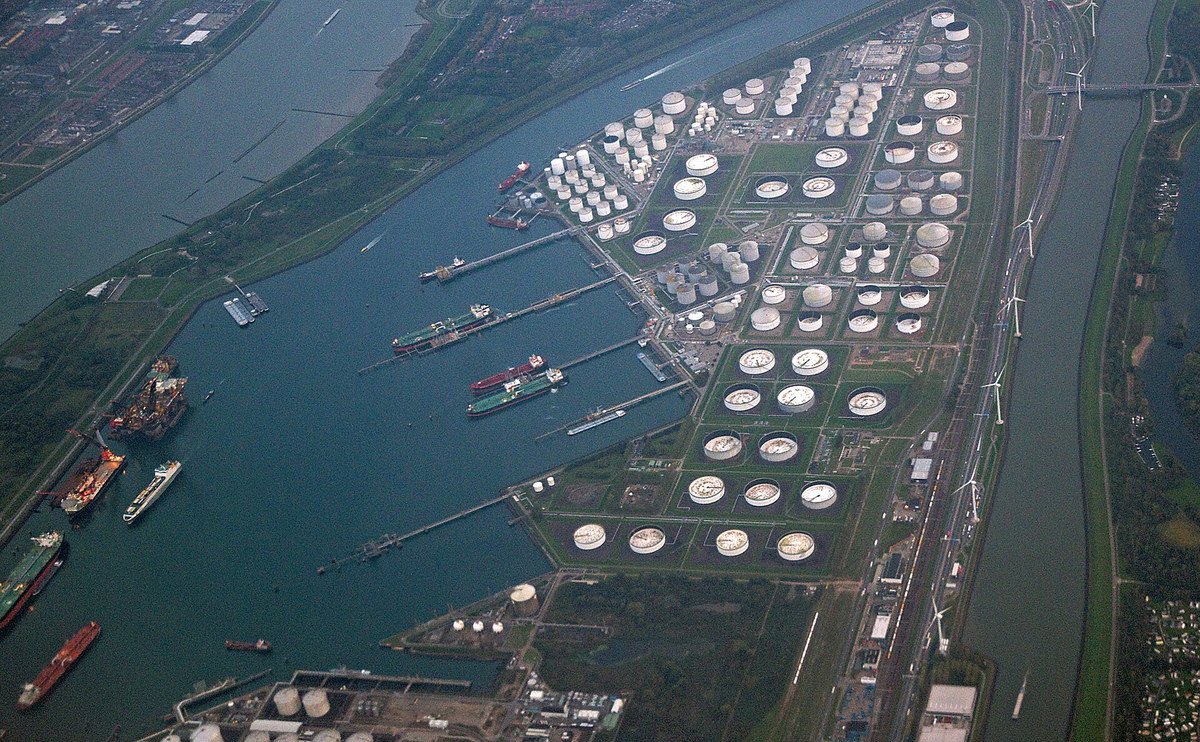
The Europoort oil terminals in the port of Rotterdam from the air, October 23, 2019. Photo: Rik Schuiling / TropCrop-TCS, CC BY-SA 4.0, via Wikimedia Commons.

The port’s digital and energy dependencies are part of the same problem. Cargo handling, access control, scheduling, customs, railway interfaces and terminal operations rely on data and electricity. Physical protection of quays and channels does not ensure throughput if cyber disruption, power loss or workforce absence prevents cargo from moving. Operational depth therefore includes the systems behind the infrastructure as well as the visible infrastructure itself.
Belgium and the Netherlands should not be described as rear areas merely because they lie west of Germany. They are enabling areas whose infrastructure contributes directly to the generation and movement of military capability. Their exposure differs from that of the Baltic States, but their operational relevance is part of the same system.
Germany is both a corridor and an operating area
Germany occupies a central position between the Atlantic and North Sea entry points and northern and eastern European destinations. This makes it a transit state, a host nation, an industrial base, a command location and a provider of forces in its own right. Those functions occur simultaneously and compete for infrastructure, personnel and protection.
The Bundeswehr’s 2026 description of Germany as NATO’s hub is useful because it makes the domestic burden explicit. Germany would need to support allied transit with transport escorts, rest areas, fuel, food, medical care and technical services while deploying its own forces and protecting the country against hybrid threats. The Bundeswehr acknowledges that routine military capacity would not be sufficient by itself and that civil authorities, reservists and commercial contractors would be required.
Germany’s operational depth is therefore not empty geographical space through which convoys pass. It contains densely used railways, roads, industrial areas, cities, energy networks, military bases and civilian services. Reinforcement flows would have to coexist with ordinary economic activity and with German national defence requirements. A railway junction used for eastward military movement may also support industry, passenger traffic and the distribution of essential goods. A rest area for convoys requires security, water, sanitation, fuel and medical support. A port receiving allied equipment may simultaneously be sending German forces and commercial cargo elsewhere.
The country also provides industrial and maintenance depth. German companies manufacture and support military platforms, ammunition, sensors and other equipment used across Europe. Industrial output, however, depends on energy, imported components, skilled labour, transport and digital services. Long-range pressure on those dependencies can affect military availability without striking a deployed unit. A damaged supplier, interrupted railway or compromised production system may reduce the flow of parts months later, which makes operational depth partly a question of time as well as geography.
Germany’s role illustrates why national defence plans cannot be designed as separate documents that connect only at the border. The capacity to support allies in transit depends on German civil preparedness, infrastructure protection and commercial agreements. The forces arriving in the Baltic region therefore carry dependencies that remain active in Germany after the initial movement has taken place.
The United Kingdom is geographically separate but operationally inside the region
The United Kingdom’s position outside the Baltic Sea can encourage it to be treated as an external reinforcement provider. Its current commitments place it inside the regional operational system. Britain leads the forward land presence in Estonia, maintains forces in the country, holds a brigade at high readiness in the UK for reinforcement and contributes maritime, air and surveillance capabilities across northern Europe. A new UK-Estonia roadmap announced in July 2026 reaffirmed the reinforcement model and expanded cooperation on targeting, command and control, long-range fires and military innovation.
The brigade held in Britain demonstrates the practical meaning of operational depth. Its combat units may be physically distant from Estonia, but their readiness, transport, equipment, ammunition, communications and integration with the Estonian Division directly influence the credibility of the commitment. The English Channel, North Sea ports, European transport corridors and host-nation arrangements between Britain and Estonia are parts of the reinforcement system rather than geographical gaps between two separate military realities.
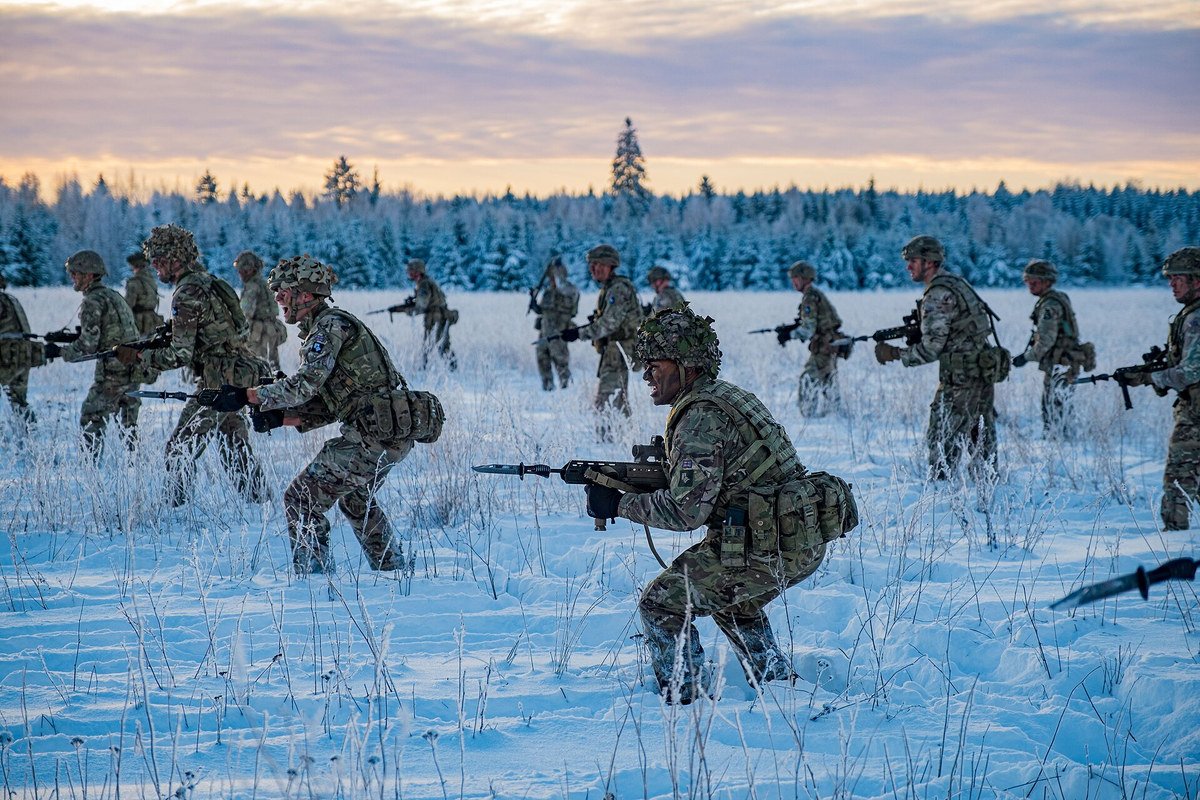
Scots Guards soldiers in winter training in Estonia during Operation Cabrit, December 10, 2022. Photo: Sgt Hart, UK Ministry of Defence, Crown copyright, Open Government Licence v3.0, via Wikimedia Commons.

The United Kingdom also leads the Joint Expeditionary Force, which connects Britain with Denmark, Estonia, Finland, Iceland, Latvia, Lithuania, the Netherlands, Norway and Sweden. JEF activity covers the Baltic Sea, the High North and the North Atlantic, and its 2025 Tarassis exercise involved more than 1,700 British personnel operating with partners across Norway, Sweden, Finland, Estonia and Latvia. Its Nordic Warden system was activated to monitor potential threats to undersea infrastructure and shadow-fleet activity, linking surveillance and information from several participating countries.
This wider regional role means that activity affecting British bases, ports, command structures, satellite services or maritime access may influence the Baltic theatre even when the event occurs far from the Baltic coast. The UK’s contribution depends on North Sea and North Atlantic routes, airspace access and connections through Belgium, the Netherlands, Germany and the Nordic countries. Britain is therefore separated from the Baltic States by geography but connected to them through operational commitments that make disruption along the intervening network consequential.
The same principle applies to industrial support. British production, maintenance, intelligence and command capacity can contribute to operations without being relocated eastwards. Those capabilities still require energy, data, transport and protection in the United Kingdom. Operational depth includes the national systems that continue generating capability after deployed forces have left their home bases.
The Nordic region changes the shape of operational depth
Finland and Sweden’s membership of NATO altered the political and military geography of northern Europe, but their significance cannot be reduced to adding territory to an alliance map. They add airfields, ports, land routes, sensors, industry, forces and access across the Baltic Sea, the High North and the North Atlantic. They also introduce their own terrain, infrastructure and distance-related constraints into the combined operational system.
Finland’s geography places it alongside the Gulf of Finland and gives it a long national border with Russia, while Sweden connects the Baltic Sea with Norway and the North Atlantic. Swedish territory, ports and airspace provide options for movement and support that did not previously exist within one integrated allied planning framework. Norway connects the Nordic region to the North Atlantic and Arctic, where maritime access, reinforcement and surveillance affect northern European security more broadly.
These relationships create depth by providing alternative locations and routes. They do not remove bottlenecks. Northern ports and roads may have limited capacity, long distances and severe seasonal conditions. Rail compatibility, bridge loads, ferry access and sparse infrastructure can constrain movement. Additional geography creates options only when the infrastructure, permissions and support needed to use those options have been prepared.
The Nordic contribution also includes industrial and technological capacity. Finland, Sweden and Norway produce military vehicles, aircraft, missiles, sensors, maritime systems and ammunition, while their civilian technology and telecommunications sectors support broader national resilience. Their factories and supply chains are therefore part of the operational depth of the region. Production capacity in Sweden or Norway can affect readiness in the Baltic States, while disruption to imported components or energy can have effects across several national inventories.
The Baltic Sea and the High North also share surveillance, air and maritime dependencies. Activity in the North Atlantic can affect reinforcement routes into northern Europe. Pressure on Arctic communications or satellite services may alter operations further south. A purely Baltic analysis therefore risks ignoring the routes and capabilities through which northern European states support one another.
Undersea infrastructure has erased another comfortable boundary
Pipelines, power cables and telecommunications links crossing the Baltic and North Seas connect national energy markets, digital services and government systems. They are physically distant from most citizens and often absent from political maps, yet they support military and civilian activity across the region. Their location on the seabed does not place them outside the operational environment.
Recent incidents have led NATO, the Joint Expeditionary Force and national governments to increase surveillance and coordination around critical undersea infrastructure. NATO’s Baltic Sentry activity combines ships, aircraft and other capabilities, while Task Force X-Baltic tested seventy air and maritime uncrewed systems during 2025 to improve situational awareness and detection around critical infrastructure. In February 2026, eight Baltic-region allies agreed to accelerate the acquisition of multi-domain naval capabilities based on the experience.
The JEF’s Nordic Warden initiative similarly uses information from participating states to track potential threats across a wide maritime area. Such systems are valuable because no single ship or national sensor can monitor every cable, pipeline, vessel and seabed activity continuously. Their effectiveness depends on combining military surveillance, commercial vessel data, intelligence, infrastructure-operator information and legal authorities across several jurisdictions.
Surveillance alone cannot eliminate the vulnerability. Undersea infrastructure stretches across large areas and may be damaged accidentally, deliberately or through conduct whose intent is difficult to establish. The seabed complicates inspection and attribution, while repair requires specialist vessels, equipment, spare components and favourable operating conditions. The EU has noted that incidents involving cables and pipelines blur the boundary between civilian and military security and create particular attribution and accountability problems.
Operational depth therefore includes restoration capacity as well as protection. A cable system may be resilient because traffic can be rerouted, a pipeline because alternative supply exists and a power connection because national generation can temporarily compensate. The relevant measure is how much disruption the wider system can absorb, how quickly damage can be located and repaired, and which other services become constrained while the infrastructure is unavailable.
The North Sea cannot be treated as a safe transit area separate from Baltic security when the same undersea and maritime networks connect Britain, Norway, Denmark, Germany, Belgium and the Netherlands to the Baltic region. Infrastructure crossing these waters supports energy, communications and reinforcement across the entire northern European system.
Electronic warfare can create effects across military and civilian geography
Electronic warfare demonstrates why the boundary of the battlefield cannot be drawn solely around physical targets. The electromagnetic spectrum is shared by military communications, radar, navigation, aviation, shipping, emergency services, mobile networks and commercial systems. Interference generated for a military purpose can produce effects outside the intended area, while civilian spectrum activity can complicate military operations.
Jamming and spoofing of satellite navigation are already affecting European aviation beyond any conventional front line. EASA’s reporting covers the Baltic Sea, Arctic, Black Sea, Mediterranean and Middle East and identifies increasing sophistication and frequency. The operational consequences include altered routes, degraded navigation, additional controller workload and reduced airspace capacity.
Military operations must account for these effects because the same airspace and navigation environment supports reinforcement, commercial aviation, medical transport and national air defence. A disruption over the Baltic can affect flight planning in Finland, Sweden, Estonia and neighbouring regions, while mitigation measures may alter capacity at airfields further west. The location of the transmitter, the area in which the effect is experienced and the organisations responsible for managing it may all be different.
Electronic warfare also influences the use of uncrewed systems, sensors and communications. A platform may remain physically intact while losing navigation, control links or access to the data required for its mission. Commanders may respond by increasing transmission power, changing frequencies, using alternative networks or accepting reduced connectivity. Each adaptation affects spectrum management and may create new interference or visibility.
The civilian consequence must be included in the operational calculation. Interference affecting maritime navigation, aviation or emergency communications can create safety risks and consume civilian response capacity. Authorities need agreed processes for identifying the source, sharing information and applying restrictions. Treating electronic warfare as an activity confined to military units ignores the environment through which its effects propagate.
Industry extends operational depth into factories and supply chains
The operational value of deployed forces depends partly on the ability to replace what they consume and repair what they lose. Ammunition, missiles, spare parts, sensors, vehicles, software and communications equipment are produced through industrial networks distributed across Europe and beyond. The factory may be far from the front line, but its output influences how long military activity can be sustained.
Industrial depth is not synonymous with the number of defence companies or production sites. It depends on production capacity, skilled labour, machine tools, raw materials, energy, components, testing, certification and transport. A final assembly facility may rely on specialist suppliers located in several countries. Increasing output at one stage can expose constraints elsewhere, including shortages of explosives, electronics, propulsion systems or qualified personnel.
The multinational deep-strike and ammunition initiatives launched in 2026 reflect the need to build scale, interoperability and industrial capacity across several countries rather than assuming that national production can satisfy all requirements independently. NATO’s Ankara Summit declaration also linked military readiness to defence-industrial depth, deployability, sustainment, deep precision strike, air and missile defence, uncrewed systems and intelligence capability.
The location of industry therefore shapes operational depth. Production in the United Kingdom, Germany, Sweden, Norway, the Netherlands or Belgium can support forces in the Baltic region, but the supply chain between factory and user must remain functional. Ports, railways, roads, energy systems, digital services and commercial carriers connect industrial output to operational availability.
Industry is also vulnerable to forms of pressure that do not resemble traditional attacks on military targets. Cyber intrusion can interrupt production or expose technical data. Sabotage can affect facilities or suppliers. Energy disruption can reduce output. Information activity can target workforce confidence or public consent. Export controls and legal restrictions may delay the movement of parts across borders. Each effect can reduce military capability without creating a visible crater.
Protecting industrial depth requires governments and companies to understand which suppliers are genuinely critical, where alternatives exist and how quickly production can recover. It also requires realistic contracts and demand signals. Companies cannot maintain large reserve capacity indefinitely without funding, while governments cannot assume that commercial production will expand immediately when a crisis begins.
Protection cannot be spread evenly across the entire system
Recognising that the operational area extends across northern and western Europe does not mean that every port, factory, bridge, cable and data centre can receive the same level of military protection. The system is too large, ownership is too diverse and threats vary by location and function. Leaders must prioritise.
Priority should be based on operational consequence rather than visibility. A large air base is an obvious asset, but a small telecommunications node, railway junction, fuel pumping station or specialist supplier may be equally difficult to replace. Some infrastructure is critical because of its capacity, while other infrastructure is critical because no alternative exists. Dependency mapping needs to distinguish between assets whose loss is inconvenient and those whose loss changes operational options.
Protection also takes several forms. Air and missile defence may be appropriate for selected military and infrastructure sites, but it cannot cover every possible target continuously. Physical security, cyber defence, concealment, dispersal, redundancy, repair capability and alternative procedures contribute different layers. A system designed to continue operating after limited damage may provide more practical resilience than one that relies entirely on preventing every attack.
The allocation problem extends across national borders. A port in the Netherlands may support several countries, while an industrial facility in Germany or Sweden may produce components used across many weapons systems. National authorities fund and protect assets within their jurisdictions, but the operational consequences of failure may be multinational. Arrangements are therefore required for sharing risk assessments, coordinating investment and deciding which cross-border dependencies deserve collective attention.
This is where political commitment must become practical planning. Statements about defending territory do not determine which railway junction receives protection, which data service is restored first or how scarce air-defence systems are allocated between forces, ports, cities and industrial sites. Those choices cannot be avoided, and they become harder when the relevant dependencies have not been identified before a crisis.
Operational depth is also temporal
Depth is usually imagined spatially, but time is equally important. Some effects are immediate, while others accumulate. Destruction of an airfield runway may interrupt operations quickly. Loss of a component supplier may not become visible until existing stocks are exhausted. Cyber access gained months earlier may be used at a later stage. Industrial mobilisation may require years, while a logistics corridor can become congested within hours.
This temporal dimension affects warning and preparation. Capabilities positioned far from the immediate area of contact may still require early decisions because their movement, production or integration takes time. A British brigade held at readiness cannot contribute merely because a political decision has been taken; transport, reception and onward movement must follow. Ammunition production cannot be doubled by instruction when new machinery, permits and trained workers are required. A damaged cable may be rerouted temporarily, but repair capacity must be available before redundancy is exhausted.
Adversaries can exploit these differences by creating pressure at several timescales. Persistent cyber reconnaissance, information activity and covert interference may shape the environment long before open military operations. Long-range strikes can then affect immediate availability, while attacks on industry or infrastructure reduce the capacity to regenerate over months. Defence planning must account for the complete sequence rather than focusing only on the first phase of a conflict.
The ability to absorb an initial disruption is therefore insufficient if the system cannot restore capacity. Operational depth depends on inventories, repair, replacement, industrial output and trained personnel continuing to generate options over time. A force may survive the first week while becoming steadily less capable because the networks behind it cannot replenish losses.
The battlefield begins wherever operational capability is generated or constrained
There is no single line at which the modern battlefield begins. The immediate area of contact remains distinct because of the intensity and directness of the violence experienced there. The wider operational environment begins wherever action can materially alter the ability to command, move, sustain, protect or regenerate forces.
For the Baltic region, that environment includes ports and railways in Belgium and the Netherlands, Germany’s transit and sustainment hub, British bases and reinforcement commitments, Nordic airfields and industrial capacity, maritime routes through the North Sea and North Atlantic, and cables and pipelines crossing the seabed between them. It includes the command networks and data systems that connect national authorities with deployed forces, as well as the civilian operators whose infrastructure keeps those systems functioning.
These locations do not face identical risks, and describing all of Europe as a front line would obscure rather than improve the analysis. The Baltic States face particular exposure because of geography, proximity and the concentration of immediate military requirements. Belgium, the Netherlands, Germany, the United Kingdom and the Nordic states contribute different forms of operational depth and face different forms of disruption. The analytical requirement is to understand how those differences connect.
Rear areas can still be identified for particular operational purposes, but they can no longer be assumed to be uncontested. Their value depends on the ability to continue generating military effect despite pressure on infrastructure, information, industry and movement. Distance provides time and options only when the connecting systems remain available.
Operational depth therefore exists far beyond the front line because the capability used in one place is generated across many others. A force in Estonia may depend on intelligence collected over the Baltic Sea, an aircraft based in Britain, equipment landed in the Netherlands, rail movement through Germany, components manufactured in Sweden and communications carried through civilian networks crossing the North Sea. None of those dependencies makes the operation inherently unworkable. They make it a wider European system whose resilience must be planned, exercised and protected accordingly.
One force in Estonia, six dependencies
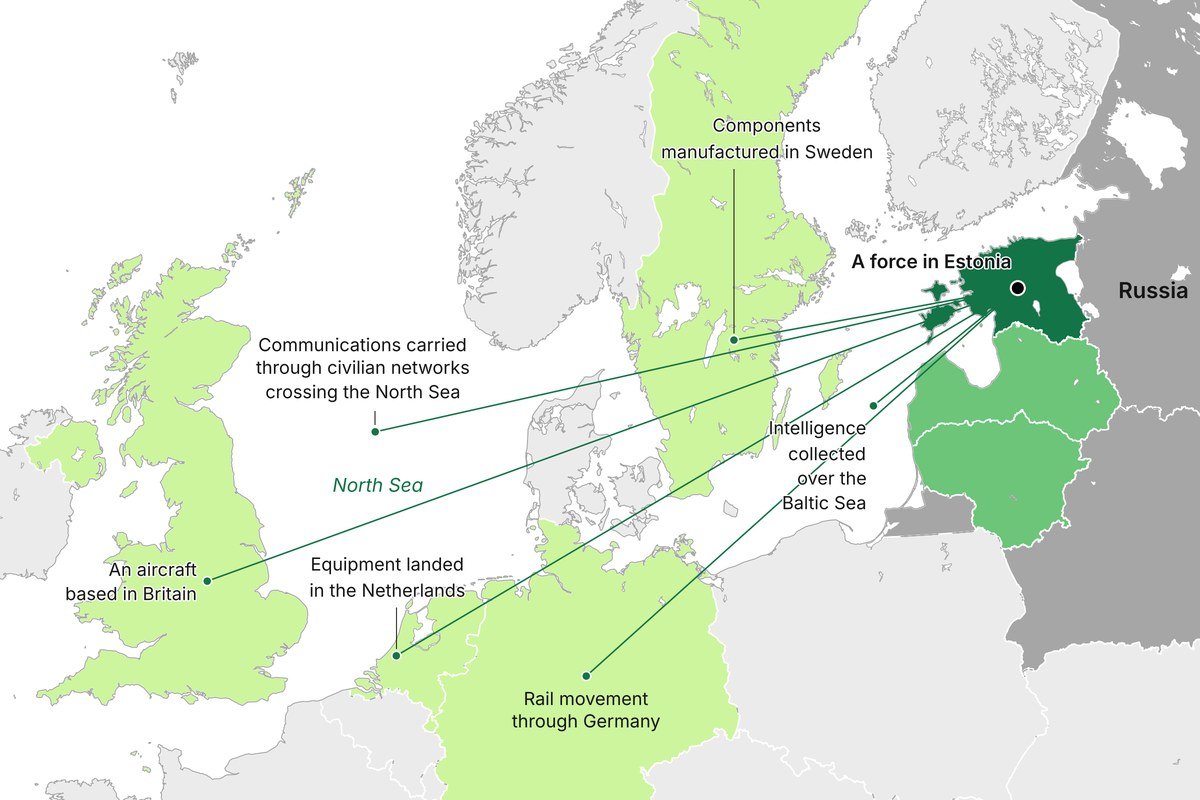
Map: BISC. Borders: OpenStreetMap contributors.
The Baltic Theatre Is One Operational System
The Baltic theatre cannot be understood as three national defence problems placed beside one another. Estonia, Latvia and Lithuania retain distinct territories, armed forces, institutions and responsibilities, but military geography does not stop at their borders. Their security depends on events and capabilities across the Baltic Sea, the Nordic region, the North Sea, continental Europe and the North Atlantic.
This does not make national planning less important. It makes isolated national planning insufficient.
Finland and Sweden have changed the operational geography of northern Europe by adding territory, forces, airfields, ports, sensors, industrial capacity and alternative movement routes to a more integrated regional framework. Finland strengthens the northern land, air and maritime picture and connects the Baltic region directly to the High North. Sweden provides geographical and operational links between the Baltic Sea, Norway and the North Atlantic. NATO’s establishment of a Sweden-led Forward Land Force in Finland in 2026 further reflects the growing integration of the northern and Baltic areas.
Their contribution does not remove existing constraints. Northern distances remain considerable, infrastructure capacity varies, winter conditions affect movement and several routes still depend on limited ports, bridges, railways and roads. Additional geography creates operational depth only when forces can use it, infrastructure can sustain it and command arrangements can coordinate activity across it.
The Baltic Sea is equally not a boundary separating national theatres. It is a shared operating environment connecting ports, naval forces, commercial shipping, energy infrastructure, telecommunications cables and coastal societies. Maritime activity affects reinforcement, trade, energy security, surveillance and the protection of undersea infrastructure at the same time. A disruption in one part of the sea may create consequences for several states and sectors before responsibility or intent has been established.
Ice in the Gulf of Bothnia, the Gulf of Finland and the Gulf of Riga, seen by ESA’s Envisat satellite, April 19, 2011. Image: European Space Agency, CC BY-SA 3.0 IGO, via Wikimedia Commons.

The same system extends westwards. Ports in Belgium and the Netherlands connect maritime transport from the Atlantic and the United Kingdom to rail, road and inland logistics networks running through Germany and onwards towards northern and eastern Europe. Germany provides transit, maintenance, industry, host-nation support and command capacity. The United Kingdom contributes forces, surveillance, maritime access, industrial support and reinforcement commitments whose effectiveness depends on the North Sea and continental movement network remaining available.
The Joint Expeditionary Force provides another connecting layer. Its participating nations span the United Kingdom, the Netherlands, the Nordic countries and the Baltic States. The JEF describes the Baltic Sea, the High North and the North Atlantic as one interlinked area of strategic concern and positions itself as a bridge between national activity and wider NATO operations, particularly during the transition from crisis to conflict.
That role is important because no single institution controls the complete regional system. NATO provides collective defence planning, military command structures and multinational forces. The European Union contributes through transport policy, infrastructure funding, regulation, energy coordination, civil protection, industrial measures and sanctions. The JEF offers a smaller regional framework capable of connecting national activity across northern Europe. National governments retain sovereignty, forces and responsibility for civil preparedness. Municipalities and private companies operate much of the infrastructure on which every level depends.
This is why preparedness cannot be measured only by national inventories or by the number of units assigned to plans. A state may possess capable forces while depending on external ammunition production, foreign transport capacity or infrastructure elsewhere in Europe. A regional plan may identify reinforcement forces while assuming ports, railways, communications and host-nation support will function without sufficient protection or testing. Civil-preparedness documents may assign responsibilities while leaving cross-border dependencies and competing priorities unresolved.
The Baltic theatre becomes credible as an operational system only when these connections are understood in advance. Plans must identify which capabilities are generated nationally, which arrive from elsewhere, which infrastructure enables them and which civilian functions must continue throughout. Exercises must test not only military manoeuvre but also transport allocation, command relationships, industrial support, infrastructure failure, multinational decision-making and civil continuity.
The Baltic States remain central because they face the most immediate geographical exposure. They are not, however, an isolated eastern edge whose defence begins at their borders. Their security is generated through northern European forces, Nordic geography, Baltic and North Sea access, British commitments, German depth, western European ports, European industry and the civilian systems that sustain all of them.
The Baltic theatre is therefore one operational system, but not one centrally controlled machine. It is a network of nations, institutions, armed forces, companies and communities whose capabilities become effective only when their connections work. Its strength is not determined solely by what each participant possesses. It is determined by whether the combined system can detect, decide, move, sustain, protect and recover across borders and institutions under the same pressure.
Conclusion
The article began with a simple observation: maps filled with arrows create the impression that military operations are primarily about movement. They are not.
Every arrow drawn across a map represents thousands of assumptions about infrastructure, logistics, command, information, industry, civilian resilience, political decision-making and the countless dependencies that allow forces to move, fight and sustain themselves. If those assumptions prove false, the arrow may still exist on paper while the operation itself becomes slower, more expensive or impossible.
The Baltic theatre illustrates this reality particularly clearly. It cannot be understood by examining individual countries in isolation or by focusing only on the immediate area of contact. It is an interconnected operational system stretching across the Baltic Sea, the Nordic region, the North Sea and the wider European security architecture. Military readiness depends on civilian infrastructure. Reinforcement depends on commercial transport. Operational freedom depends on resilient energy, telecommunications, industry and public services. National plans depend on multinational cooperation, while multinational plans depend on national implementation.
None of these systems exists independently. Each creates opportunities, constraints and dependencies that shape the others.
Simplified maps remain valuable because they communicate ideas quickly and provide a common starting point for discussion. They are, however, poor substitutes for operational analysis. Understanding the Baltic theatre requires looking beyond political borders and recognising the interconnected military, civilian, geographical and logistical systems that determine whether operations succeed, stall or fail.
The next part builds on this foundation by examining how these interconnected systems influence decision-making, uncertainty and command during operations.
Further Reading
Readers interested in exploring these topics further may find the following resources useful:
- NATO Strategic Concept (2022) – https://www.nato.int/strategic-concept/
- NATO Allied Joint Doctrine (AJP-01) – https://www.nato.int/cps/en/natohq/topics_69269.htm
- NATO Logistics Handbook – https://www.nato.int/docu/logi-en/logistics_hndbk.pdf
- NATO Allied Command Transformation – https://www.act.nato.int/
- NATO Data Strategy – https://www.nato.int/cps/en/natohq/official_texts_202761.htm
- European Commission – Military Mobility – https://transport.ec.europa.eu/transport-modes/military-mobility_en
- European Defence Agency – Military Mobility – https://eda.europa.eu/what-we-do/all-activities/activities-search/military-mobility
- ENISA NIS360 Report – https://www.enisa.europa.eu/publications/nis360-2026
- EU Civil Protection Mechanism – https://civil-protection-humanitarian-aid.ec.europa.eu/what/civil-protection/eu-civil-protection-mechanism_en
- European Union Cybersecurity Strategy – https://digital-strategy.ec.europa.eu/en/policies/cybersecurity
Previous Articles in this Series
Part 1 – Geography Shapes Security https://www.linkedin.com/feed/update/urn:li:ugcPost:7483761485085782016/
Part 2 – The Baltic Is Larger Than Three States https://www.linkedin.com/posts/eva-sula-02b9a73_balticsecurity-militarygeography-northerneurope-activity-7486287982132436992-TTZf?utm_source=share&utm_medium=member_desktop&rcm=ACoAAACuNWMB01mVJbkCqgES16cax_p6qgUB3JQ
Eva Sula is an independent defence and security strategic advisor specialising in NATO and European defence cooperation, regional security, emerging technologies and operational capability development. She is a NATO DIANA Defence Mentor, a Senior Fellow for Estonia at the Council on Strategic and Foreign Intelligence (CSFI), and a member of The Alphen Group.
© Eva Sula
First published on LinkedIn on July 27, 2026. Read the original article or the LinkedIn post.
All opinions expressed are those of the author alone and may not represent those of the institutions they represent or the Baltic International Security Centre (BISC). BISC maintains a strict intellectual independence policy across all its projects and publications.