
A Kremlin compliment, a Kaliningrad update
Sign up to get Be More Baltic by email.
Who needs a Pulitzer? Edward Lucas is “the chief ideologue of British Russophobia,” according to Vladimir Kornilov, a leading Kremlin-friendly commentator. That was in response to our founder’s Times column on Kaliningrad. Russian state media are paying attention to our work. So are others. More on that in a moment.
WHAT THE SIMULATIONS FOUND
Earlier this month, at ISM University’s Wargaming Lab in Vilnius, we had experts play the decision-makers in three Kaliningrad crises: shortages, a mutiny and a toxic fire. Our write-up has the findings. Briefly:
- Lithuania, Poland and their partners took the initiative, though they still had to agree among themselves.
- The Kremlin prioritised political control over problem-solving.
- Russia had only bad options. But that creates new risks.
Sky News was also in the room. Deborah Haynes’s film for its Defence Insider app (available in the UK only) and her website piece showed how quickly Kremlin bluster turned to weakness.
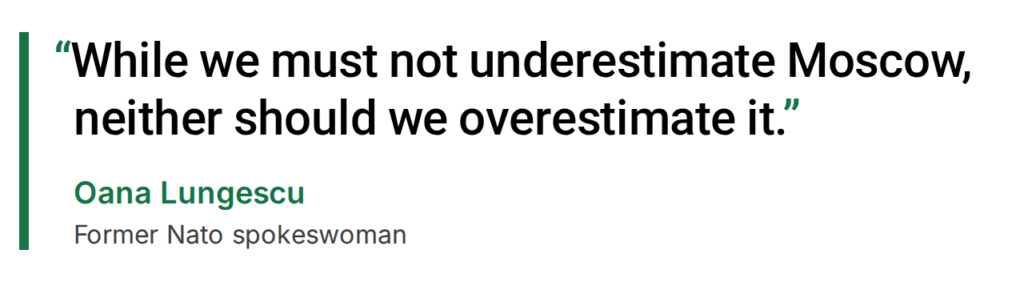
Oana Lungescu helped adjudicate the simulations and played, among other roles, Nato’s top military commander. She wrote this on LinkedIn afterwards.
SKY’S NOT THE LIMIT
In our previous newsletter we reported on the Lithuanian media’s blanket coverage of the simulations. In the two weeks since, we’ve counted 39 reports on the simulations in 26 outlets across eight countries. To name a few: Fakti.bg, Rzeczpospolita and Onet [Polish], t-online and Euronews [German], Jauns.lv [Latvian].
Meanwhile, our chief ideologue’s latest Times column looked at what may be Western intelligence info-ops in Kaliningrad and elsewhere in Russia. Daria Zhukauskaite, our Kaliningrad 2050 research associate, crunched the numbers.
Our weekly Kaliningrad media report tracked the response. The region’s governor, Alexey Besprozvannykh, accused hostile foreign states of large-scale information attacks (we’ll pass on the compliment).
WELCOME
Estonia’s new president, Ülle Madise, was sworn in on October 12. Hello too to Latvia’s newly elected Saeima. We look forward to working with them. As usual for Estonia’s heads of state, her first foreign visit was to Riga, followed by Vilnius on October 21. To the West we say “Be more Baltic!” Here, it’s: “Be more Baltic!”
WHAT WE ARE DOING
On October 22 we held our autumn reception in the grandeur of the National Liberal Club in London, co-hosting with the Lithuanian Chamber of Commerce in the UK. Guests were greeted by hot-off-the-press copies of the latest Baltic Barometer, edited by Caspar Schulze, featuring Baltic progress in energy security. Diversification, interconnection, resilience — a lesson to much of the rest of Europe.
They included participants from the LT-UK Business Forum, and London VIPs such as John Whittingdale MP and Lord Altrincham, plus military, government, finance and think-tank bigwigs, as well as the Lithuanian Ambassador Asta Radikaitė (pictured).
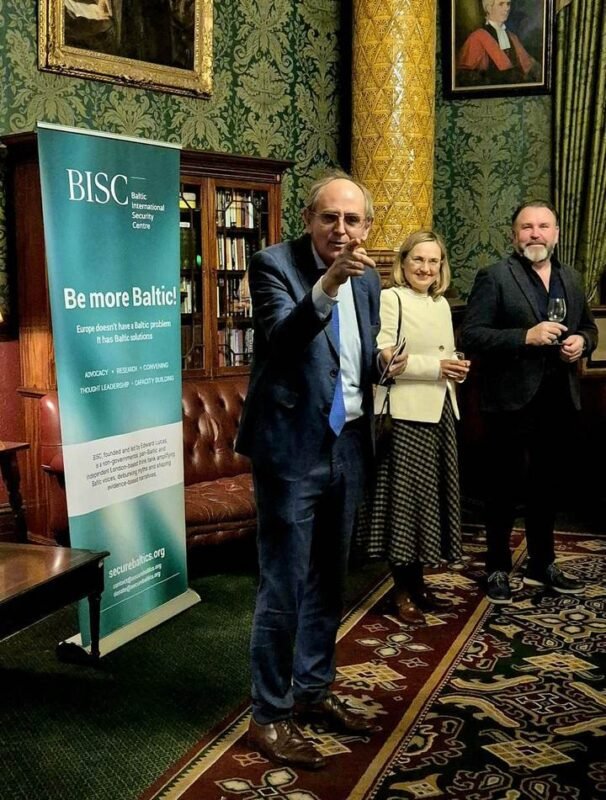
BISC needs you! Edward Lucas with Ambassador Asta Radikaitė and Linas Bielskis at the National Liberal Club, October 22. Photo by Lord Altrincham
On October 26 and 27 a BISC team is at the Defending Baltics conference in Vilnius. If you are there too, come and say hello.
GOOD GERMAN JOURNALISM
Bouquets this week in our regular press review to Matthias Gebauer and Sven Röbel at Der Spiegel for their scoop on the latest spy bust (the alleged culprit was particularly interested in the German deployment in Lithuania).
And to Julian Staib of the FAZ for his exposé, based on the Finnish satellite company Iceye’s data, of Russia’s electronic-warfare and surveillance build-up in Kaliningrad (though we question whether the air defences there are really any stronger).
This week’s edition comes with an English summary and the full German version. Both of our weekly media reviews are made possible by the Friedrich Naumann Foundation for Freedom in Vilnius.
BISC IN THE WILD
- The i Paper: (quoting Edward Lucas) the Kremlin is working to split Nato by prising the Baltic states and Poland away from the rest of Europe; an attack on them is an attack on the alliance.
And in his own words…
- EUobserver: Ukrainians are Europe’s human shields, and Europe’s only problem is a lack of will-power.
- Times Radio: by barring Ukraine from hitting Russian refineries, the U.S. administration is throttling it just as it had found a way to win.
- Times Radio, with Peter Hitchens: what history says about the U.S. administration’s handling of Ukraine and Iran, and what should come next.
- The Times: a review of Elisabeth Braw’s book on seabed warfare. Also in Lithuanian on Delfi.
- Aftonbladet [in Swedish]: Russia should not be told how the West would answer, from the EUobserver column.
- Armádní Zpravodaj [in Czech]: Kaliningrad as the strategic weakness Russia cannot defend.
WHAT WE ARE READING
- Gabrielius Landsbergis, Lithuania’s former foreign minister: if Europe shoots little green men, what then? Sabotage and incursions on Nato’s eastern flank go unanswered because Europe doubts it has U.S. backing. “The issue is not our ability, it is only willingness which we lack.”
- Baltic Sentinel: Meelis Oidsalu asks whether Nato could close the Gulf of Finland to Russian shipping in wartime, and what that would cost the alliance’s own supply and transit routes.
- Baltic Takes on China’s embassy in Tallinn, which sent Estonia’s parliament a formal note after a cross-party group of MPs marked Taiwan’s national day. The embassy seems not to grasp that MPs do not work for the government.
READ OF THE WEEK
Sandra Martinsone, our director of operations, picks Turbulence as a driving force, a new book edited by the Latvian historian Gatis Krūmiņš. In the age of uncertainty this is a timely book providing valuable lessons and inspiration based on Latvian and Baltic history.
OVER TO YOU
Which Baltic story deserves more attention abroad than it gets? Tell us. And as always, send us spots and tips, rants and raves. Follow us on Facebook, LinkedIn and X (coming to Instagram soon).
If you would like to support our work, write to us at donate@securebaltics.org.
Best regards, Edward Lucas and the BISC team
Next dispatch: November 9.
BISC’s motto is “Be more Baltic!” Estonia, Latvia and Lithuania see what the rest of Nato doesn’t see. And they do what others don’t do.
EARLIER DISPATCHES
- Dispatch three: Crises in Kaliningrad, October 12
- Dispatch two: Narva is not next, September 28
- Dispatch one: We asked Budanov to change his tune, September 16