Leonidas Donskis was one of the greatest Lithuanian intellectuals: a polymathic public figure, rooted in the European liberal tradition. An annual conference in his honour is a calendar highlight for his friends and admirers.
BISC founder-director Edward Lucas was a keynote speaker at this year’s conference. Here’s his speech.
Rarely a day goes by that I don’t think of Leonidas Donskis and his legacy. I lived in Lithuania in the early 1990s and followed your country and the region very closely since then. And I think I can say from the bottom of my heart that Donskis was one of the greatest people that I met who shaped my understanding not just of Lithuania, and of Lithuania’s place in the world, but also of fundamental concepts such as modernity, the relationship between markets and morals, and the role of the individual in a hyperglobalised, technology-dominated world.
Since his death, the importance of his work and thinking has only grown, with the intersection of technological progress, if we should call it that, and the fashion for autocracy, spurred by cynicism, impatience, even contempt, for democracy and the rule of law. Perhaps the opposite of Donskis’s moral imagination – what one might call immoral imagination.
I also want to echo Viktoras Bachmetjevas in his opening remarks – we are meeting in the national library, not in a bunker. We all slept well last night. Let us remember the bravery and sacrifice of our Ukrainian allies. We, especially in the “old West”, could do much more to help them. Let us do it and do it quickly.
I want to talk today about small and medium-sized states in an uncertain world, and to do so as from the point of view of practical geopolitics. Donskis was not just a thinker, he was a do-er too.
It’s at first sight not a particularly cheerful topic.
We are in the era of Trump, Xi Jinping, and Vladimir Putin, an era where the big countries do the deals that they can, and the small countries accept the fates that they must. That’s pretty bad. It’s the antithesis of the rule-based international security order that we dreamed of after 1991.
It is also pretty bad that some of the big countries that we look to for leadership, Britain, France, Germany, in the case of Europe, are not fulfilling their potential, to put it mildly. My own country, Britain, seems to be consumed with its own economic and other problems. We’ve seen the rise of the far-right AFD in Germany, which is potentially very destabilizing, and perhaps most of all, Marine Le Pen as the favorite for the presidential election next year in France.
In all, that’s a classic example of what Donskis called Adiaphorization, a feature of the concept of Liquid Modernity pioneered by him and Zygmunt Bauman. A kind of moral numbness, a fundamental lack of empathy. Exemplified by the might-is-right, greed-is-good approach of the Trump administration.
But I’m actually really optimistic, and I will explain why. These conditions of uncertainty we face may be new for what you might call the Old West. We were asleep at the dawn of the 1990s because we were hungover from celebrating the collapse of the Soviet Empire. We thought that we were in the end of history, and all that remained was just to get even richer and even happier, and nothing was going to disturb this illusion.
And that remained baked-in, through the ‘90s and mostly through the noughties, undisturbed by the 2008 financial crisis, which for me, put an enormous question mark over the way in which the global financial elite have been running the world, highlighting the dangerous, costly and fundamentally undemocratic nature of a highly leveraged and financialised economic model. Put crudely, one where profits are privatised and losses are socialised.
On the geopolitical front our sleep was undisturbed by the two Chechen wars, by Putin’s belligerent speech at the Munich Security Conference in 2007, by the war in Georgia in 2008, even by the invasion of the Donbas and the seizure of Crimea in 2014.
But you saw it, and when I say you, I mean the three Baltic states, but I would also add your neighbour Finland, and also Poland, perhaps more on the medium size than the small size.
You understood what we didn’t understand. You saw things that we didn’t see. You smelled things we didn’t smell, and you did things that we didn’t do. You started building up your defences far before we did. Estonia never dropped below 2% of GDP spending on defence. All three Baltic states now beat the rest of Western Europe by a margin in your military spending, and also in your security culture. That goes beyond how much you spend and on what, It concerns the way you do security, not just across all of government but across the whole of society.
So what is new for the Old West is absolutely not new for you. You’ve trained on these problems. You have muscles, and you have muscle memory. You have no choice. You know what it is like to lose your freedom. You are determined to defend it. And you know that this is not just about your own efforts, but working with others. Alliance solidarity, based not just on shared interests but shared values, is, to echo Viktoras Bachmetjevas, a structural necessity.
I have set up a new think tank called the Baltic International Security Centre, and its message is “Be more Baltic”, because I think there’s so much that the Old West can learn from what you’ve done. We can learn from your vigilance,, your readiness, and your cohesion. We can learn from the way you interpret threats, the way you act on them, the way you tell the public about them. We should be copying you.
But it could be even better. If 80% of the “Be more Baltic” message is for the Old West, 20% of the message is direct to the Baltic states. because one of the things that’s really struck me over the 36 years that I’ve been coming to your countries is that Baltic cooperation, I call it B3 for short, has, to put it mildly, not really reached its potential. Leonidas Donskis knew that I was travelling constantly through the Baltics, he would often ask me, “What’s happening in Latvia? What’s happening in Estonia? What can we learn from these other countries’ experience?” And of course, conversely, what can we teach them?”
There is a certain inter-Baltic sibling rivalry, which has both costs and benefits. I understand sibling rivalry. I have three children myself, and I’m from a family of four. Sibling rivalry can be a powerful force. But you overdo it. Too often at the moment, we are getting one plus one plus one equals two because of the lack of cooperation. Three would be good, but the potential is one plus one plus one equals not three, but four.
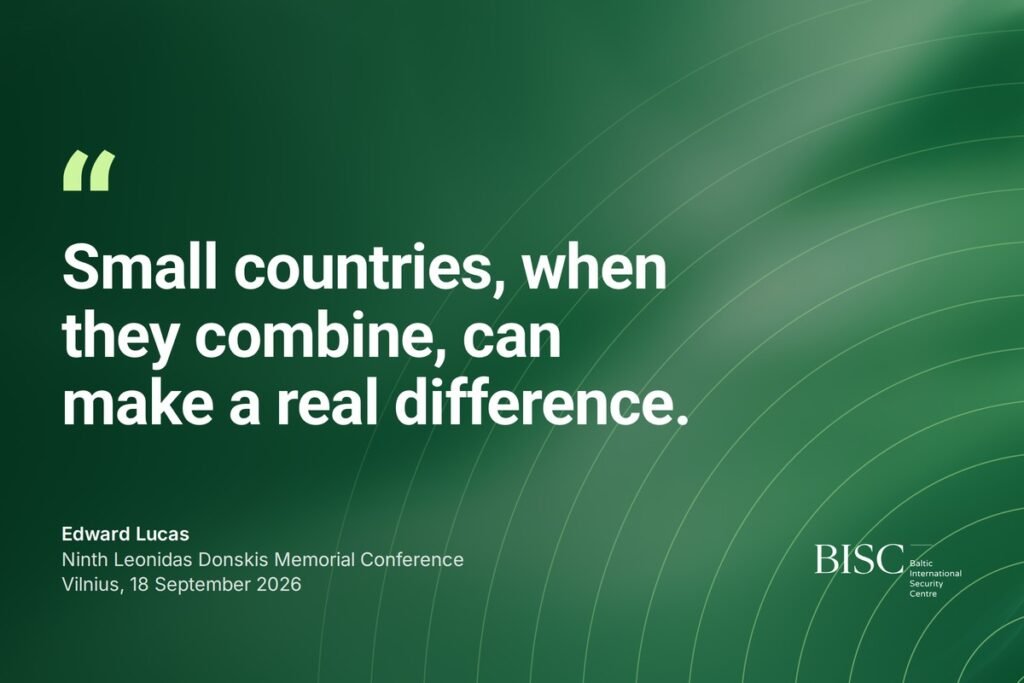
And perhaps the biggest message I have today is that small countries, when they combine, can make a real difference.
Now, here’s my first big example of this. If you put together the Nordic Five, the Baltic Three, and Poland, we call it the NBP9. The NBP9 has a GDP of $3.46 trillion USD (or roughly €3.2 trillion) calculated crudely via the current exchange rates. bigger than Russia. $2.66 trillion. Russia gets more bang for the buck, or rumble for the rouble, so measured by purchasing power GDP is bigger — $7.5 trillion versus $4.87 trillion for the NBP9. But Russia has to run the world’s largest country by landmass, and has a population twice the size.
If the NBP9 were on country, call it Baltic Sealand if you want, it would be in the G7. It’s a bigger economy than Italy. These countries, that individually struggle to make a consistent mark on the world stage, create, if they are combined, a really big lump of economic power and potentially a really big lump of political and military power. To disagree slightly with Viktoras, we are not dealing here with what Václav Havel called power of the powerless. We are dealing with the potential power of the less powerful, who are powerful if they combine.
It’s not straightforward. The Nordic Five are very used to coordinating with each other. But they still don’t always treat the Baltic Three as exact equals, so there’s work to do on that, particularly when it comes to sharing information between governments. Then there’s the question of how do we bring Poland in. Poland is too big to be too small and too small to be big. It’s just Poland. But Poland has not always excelled at multilateralism, and dealing with its smaller neighbours, or at maintaining predictability in foreign and defence policy.
But these are solvable problems. This is what we pay our diplomats and our politicians and our decision-makers to do. Put those eight or nine countries together, and we have a really powerful counterweight to Russia, and we also have an example for the rest of Europe.
Let me give another example.
In this era of uncertainty, the most important thing is to tell our public what is going on. Whether it’s climate change and natural disasters or those sort of things, whether it’s organized crime and terrorism, or whether it’s hostile state activity, chiefly from Russia, but also from China and Iran, we are expecting the public to pay partly with their taxes, but more often with their time, in order to provide a kind of what I call national security insurance.
We expect we need people to sacrifice some time and some convenience in order to deal with these uncertainties. And so if you’re Lithuanian, it may mean you join the Riflemen’s Union, you spend your weekends on that, whether it’s on the military side or on the civilian side. Remember, although we call them riflemen, there are women as well. If any foxes are in the audience, thank you from me for what you’re doing. You’re not just defending Lithuania, you’re defending all of us
And if we want people to make sacrifices and bear risks, , we have to communicate the threat to them. And that is something that the Baltic states have pioneered.
I don’t know if there are any Estonians in the audience, I don’t want to embarrass them by praising them, but you started in 1998 with an annual yearbook from your security police, the KaPo, defence police is its literal translation, just stating the threats and what was being done about them. And you did this in the teeth of criticism from the big countries. Your big-country partner services, not least the Brits, said, “Don’t do this. It will scare the public. It will give clues to the enemy. It will be a sign that you’re not really serious about national security. Serious services and serious people don’t talk about these serious things in public.”
And the Estonians said, “No, we’re going to do it. We’re going to publish an annual yearbook because we have to show the public, yes, there are serious threats, but yes, we are serious people. We are dealing with these threats seriously, and we’re getting serious results.”
And that messaging of seriousness is not just a message to the public in the countries concerned. It’s a message to the allies, we’ve got this, and it’s a message to the threat actors, watch out, we see you, we do stuff. And that is something that was pioneered by Estonia, then Latvia and Lithuania.
I have suggested privately, and take the opportunity of this speech do so publicly, that the NB8 or NBP9 countries combine in their response to sub-threshold attacks, the state terrorism that is raging across the European alliance. My suggestion is that they combine to produce a regular report, outlining publicly the attacks they have experienced, attributing them to Russia – or to whichever other hostile state actor is responsible – and also (and this is very important) outlining their response. This would
- Compiling the report forces agencies and ministries to work together and exchange information.
- Publication attracts attention, and builds a public security culture across the region, making everyone safer. The public will ask uncomfortable questions such as “how did we get into this mess” and “what are you going to do about this?” Politicians will have to find answers.
- It signals to Russia that these countries take sub-threshold security seriously: in itself a deterrent.
- It creates geographical benchmarks, highlighting countries that are working well on security and those that are not.
- It draws attention to cross-border threats, where perpetrators are in one country, taskmasters in a second, and victims in a third.
- Over time it also creates historical benchmarks, tracking progress over time
- It builds political consensus behind collective deterrent responses. Instead of leaving it to the country attacked to bear the risk and cost of retaliation, it creates a framework in which allies join in solidarity, sharing the risk and increasing the impact..
It does one more thing – it plays to your strengths. This is something that you already do. It helps, to put it bluntly, in getting the rest of Europe to take you seriously. It also shows that you have agency, countering the corrosive pessimism and defeatism that Viktoras mentioned earlier. The Baltic states have a voice: in the NB8, in the EU, in Nato, at the UN, in the OSCE, in the Council of Europe. Never in your history have you been safer, more prosperous, and most of all more influential. You have a voice, use it.
And now my final point. I get really fed up, as I’m sure you in the audience do, with the clichés about the Baltic states. Tiny, ex-Soviet countries. Frontline states, fragile and friendless, Russia’s next victims. My thinktank has identified these as the “seven deadly sins” of Western commentary on this region.
But look at a map. The Baltic states are not tiny. When I lived in Lithuania, which I did in the early ‘90s, I crisscrossed your country, with the aim, over many weekends, of visiting every single border crossing. So I’m completely aware how big Lithuania is, how big Latvia is, how big Estonia is. These are countries the size of Belgium. Nobody calls Belgium “tiny”.
“Tiny” fits Liechtenstein or Monaco or Andorra or San Marino, one of these real micro states. We need get people to understand that small is not the same as tiny.
Then there’s that “ex-Soviet” implying that your history under Soviet occupation – or worse as quote “part of the Soviet Union” is a defining characteristic. We don’t speak of Czechia as “ex-Hapsburg” or Austria as “ex-Nazi. It’s what in academic parlance is called othering, the idea of making the Baltic states or Eastern Europe generally into a special category that is different, threatening, backward. An “other”. Not the real Europe. Not the real thing. The message is that these are strange, even comical places, with strange people, strange languages, strange spelling, strange names, somehow not mainstream Europe.
It’s not just insulting, it’s damaging.
But you do have allies. You have built up strong personal and institutional networks over the past 36 years. You need more cohesion, and more confidence, but I am convinced you can get your message across.
Because the real front line is not here. The real front line in this era of uncertainty is further south and further west. It’s further south when it comes to climate change and natural disasters. Even if we get runaway climate change, the Baltic states are still going to be okay. You may have a Mediterranean climate instead of a northern one, but you’ll be fine. But in places further south, they’ll become uninhabitable or need to make enormously difficult adjustments. Similarly, I would argue with the threat from Russia, you’re not the front line. You see it. You are vigilant. You have deterrence, your allies have deterrence, and you’ve got Kaliningrad as kind of hostage, a Russian hostage, which is extremely vulnerable. My think tank is doing a lot of work on Kaliningrad at the moment to explain the different economic, social, environmental, and other problems there, and also the fragility of Russia’s military posture.
No, the front line runs through Germany right now. It runs through Italy. It runs through France. It runs through my own country, Britain. It runs through Washington DC.
So I really appreciate this opportunity to talk to you. My message to the non-Baltics in the audience is “Be more Baltic”. Listen to your Baltic friends and colleagues.
My message to the Estonians, Latvians, and particularly Lithuanians in the audience is please show solidarity. Learn from each other.
Most of all, please bear Donskis in mind. Read his books. Honor his memory.
Have more conferences like this, and “Be more Baltic”. Thank you