
Jack Twiss Quarles van Ufford
Jack Twiss is the former Netherlands ambassador to Lithuania and now a lecturer at the Baltic Defence College Tartu. This piece represents his personal view
Taking off my shoes before a family dinner with friends, I noticed sports bags under a hanger. My first thought was simple — they must have just returned from the gym. However, I soon heard an explanation: “Here are the children’s travel bags, and here is my Riflemen’s Union equipment.” This was one of my first experiences when I arrived in Vilnius in 2022 as the ambassador of the Netherlands.
Today, as hybrid attacks intensify across Europe, societal resilience is becoming an increasingly important issue.
Yes, defence requires more equipment — steel, drones, cyber defence. It also requires enough troops. This is the absolute minimum necessary for the security of the Baltic states and Nato as a whole. And all of this was needed yesterday. The courageous Ukrainian resistance has demonstrated this to us since 2014, and particularly since 2022.
Before embarking on a career in diplomacy and intelligence, I studied social anthropology. So, engaging in what the anthropologist Bronisław Malinowski called “participant observation”, I would like to look at Lithuania as a case study.
- What can it tell us about identity and resilience?
- What lies behind the centuries-long struggle to preserve the language, the people, the religion, and the state?
- What common foundation, what foundational history, binds all this together?
A common enemy or threat, of course, helps to unite society. However, that alone is not enough. We need a shared understanding of what is worth defending.
Societies are not homogeneous, but they nevertheless share certain fundamental values, often so self-evident that they do not even need to be discussed. History is passed down from generation to generation — through formal and informal education, in the school classroom and around the kitchen table, through songs, stories and folklore.
We need a shared understanding of what is worth defending.
Vytis and the Guardian Angel
As an anthropologist, I enjoy seeking out shared symbols. One of the most obvious in Lithuania is the horseman, Vytis. He is a symbol of resilience and a readiness, over the centuries, to fight for the nation, the language and the land — even when the enemy seems almost invincible.
This is the only way to understand the unequal struggle waged for nearly a decade by the Lithuanian partisans (the “forest brothers”) against the NKVD and other Soviet forces.
Vytis symbolises the need to invest in a strong defence — both individually and as a society. However, it is often forgotten that Vytis embodies true resilience only alongside another symbol – the Rūpintojėlis.
Christ, depicted as pensive, suffering and yet caring, symbolises the recognition of people’s suffering under oppression, the meaning given to their sacrifices, and the hope of salvation.
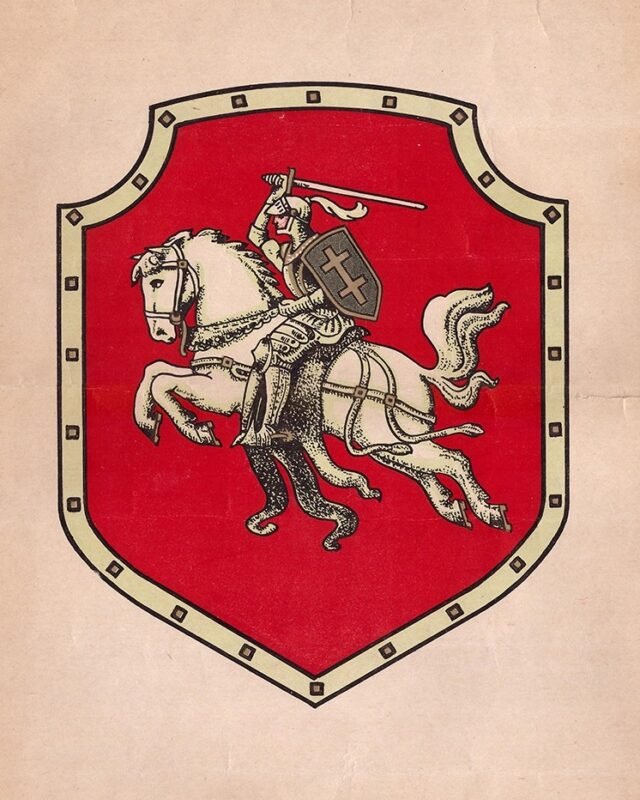
Vytis, the horseman of Lithuania’s coat of arms, in Antanas Žmuidzinavičius’s design of about 1918.
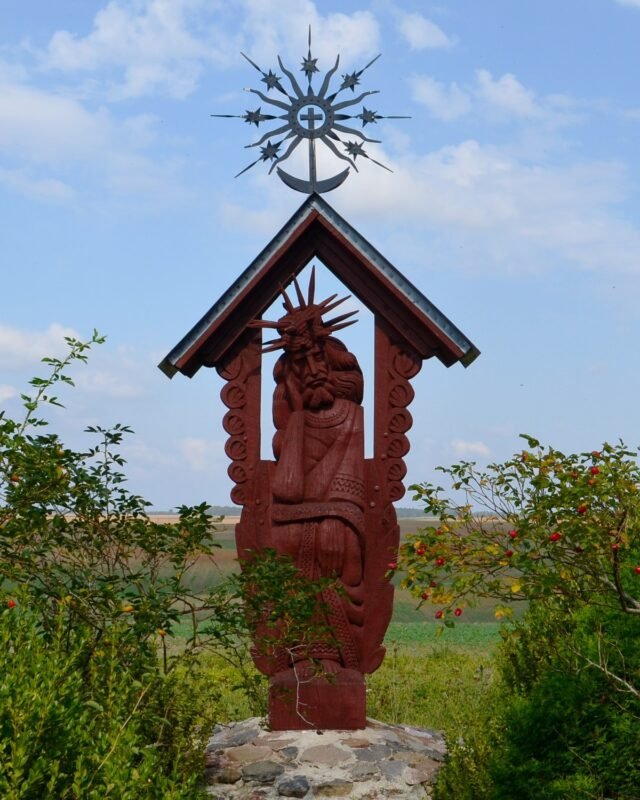
Rūpintojėlis, the pensive Christ, in a carving at Vantainiai, Kėdainiai district.
This medieval Christian symbol, within the Lithuanian folk Catholic tradition, which is interwoven with ancient pagan motifs, eventually became an image into which people could project their suffering, whilst at the same time drawing hope and strength from it.
Thus, Vytis and Rūpintojėlis become two distinct yet complementary national symbols: one speaks of the resolve to fight, the other of the ability to endure.
All opinions expressed are those of the author alone and may not represent those of the institutions they represent or the Baltic International Security Centre (BISC). BISC maintains a strict intellectual independence policy across all its projects and publications.